
24/7 Customer Support

Free returns

Same-day & Next-day Delivery

Quality Guaranteed

Unlock Your Welcome Offers: FREE Delivery | Up to 80% OFF | Free 30-day JoyPlus trial
Download the APP
Buying USB chargers and adaptors can look straightforward until a phone charges slowly, a laptop repeatedly disconnects or an overseas plug cannot be used safely in a UK socket. Product listings may promote high wattage, GaN technology or “universal” compatibility, but these terms do not always tell you whether an accessory suits your devices.
The main buying pitfalls are usually easy to avoid:
For smartphones and tablets, a fast USB-C charger with USB Power Delivery (PD) can offer quicker charging when the device and cable support the same protocol. A PD fast charger does not force a device to accept more power than it is designed for; the connected equipment negotiates an appropriate level.
Laptop users should check the manufacturer’s recommended wattage. A compact 30W USB power adaptor may suit a phone or tablet, while some laptops require 60W or more. A dual-port charger rated at 102W total, for example, may provide a maximum of 60W per USB-C port according to its listed specifications.
USB-C to USB-A and USB-A to USB-C adaptors perform different jobs:
For larger households, a multi-port charger can reduce socket clutter. However, check the shared output and the number of ports rather than assuming every port operates at the advertised maximum simultaneously.
A UK plug charger should fit standard UK three-pin sockets, while an EU plug charger uses a different pin configuration. Travellers may need a suitable plug adaptor, but a plug adaptor changes the physical connection and may not convert voltage. Always check the charger’s input range and the destination’s socket requirements.
For electrical accessories, look for clear manufacturer information, safety instructions, load ratings and the relevant conformity marking for the market where the item is sold. Do not exceed the stated current or wattage. A mains extension socket should never be daisy-chained with another adaptor unless the manufacturer specifically permits it.
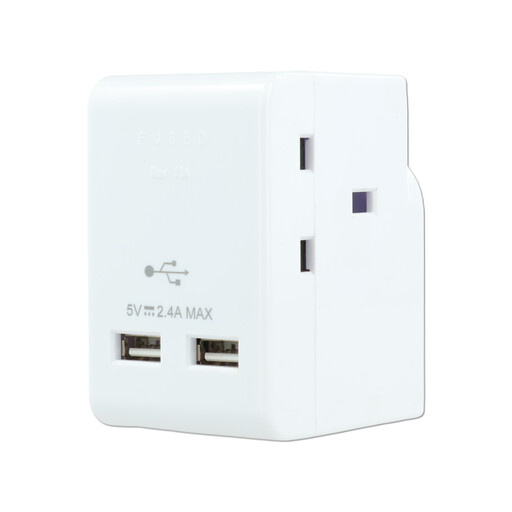
Why This Fits Their Persona: A practical option for students, renters and home users who need to expand one UK socket for everyday low-power electronics.
Its specifications state a UK three-pin format, a 13A maximum and a shared 5V, 2.1A USB output, making the limits clearer than a vague “fast charging” claim.
Three mains sockets and two USB ports; rated for a maximum total load of 3250W. Do not use for high-demand appliances beyond the stated limits.
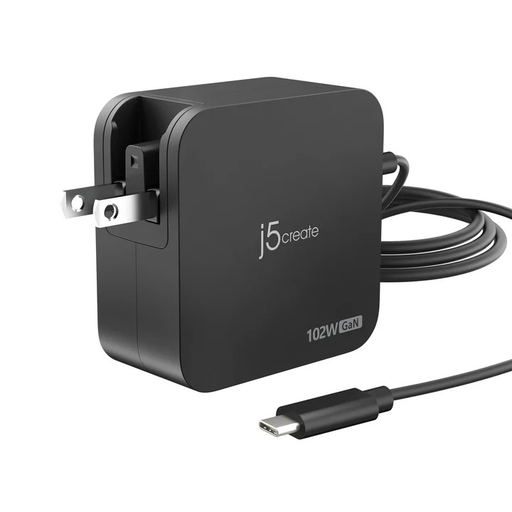
Why This Fits Their Persona: Suitable for professionals and frequent travellers carrying a laptop, phone and tablet while moving between compatible international sockets.
The listing identifies 102W total output, two USB-C PD ports and a maximum 60W per port, so users can plan around shared charging rather than relying on the headline figure.
GaN construction, changeable AC plugs, 100–240V input and listed protection against overcurrent, overvoltage, short-circuit and overheating.
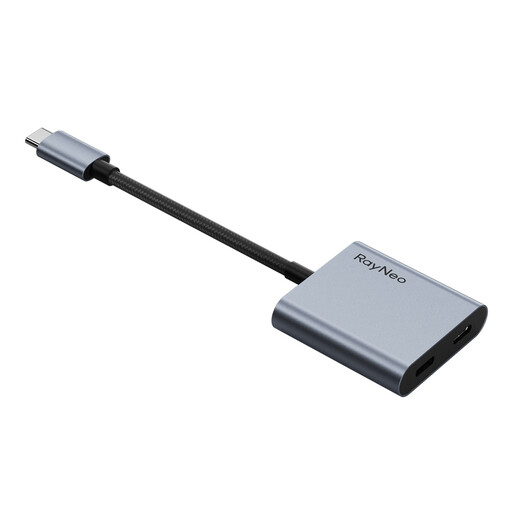
Why This Fits Their Persona: Designed for gamers and smart-glasses users who want charging and video output through one USB-C connection.
Its listing specifies the key functions separately: up to 100W PD charging and 4K at 60Hz video output. Confirm that the host device, display and cable support these features.
Compact 27g design; supports charge-and-play setups for listed devices including Switch, Steam Deck, laptops and compatible smart glasses.
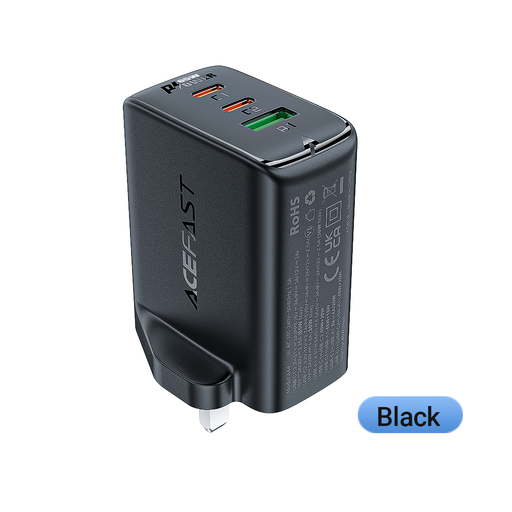
Why This Fits Their Persona: A convenient desk, bedside or household charger for users who need USB-C ports alongside an existing USB-A cable collection.
The port arrangement is stated clearly: two USB-C ports and one USB-A port. This helps prevent buying another single-port plug when several devices need charging.
65W total output and a UK plug format; listed compatibility includes the iPhone 18 series and other USB-enabled devices.
We have compiled a complete, real-time list of products that fully satisfy these strict selection criteria and UK safety regulations.
Before connecting a new USB charger or adaptor:
It can be suitable when the charger, cable and phone support compatible charging protocols. The phone normally negotiates its required power, but users should still choose products with clear specifications and avoid damaged or unverified cables.
Not necessarily. Wattage describes the maximum power available, not the amount continuously consumed by the device. Running cost depends on charging time, the device’s battery and electricity tariffs. A higher-output charger may be useful for a laptop or several devices, but it does not automatically use less electricity.
Lifespan varies with build quality, heat, socket conditions and handling. Keep the accessory dry, avoid bending cables at the connector and unplug it when it will not be used for extended periods. Regularly inspect both the charger and its cable for wear.