
24/7 全天候客户支持

免费退货

当日/次日达

品质保障

开启新人专享福利: 全场免邮 | 低至 2 折 | 免费试用 30 天 JoyPlus 会员
下载 Joybuy
Choosing among modern vacuum cleaners is not simply a matter of picking the highest wattage or longest advertised battery life. UK homes vary considerably: a carpeted terrace house has different requirements from a compact flat, while pet owners, allergy sufferers and car owners may need specialist attachments or filtration.
The following guide explains the features that matter, the common buying traps to avoid and a selection of models matched to practical household needs.
A motor’s wattage indicates electrical power consumption, not necessarily how effectively the vacuum lifts dust. Airflow, brush design, seals, filters and the type of suction measurement used all affect performance. A powerful suction vacuum should therefore be assessed using the manufacturer’s stated suction figure alongside floor compatibility and brush-head design.
Cordless models commonly quote runtime in their lowest setting, often with a non-motorised attachment. Using a motorised brush on carpet or selecting maximum suction can reduce this considerably. Check the stated runtime by mode, charging time and whether the battery is removable before choosing a cordless vacuum cleaner.
A bagless vacuum cleaner may avoid the cost of replacement bags, but its dustbin, cyclone system, brush roll and filters still need regular cleaning. Hair can wrap around a floor head, while a damp or blocked filter can restrict airflow. Before purchasing, confirm that filters are washable or replaceable and that essential attachments are available.
For a vacuum cleaner for carpets and hard floors, look for a floor head designed for both surfaces or clearly labelled modes. Stiff bristles can help agitate carpet fibres, while softer rollers may be more suitable for hard flooring. An anti-tangle brush can be useful in homes with long hair or pets, but it does not remove the need for occasional inspection.
Pa figures such as 17.5kPa, 38kPa or 45kPa describe suction pressure under specified conditions. They are useful for comparison within a product range, but do not alone determine cleaning results. Attachments for upholstery, stairs and crevices are equally important.
A cordless stick vacuum cleaner is convenient for quick cleaning and homes where plugging and unplugging is inconvenient. However, consider the usable cleaning time, charging period and battery replacement cost. A removable battery can extend the product’s practical life or allow a spare to be charged separately.
Corded models provide continuous operation and can suit larger cleaning sessions. Check the cord length, cleaning radius, storage footprint and whether the machine includes automatic cord rewind.
A HEPA filter vacuum can be helpful for households that want fine-particle filtration, provided the filter is correctly fitted and maintained. Check the exact filtration description rather than assuming every product labelled “high filtration” uses a certified HEPA system.
Dustbin capacity also affects convenience. A 0.4–0.5-litre container may be suitable for quick cleans or a small flat, while a 0.7–1.1-litre capacity can reduce emptying during whole-home cleaning. Always empty dry-use vacuums before the debris reaches the marked maximum line.
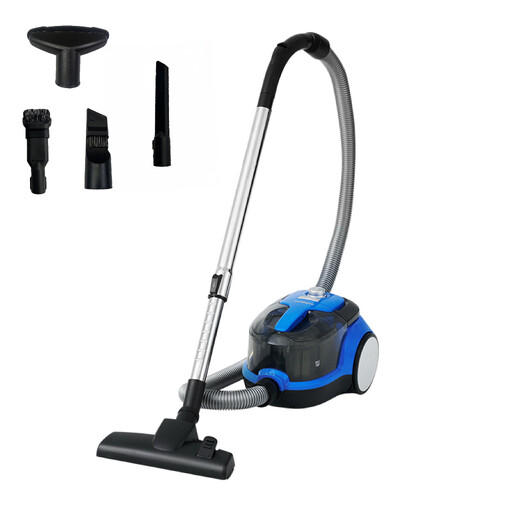
Why This Fits Their Persona: A practical corded option for everyday cleaning in flats, terraces and family homes where uninterrupted operation matters more than cordless portability.
Its 800W motor, stated 17.5kPa suction and 1.1-litre dust container provide clearer information than wattage alone. It also has automatic cord rewind and a washable removable filter.
Bagless design; multiple brush heads for carpets, hardwood, tile and upholstery; continuous mains operation.
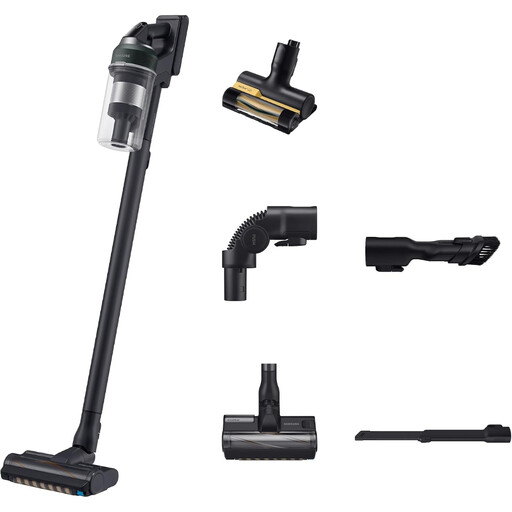
Why This Fits Their Persona: Suits households seeking cordless convenience, dedicated pet-hair tools and a specified fine-dust filtration system for regular whole-home cleaning.
The specification separates up-to-60-minute minimum-power runtime from higher-power use. The removable battery and 210-minute charging time are also stated clearly.
0.8-litre dust container; Pet Tool+; four cleaning modes; HEPA filtration specified as capturing 99.995% of fine dust particles.
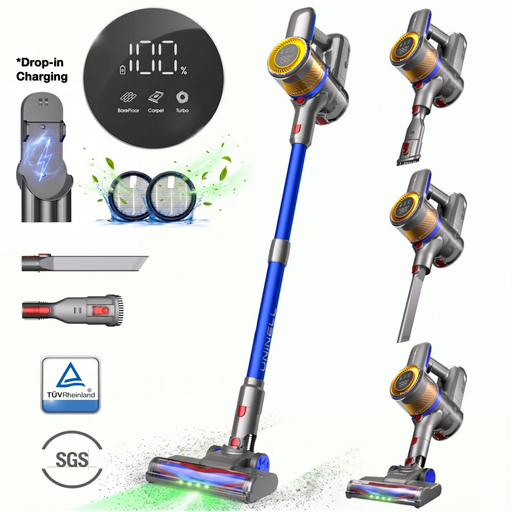
Why This Fits Their Persona: Designed around larger cleaning tasks, pet hair and awkward areas such as under sofas, stairs and furniture.
The listed runtime is identified as up to 60 minutes in Bare Floor Mode, while the detachable battery offers a defined upgrade path. Its anti-tangle brush is intended to reduce hair wrapping.
45,000Pa stated suction; 1.7-litre capacity; 180-degree lie-flat reach; 1.2kg listed weight.
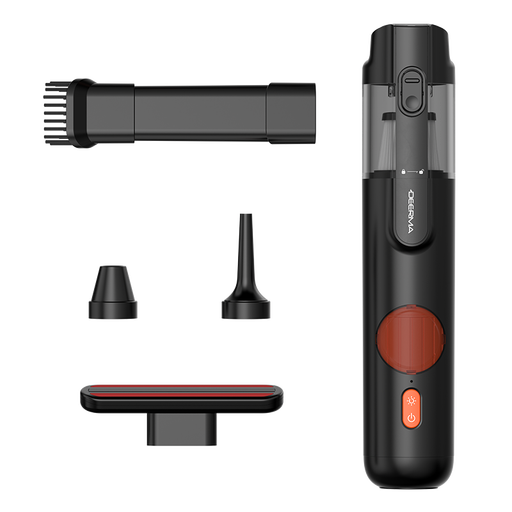
Why This Fits Their Persona: Its compact format suits car interiors, desks, keyboards, stairs and small spills of dry crumbs where a full-size machine is inconvenient.
The 434g weight and 30-minute stated runtime make its intended quick-clean role clear, rather than presenting it as a replacement for an upright vacuum.
7,500Pa stated suction; Type-C charging; six-in-one accessory kit; one-touch dust disposal.
We have compiled a complete, real-time list of products that fully satisfy these strict selection criteria and UK safety regulations.
Regular care can help preserve cleaning performance:
A lightweight vacuum cleaner is easier to carry upstairs, but weight should be considered alongside dustbin size, floor-head movement and handle design. For a vacuum cleaner for home and car, a detachable handheld unit or separate compact handheld vacuum may be more practical than repeatedly carrying a full-size upright.
Electricity use depends on motor power, cleaning frequency and runtime. Cordless models may use less energy per short session, but battery replacement and charging time also form part of ownership costs. Corded vacuums can be more suitable for long cleaning sessions because they do not require recharging.
Lifespan varies according to construction, frequency of use, maintenance and availability of replacement filters, batteries and brush parts. Keeping filters clear, avoiding liquids and not operating with a blocked airflow path can reduce unnecessary strain on the motor.
A HEPA filter may be worth considering if fine dust and dander are a priority, but the complete system matters: seals, cyclone design, filter maintenance and dust disposal all affect how particles are handled. Pet owners should also look for a motorised or anti-tangle tool designed for upholstery and floors.