Freezer batch cooks
If you divide larger quantities of meat into several portions, a countertop sealer with compatible rolls lets you make different bag lengths. Check the maximum bag width against the cuts you usually freeze.


For regular batches of freezer portions, choose a countertop heat-sealing vacuum sealer with bags that fit your cuts; moist-food and pulse controls are particularly worth checking for juicy meat. A compact handheld system suits occasional portions if you accept its compatible valve-bag system, while a chamber sealer is worth considering for routinely packing liquid-heavy marinades. None of these formats changes the need to follow use-by dates and safe-defrosting guidance.
If you divide larger quantities of meat into several portions, a countertop sealer with compatible rolls lets you make different bag lengths. Check the maximum bag width against the cuts you usually freeze.
For cuts with surface juices, look at moist-food settings and pulse or manual control. If bags regularly contain liquid marinade, investigate a chamber sealer rather than assuming an external-suction machine will handle the same task.
A handheld system takes less storage space than a countertop machine and may suit infrequent, smaller portions. Check its valve-bag sizes and availability before committing to that bag system.
Choose it when: You freeze occasional pre-portioned meat and have little cupboard space.
Trade-off: A handheld system depends on compatible valve bags and is less suited to making repeated custom-length bags.
Choose it when: You regularly divide meat into freezer portions and want to make heat-sealed bags from compatible rolls.
Trade-off: The appliance needs worktop or cupboard space, as well as a continuing supply of suitable bags or rolls.
Choose it when: Packing liquid-heavy marinades is a regular part of your meat preparation.
Trade-off: Allow space for a larger specialist appliance and check its usable chamber dimensions, electrical suitability and support arrangements.
| Concern | What to check | Who this matters to |
|---|---|---|
| Regular freezer batches | Check for heat sealing, compatible freezer bags or rolls, and a bag width that fits your portions. | If I portion several cuts at once, I want to make bags to fit without changing systems between portions. Around 39% of consumers put repeatable batch sealing first. |
| Moist meat | Look for a moist setting and pulse, variable-speed or manual control. | When meat has surface juices, I want control over the vacuum cycle before liquid reaches the sealing area; around 23% of consumers make moisture control their primary concern. |
| Occasional portions | Check the device size, compatible valve-bag capacity and whether those bags are suitable for freezer food. | If I freeze only a few portions now and then, cupboard space matters more to me than making bags in bulk. Compact occasional use comes first for around 23% of consumers. |
| Liquid-heavy marinades | For a chamber model, check usable chamber dimensions, bag fit and UK electrical suitability. | When my portions contain substantial liquid marinade, I need to assess a machine intended for that packing task; around 15% of consumers prioritise liquid-heavy use. |
A sealed bag does not change when meat should be frozen or how promptly it should be used after defrosting.
Label portions with their contents and freezing date. The Food Standards Agency says pre-packed food can be frozen up to its use-by date and should be consumed within 24 hours once defrosted.
Surface juices can move towards the sealing area during external suction, making control over the cycle relevant.
Compare moist-food and pulse or manual controls for wet cuts. For routinely packing liquid marinades, assess chamber models separately.
Handheld valve-bag systems and countertop heat sealers use different bag formats; a bag that fits one system should not be assumed to fit another.
Check the appliance instructions, bag sizes, freezer suitability and availability of compatible replacements.
Compatible bags or rolls are continuing consumables.
A bag intended for bedding or clothing should not be assumed suitable for direct food contact or freezer storage.
Choose bags identified by the appliance maker or retailer for food and freezer use.
FoodSaver UK lists countertop systems for meat and produce, including the VS3190 and FFS005.
Lakeland's compact handheld system is a route for occasional portions using StayFresh valve bags or containers.
CASO Design makes chamber systems relevant to shoppers who regularly pack liquid-rich foods or marinades.
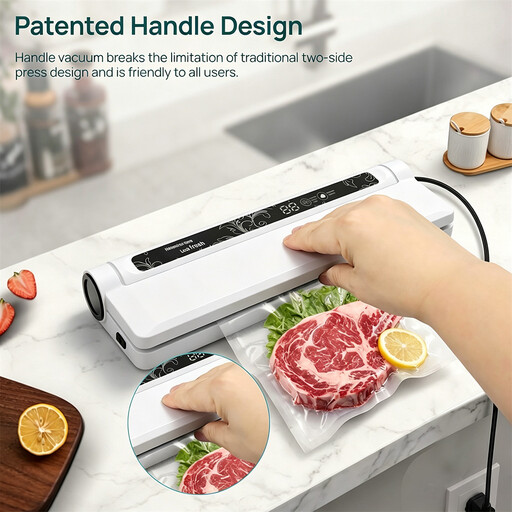
This household vacuum-sealing machine is a product to assess for meat portions. Confirm its sealing method, supplied bag format and freezer-food suitability before relying on it for that task.
 No image available
For household meat portions, check that its sealing method and the bags supplied are suitable for packing food for the freezer.
The machine has a built-in storage pocket. Confirm whether the pack contains the 20 pre-cut 17 × 25 cm bags named in the title or a roll, and whether those bags work with the machine.
If you regularly seal juicy meat, check whether moist-food and pulse or manual controls are available.
No. The Food Standards Agency says pre-packed food can be frozen up to its use-by date and should be consumed within 24 hours once defrosted. A vacuum seal does not replace that guidance.
Follow the food's instructions and defrost safely in the fridge where possible. The Food Standards Agency advises consuming food within 24 hours after defrosting; vacuum packing is not a reason to extend that period.
Yes, if you often pack cuts with surface juices. FoodSaver UK lists moist and dry settings on the VS3190 and FFS005, while the VS3190 also lists pulse control. For bags containing substantial liquid marinade, investigate a chamber sealer instead of assuming a countertop external-suction model suits the task.
No; check the bag format specified for the machine and whether the bags are identified as suitable for food and freezer use. Lakeland specifies StayFresh bags and containers for its handheld sealer, so a different bag should not be assumed compatible.