Bulk-rice portioners
If you divide a larger bag of dry rice into different portion sizes, check roll compatibility, sealing width and whether the machine can seal a bag without vacuuming it.


Choose a countertop bag sealer if you divide larger purchases of dry rice into portions and need custom-length bags or a separate seal-only function. A handheld system suits smaller, occasional batches if its dedicated bags or containers meet your needs; a compatible vacuum-container system is another option when you reopen the same rice supply regularly. Vacuum sealing dry rice does not replace food-safety guidance for cooked rice.
If you divide a larger bag of dry rice into different portion sizes, check roll compatibility, sealing width and whether the machine can seal a bag without vacuuming it.
If you seal small amounts only occasionally, a compact handheld appliance may be easier to store. Check which dedicated bags or containers it needs before choosing one.
If you reopen the same dry-rice supply frequently, consider a reusable vacuum container and a compatible appliance or hose rather than making many separate bags.
Decide whether you mainly need flexible portions, an appliance that stores compactly, or repeated access to one container; then check the accessories required for that format.
| Concern | What to check | Who this matters to |
|---|---|---|
| Flexible portions | Check compatible rolls, the maximum sealing width and whether there is a separate seal-only function. | When I divide a large rice purchase into portions, I want bags sized to each amount; around 45% of consumers put flexible portioning first. |
| Compact storage | Check the appliance’s storage footprint and its required bags or containers. | If I seal small amounts only occasionally, I need an appliance I can put away easily; roughly 33% of consumers prioritise compact, occasional use. |
| Reusable containers | Check container compatibility and whether the required hose or other accessories are included. | When I take rice from the same supply regularly, I would rather reopen a reusable container than make individual bags; around 22% of consumers make frequent-access storage their main concern. |
Lakeland specifies StayFresh bags or containers for its handheld sealer and says these are sold separately.
Before choosing that system, check that the compatible storage format suits your rice portions and that you can obtain the accessories you need.
FoodSaver describes customisable rolls, while CASO Design lists a separate sealing function and a seam up to 30 cm wide for the VC10. Those features should not be assumed for other models.
If portion size varies, confirm roll compatibility and sealing width for the exact machine you intend to use.
This choice concerns dry rice. The Food Standards Agency advises that refrigerated cooked rice should be consumed within 24 hours; vacuum packaging does not replace appropriate chilling and storage.
If you also seal cooked foods, follow the food-specific storage guidance rather than extending storage time on the strength of the packaging alone.
A countertop sealing system to consider if you want custom-sized bags alongside other compatible storage accessories.
A countertop option for buyers considering separate sealing and container use.
A compact handheld format for occasional, smaller dry-rice batches.
A countertop brand to consider if automatic, manual and container functions are relevant to your storage plans.
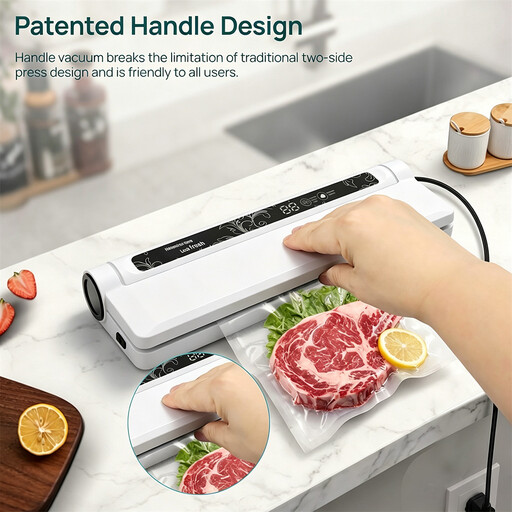
This bag-sealing appliance is relevant if you plan to portion dry rice; check its bag format before choosing it for custom-sized portions.
 No image available
Consider this machine for portioning dry goods such as rice into bags. Its product title lists a built-in storage pocket and 20 bags measuring 17 × 25 cm, while its description also mentions a roll; confirm the supplied consumables. If you need custom-length bags or sealing without vacuuming, check roll compatibility and the available sealing functions before buying.
Decide whether you will make individual portions or repeatedly open one container. For portions of varying sizes, check roll compatibility and a seal-only function; for container storage, check that the appliance works with the container and any required hose.
Do not assume ordinary bags will work with a vacuum sealer. Check the exact appliance’s compatibility instructions: FoodSaver specifies bags for its sealers, while Lakeland specifies StayFresh vacuum bags or containers for its handheld model.
Check what comes with the exact appliance and which compatible supplies it needs afterwards. Lakeland says bags and containers for its StayFresh handheld sealer are sold separately; other bundles and accessory systems differ.
No: vacuum sealing is not a substitute for safe handling of cooked rice. The Food Standards Agency advises chilling cooked-rice leftovers promptly and consuming refrigerated rice within 24 hours.
Yes. Food Standards Agency food-business guidance says vacuum packing creates reduced-oxygen conditions that can favour certain bacteria in suitable foods. A business should assess the food, packaging, storage conditions and intended shelf life as part of its food-safety controls; this is distinct from choosing a home appliance for dry rice.