
24/7 Customer Support

Free returns

Same-day & Next-day Delivery

Quality Guaranteed

Unlock Your Welcome Offers: FREE Delivery | Up to 80% OFF | Free 30-day JoyPlus trial
Download the APP
Bulky coats, spare duvets and seasonal jumpers can quickly overwhelm a small UK wardrobe. Vacuum storage bags reduce the volume of soft items by removing air, helping renters, students and families make better use of wardrobes, lofts, under-bed areas and suitcases.
However, not every space saver bag performs equally well. A low-quality zip, unsuitable shape or unrealistic capacity claim can leave you with leaking bags, damaged clothing or storage that is difficult to handle. The following guide explains the main buying pitfalls, the specifications worth checking and which formats suit different households.
Claims such as “save up to 80%” describe a potential result under particular conditions, not a guaranteed outcome for every item. Thick duvets, feather-filled coats and loosely packed bags may compress differently from thin clothing.
Treat compression claims as an indication rather than a measurement. Check the finished dimensions, the shape of the bag and the type of items it is designed to hold.
A bag may compress successfully at first but gradually reinflate if the double zip is not fully closed or the air valve does not seal properly. This is especially inconvenient when bags are stored in lofts, garages or cupboards and are not checked regularly.
Look for a double-zip closure, a sealing slider or clip and clear confirmation that the zip is closed. A one-way or cap-free valve can also simplify use, particularly if you plan to use an ordinary household vacuum cleaner.
Vacuum packing is practical for many washable textiles, but it is not automatically suitable for every garment. Structured suits, delicate fabrics and feather- or down-filled items may need more care to avoid creasing or loss of shape during extended storage.
Read the garment care label first. Do not overfill the bag, and avoid placing sharp buckles, hangers or accessories directly against the plastic. For garments that should remain ready to wear, hanging vacuum storage bags can be more suitable than flat bags because clothing remains on integrated hooks.
PA and PE laminates, also described as polyamide and polyethylene, are commonly used in vacuum seal bags. A suitable bag should feel flexible but not excessively thin, with seams that remain intact when the contents are compressed.
For storage in a damp UK home, waterproof and airtight construction can help reduce exposure to dust and moisture. It does not replace dry storage: always pack clean, completely dry textiles and avoid placing bags where standing water or condensation can reach them.
External dimensions do not tell the whole story. Check whether the bag is flat, cube-shaped or designed to hang.
A cube bag with a stable base can be easier to fill than a flat bag when storing bulky bedding. For example, the 31 x 40 x 15-inch cube format in selected TAILI products is designed for quilts, blankets and duvets, while medium 25 x 19 x 11-inch bags are more portable.
Check whether a bag requires a vacuum cleaner, a hand pump or manual pressing. Vacuum-compatible valves are convenient for home use, but hand-compression formats can be more practical in a student room, hotel or suitcase.
Also consider visibility. Clear clothes storage bags make it easier to identify contents without opening several packages. For a wardrobe, hanging hooks and rotating rings may be more useful than simply choosing the largest capacity available.
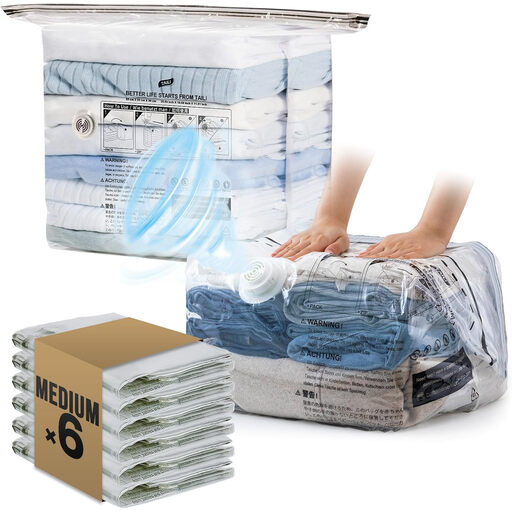
Why This Fits Their Persona: The medium cube format suits students, renters and first-time organisers who need flexible storage for clothes, blankets or travel packing without committing to a bulky wardrobe system.
The 25 x 19 x 11-inch size makes capacity easier to manage than an oversized bag. Its wide double zip and printed instructions support straightforward set-up.
Six bags are included; air can be removed manually, so a vacuum cleaner is not required.
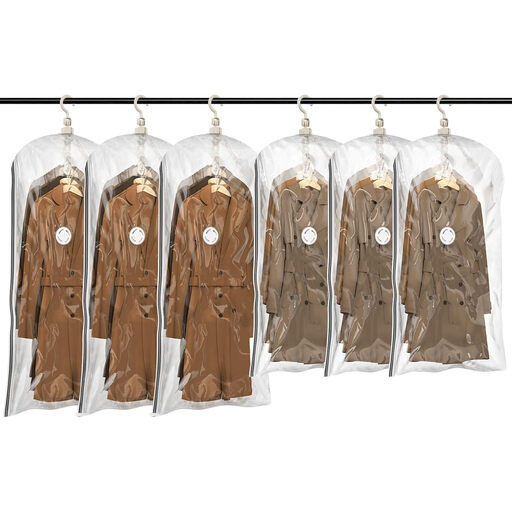
Why This Fits Their Persona: This six-piece hanging set is suited to households storing suits, coats and jackets in a wardrobe while keeping garments visible and vertically arranged.
The double colour-changing zip gives a visible indication of sealing, while the cap-free valve closes by rotating after air removal.
The set includes three long and three short bags, with five-ring hooks and compatibility with regular vacuum cleaners.
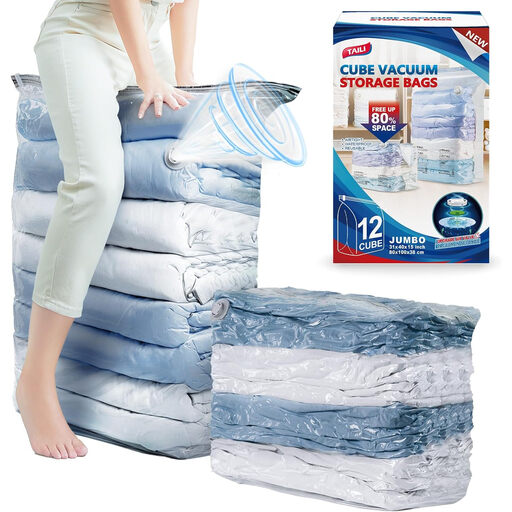
Why This Fits Their Persona: A large household, frequent mover or anyone managing multiple duvets and seasonal bedding may benefit from a larger set of extra large bags.
The self-standing cube structure helps with filling bulky items, while the included sealing clips support a complete zip closure.
The 31 x 40 x 15-inch cube design is supplied in a 12-pack and is intended for bedding, clothing and household storage.
We have compiled a complete, real-time list of products that fully satisfy these strict selection criteria and UK safety regulations.
Most valve-based models are designed for use with a regular household vacuum cleaner, but connection sizes can vary. Check the product instructions before purchase. Hand-compression bags do not require an electrical vacuum and may be more convenient for travel.
There is no fixed lifespan because performance depends on material, zip condition, punctures and how often the bag is opened. Keep the seal clean, avoid sharp items and inspect the valve if the bag begins to reinflate.
Yes, many bedding storage bags and blanket storage bags are designed for duvets, quilts and comforters. Pack items when completely dry, avoid exceeding the stated capacity and allow delicate or feather-filled bedding to recover its shape before use.