Who is each format for?
The useful distinction is whether the chocolate will be handed out in sealed portions, divided at home or given as a box.
Parents packing an occasional Valentine treat
Separately wrapped portions make allocation clearer, but check the school’s food rules and the pack’s allergen statement. NHS lunchbox guidance recommends building the main lunch around foods such as bread, rice, pasta or potatoes, with fruit and vegetables.
Shoppers happy to portion white chocolate at home
A button bag gives you white chocolate to divide into containers yourself. Cadbury describes its White Chocolate Buttons 100g product as a bag of bite-sized buttons, not a pack of sealed individual servings.
Valentine gift buyers
A white-chocolate truffle box suits a present or household sharing better than handing out sealed lunchbox portions. Lindt lists its LINDOR White Chocolate Truffles in a 200g box; check its current allergen statement for the intended recipient.
What should you check before buying?
Start with how the chocolate will be shared, then read the exact pack for portion details, ingredients and nutrition information.
Individually wrapped pack
Choose when: Each recipient needs a separate, unopened portion.
Bear in mind: A general chocolate multipack listing does not establish that a particular pack contains white chocolate; confirm the product and its unit count.
White-chocolate button bag
Choose when: You can divide the chocolate at home before giving it out.
Bear in mind: You will need to handle and contain each portion yourself, and an opened bag may not meet a school’s rules.
White-chocolate gift box
Choose when: The purchase is a present for one person or chocolate to share at home.
Bear in mind: A box of truffles does not, by itself, provide individually wrapped lunchbox portions.
| Priority |
What to check |
Your needs |
| Portion format |
Read the exact pack for its unit count, whether portions are individually wrapped and the weight per unit. Do not treat a bag of bite-sized pieces as a sealed multipack. |
I need one clearly allocated portion for each recipient, or I have time to divide a bag into containers at home. |
| White-chocolate content |
Check the product name and contents, not just the multipack category. An assorted box may contain milk or dark chocolate as well as white. |
White chocolate matters to me, so I need to know whether every piece in the pack meets that preference. |
| Lunchbox role |
Check school food rules. NHS lunchbox guidance recommends a main item based on foods such as bread, rice, pasta or potatoes, alongside fruit and vegetables, and suggests swapping chocolate for other options. |
If this is going into a child’s lunchbox, I’m choosing an occasional Valentine extra rather than replacing the main food. |
| Ingredients and allergens |
Read the physical pack’s ingredients, highlighted allergens and any precautionary statements. Compare nutrition figures on the same per-100g basis, then check the portion you intend to serve. |
I need current information for the intended recipient, particularly if milk, soya, wheat or nuts are relevant. |
Brand and retailer references
These examples illustrate different white-chocolate formats; a brand or retailer name alone does not confirm an individually wrapped pack.
Cadbury
Cadbury lists White Chocolate Buttons in a 100g bag of bite-sized pieces.
- A white-chocolate option when you intend to divide the bag yourself.
- The bag is not stated to contain sealed individual portions.
Lindt
Lindt lists a 200g LINDOR White Chocolate Truffles Box with a melting filling.
- A boxed format to consider for a Valentine gift or household sharing.
- The listing says it may contain hazelnuts and other nuts; the box is not a stated lunchbox multipack.
M&S
Marks & Spencer lists a white-chocolate product and a separate selection box containing milk, dark and white chocolates.
- The formats let you distinguish a white-chocolate product from a mixed assortment.
- The mixed box does not meet a white-chocolate-only requirement. Marks & Spencer advises reading the pack because product information can change.
Waitrose
Waitrose & Partners lists white-chocolate bars, white-chocolate boxes and a separate chocolate-multipack category.
- Its format categories can help you narrow down the kind of pack you want.
- A general chocolate-multipack category is not enough to establish that an individual product is white chocolate.
White-chocolate packs on Joybuy
These Kinder Bueno White packs are options to examine when separately wrapped treats matter. Check the current outer pack, portion count and allergen statement before choosing one for a lunchbox.
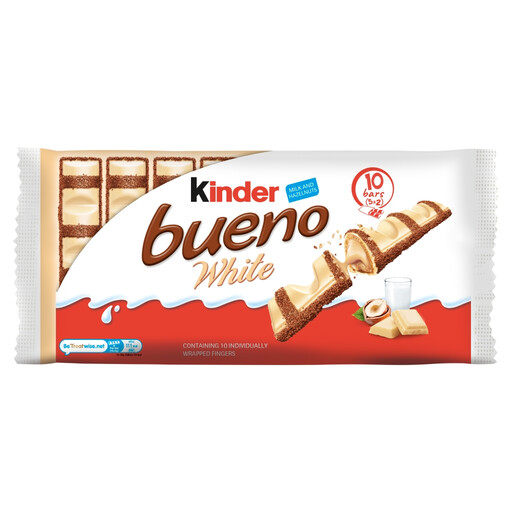 Image unavailable
Kinder Bueno White 5-Pack 195g
For allocating wrapped treats, the product description states that this 195g pack contains 10 individually wrapped fingers of 19.5g each. The title says “5-Pack”, so check how the outer pack is arranged and how many portions you intend to hand out. The product information identifies wheat, milk, hazelnuts and soya; read the current physical-pack allergen statement before serving.
View on Joybuy
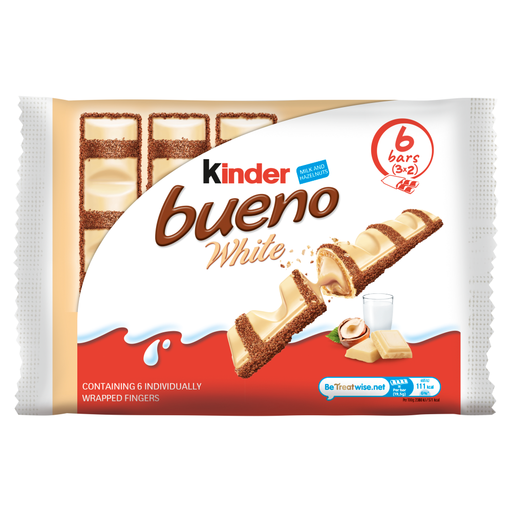 Image unavailable
Kinder Bueno White 3 Pack 117g
This 117g pack is described as containing three individually wrapped bars, which may suit three separately allocated treats. Check the weight of each bar if portion size matters. The product information identifies dairy, soya, wheat and hazelnuts and says it may contain other nuts; read the current physical-pack allergen statement before serving.
View on Joybuy
Questions about Valentine lunchbox treats
Is a white-chocolate button bag a multipack?
No: Cadbury describes its White Chocolate Buttons 100g product as a bag of bite-sized buttons, not several sealed servings. If each person needs an unopened portion, look for an exact pack that states its unit count, wrapping and weight per unit.
Can white chocolate go in a Valentine lunchbox?
An occasional treat is a decision to make alongside the child’s needs and the school’s food rules. NHS lunchbox guidance recommends basing the main item on foods such as bread, rice, pasta or potatoes, adding fruit and vegetables, and swapping chocolate and similar snacks for alternatives; chocolate should not replace those main foods.
Which allergen details should I check?
Read the physical pack’s full ingredients, highlighted allergens and any “may contain” statement for the intended recipient. Lindt’s white LINDOR truffle listing says it may contain hazelnuts and other nuts, while Marks & Spencer warns that online product details can change.
Does “may contain nuts” matter when nuts are not listed as an ingredient?
Yes, it can matter to someone managing a nut allergy. The Food Standards Agency explains that precautionary allergen wording communicates possible unintended allergen presence; the absence of nuts from the ingredient list alone does not settle suitability for that person.


