Buying priorities
Start with the measured bowl: carbohydrate, sugars and serving size are more useful for comparison than a single front-of-pack claim.
| Priority |
What to check |
Your needs |
| Carbohydrate and portion |
Compare carbohydrate per labelled serving; check the serving weight; measure the bowl you usually eat. |
I want to plan for the carbohydrate in my actual breakfast, not simply the portion printed on the pack. |
| “No added sugar” claims |
Read sugars and carbohydrate together; compare products on the same serving or per-100g basis; check for dried fruit in the ingredients. |
I want to understand what remains in the cereal rather than treating “no added sugar” as a guarantee about my diet. |
| Pack value |
Compare pack weight on a like-for-like basis; check any membership conditions; review the shelf or online listing before purchase. |
A larger bag should suit my shopping routine, but I do not want pack size alone to decide the purchase. |
| Allergens and ingredients |
Read the current allergen statement; check gluten-containing cereals, milk, peanuts and tree nuts; review the pack again after reformulation. |
Everyone who may eat the muesli needs to be able to use it safely. |
Joybuy muesli options
Joybuy product option for a branded no-added-sugar muesli route, with nutrition information intended for measured-portion comparison.
 No image available
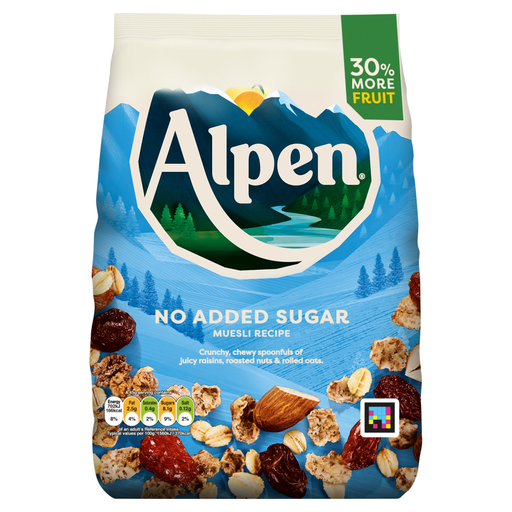
Alpen No Added Sugar Muesli 950g
A 950g muesli option for shoppers who want to compare a measured portion with their individual carbohydrate plan.
Alpen lists 29g carbohydrate, 8.1g sugars and 3.6g fibre per 45g serving. It contains wheat, oats, milk, almonds and hazelnuts; check the current pack label for allergens.
Joybuy
Frequently asked questions
Is “no added sugar” muesli sugar-free?
No. Under UK rules, “no added sugar” means sugars or ingredients used for sweetening have not been added; it is not the same as a sugar-free claim. Alpen No Added Sugar lists 18g sugars per 100g and Tesco Swiss Style No Added Sugar lists 13.3g per 100g, so check total carbohydrate and sugars on the current pack.
For diabetes-aware choices, should I check carbohydrate or sugars?
Check total carbohydrate per portion first and use sugars as an additional label value. Diabetes UK explains that carbohydrate type and amount can affect blood glucose, while a no-added-sugar claim alone does not show the carbohydrate in your bowl.
How much muesli should I serve from a value pack?
Use the product’s labelled serving as a comparison starting point, then follow your own diabetes-care plan. Diabetes UK notes that larger portions can increase carbohydrate intake, so measuring your usual bowl can help you compare it with the nutrition panel.
Can a muesli be marketed as treating diabetes?
No. GOV.UK food-labelling guidance says food businesses cannot claim or imply that a food can treat, prevent or cure a disease or medical condition. “Diabetes-aware” is a dietary-selection context, not a medical treatment claim.
What allergens should I check before buying a large muesli bag?
Check the current pack every time. The mueslis considered here commonly contain gluten-containing cereals and nuts, while Alpen and Tesco Swiss Style also list milk ingredients; some products also carry cross-contact warnings for peanuts or other nuts.


