
24/7 Customer Support

Free returns

Same-day & Next-day Delivery

Quality Guaranteed

Unlock Your Welcome Offers: FREE Delivery | Up to 80% OFF | Free 30-day JoyPlus trial
Download the APP
By Joybuy Product Recommendation Officer
Vanity mirrors can make make-up application, shaving and daily grooming easier, but the wrong model may quickly become an expensive inconvenience. A mirror that looks impressive in a product photograph may provide poor lighting, occupy too much space or lack the stability needed for regular use.
Before choosing between an LED make-up mirror, magnifying make-up mirror, wall-mounted design or a complete dressing table, look beyond appearance. The most useful buying decision usually comes down to three practical questions: where the mirror will go, how accurately you need to see detail and whether its lighting and construction suit the room.
Magnification helps with detailed work, but a high magnification level can make the reflected image feel narrow and distorted when used too close to the face. A dual-sided make-up mirror with both standard and magnified views is more flexible for everyday use.
For general make-up, a 1× view is useful for checking the overall result, while 3× or 7× magnification can assist with close-up grooming. Always check whether the stated magnification applies to one side only.
“LED” describes the light source, not necessarily its brightness, colour quality or positioning. A light ring may still leave shadows if the mirror is placed against a dark wall or if illumination only comes from one direction.
Check whether the light is adjustable, whether the mirror uses batteries or mains power and whether the cable can reach a nearby socket. Battery-powered models are convenient for renters and flexible placement, but ongoing battery replacement is part of the ownership cost.
A large illuminated vanity mirror needs suitable wall fixings and enough clearance around it. In bathrooms, a product must also be used according to its instructions and kept away from water unless specifically designed for that environment.
Freestanding mirrors should sit on a flat, dry surface with a stable base. Wall-mounted products should be secured using the supplied hardware and appropriate fixings for the wall type. Do not rely solely on a product’s appearance when judging whether it will remain safe in a busy bedroom or bathroom.
Measure the available wall, shelf or dressing table before ordering. A tabletop vanity mirror should leave enough space for cosmetics, brushes and lighting. Larger models provide a broader view for hair styling and outfit checks, while compact mirrors are easier to move between rooms.
For a wall-mounted oval mirror, check both the external frame dimensions and the usable glass area. Also decide whether you need portrait or landscape mounting. Some wall mirrors include hooks for both orientations, but this should be confirmed in the product details.
Choose 1× magnification for a natural full-face reflection. A 3× magnifying make-up mirror is suitable for more detailed tasks without being as close-up as 7× magnification. An adjustable make-up mirror should tilt, rotate or pivot smoothly while remaining stable when positioned.
If more than one person will use the mirror, a rotating or dual-sided design reduces the need to move the whole unit.
LED mirrors may be mains-operated, battery-powered or built into a dressing table. Mains models avoid regular battery purchases but need a suitable socket and careful cable placement. Battery models are easier to reposition, although batteries may not be included.
For electrical mirrors, follow the supplied safety instructions. A mains-powered model such as the Beurer BS55 should not be used near sinks, baths or other water sources. A bathroom vanity mirror must be selected and installed with particular attention to moisture, ventilation and the manufacturer’s instructions.
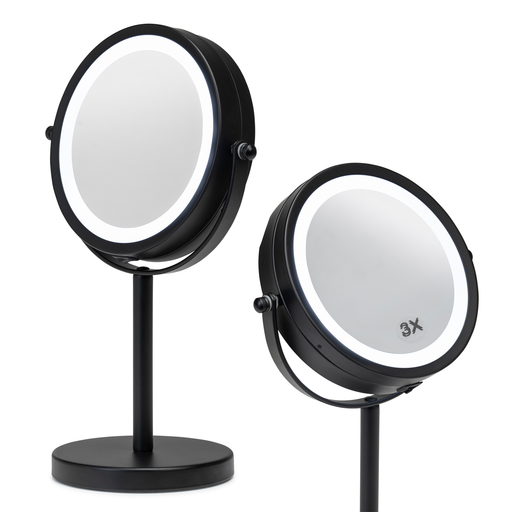
Why This Fits Their Persona: This freestanding model suits renters, students and first-time buyers who want flexible placement without wall drilling or permanent wiring.
It clearly provides 3× magnification on one side and a 1× view on the reverse, while the battery-powered design avoids dependence on a nearby socket.
Rotating 360° face, forward and backward tilt, LED edge lighting and no assembly required. Four AAA batteries are required and not included.
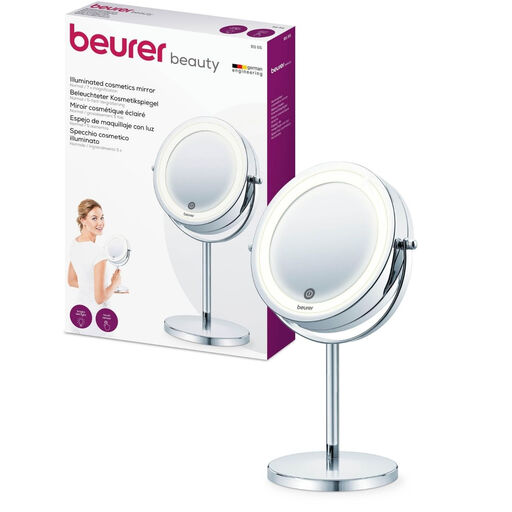
Why This Fits Their Persona: A mains-operated tabletop mirror for shoppers prioritising a defined grooming station and detailed close-up visibility.
The two-sided format prevents a single high-magnification view from being used for every task: one side is 1× and the other is 7×.
It has 18 LEDs, a touch sensor, a rotatable head and a chrome finish. The approximate mirror diameter is 13 cm.
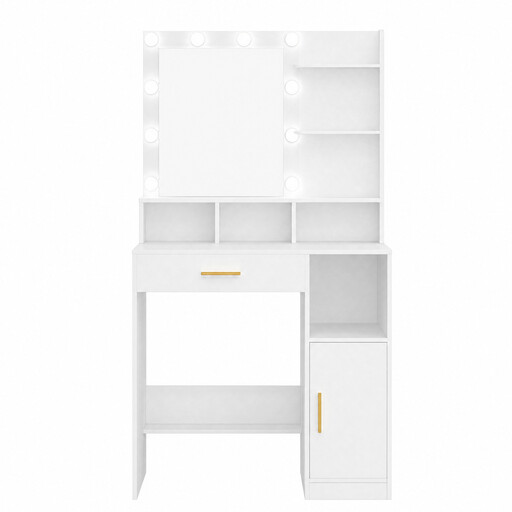
Why This Fits Their Persona: This all-in-one dressing table suits frequent users who need dedicated storage for cosmetics, accessories and larger personal items.
Rather than buying a small mirror and separate storage, this design combines a mirror, 10 LEDs, three open shelves, four compartments, a drawer and a cabinet.
The lighting offers five-level dimming, and the unit includes an anti-tipping device. Assembly is required, so check room dimensions and access before ordering.
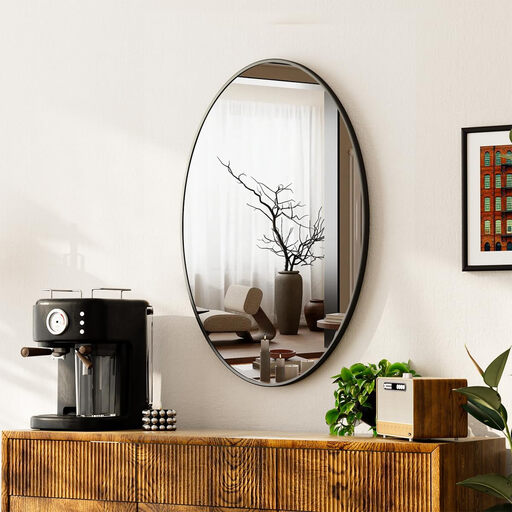
Why This Fits Their Persona: A practical choice for homeowners and renters wanting a larger decorative mirror for a bedroom, hallway, living room or suitable bathroom setting.
The 51 × 71 cm format offers more than a small close-up mirror, while rear hooks support vertical or horizontal wall mounting. Secure installation remains essential.
The aluminium frame is described as rustproof and water-resistant, and the mirror can also be leaned against a wall where appropriate.
We have compiled a complete, real-time list of products that fully satisfy these strict selection criteria and UK safety regulations.
Running cost depends on the wattage, usage time and power source. Battery-operated models require replacement batteries, while mains-powered mirrors use electricity through an adaptor. A dressing table with mirror may also include several LEDs, so check the product specifications and switch the lighting off when it is not needed.
Only use an electrical mirror in a bathroom if the product instructions specifically permit it and the installation meets applicable UK electrical safety requirements. Keep mains-powered mirrors and adaptors away from sinks, baths and splashing water. Non-electrical wall mirrors can be more straightforward, but they still need secure mounting and suitable moisture care.
Lifespan depends on glass quality, frame construction, installation and cleaning. Avoid abrasive products, harsh chemicals and spraying liquid directly into frame seams. Keep freestanding models on stable, dry surfaces and inspect wall fixings periodically. LED components may last for a long time, but replacement arrangements vary by product, so check warranty and care information before purchase.