Everyday vegan storecupboard shoppers
If dried pasta is a regular meal staple, check the current pack’s ingredients and dietary information whenever you choose a new shape or recipe. A familiar brand name is not a substitute for that check.


For vegan meals, start with the ingredients and dietary information on the exact dried-pasta pack rather than assuming every shape or brand is suitable. Plain durum-wheat pasta can be an everyday choice if its ingredients meet your needs, but it contains gluten. Choose wholewheat for a wholegrain option, or check a specifically labelled free-from product if you must avoid wheat or gluten; a vegan label alone does not establish allergy suitability.
If dried pasta is a regular meal staple, check the current pack’s ingredients and dietary information whenever you choose a new shape or recipe. A familiar brand name is not a substitute for that check.
Vegan suitability and avoiding wheat, gluten, milk or egg are different requirements. Match the pack’s allergen information and any free-from claim to the restriction you need to manage.
Wholewheat and pea-based pasta offer different ingredients from standard semolina pasta. Compare the relevant nutrition information per 100 g while checking vegan suitability and allergens separately.
Check dietary suitability on the exact pack before choosing between standard, wholewheat, free-from and pea-based pasta.
| Concern | Buying checks | Who this matters to |
|---|---|---|
| Vegan ingredients | Read the current ingredient list for egg, milk and other animal-derived ingredients; check any vegan statement on that product. | I want an everyday pasta that fits my vegan meals without relying on the shape or brand as proof. About 33% of consumers put exact-pack vegan suitability first. |
| Allergens and gluten | Match any free-from claim to your restriction, then read the allergen information and precautionary wording. | If I must avoid wheat or gluten, or manage a milk or egg allergy, a vegan label alone cannot settle my choice. For about 27% of consumers, that separate restriction is the primary concern. |
| Wholewheat choice | Look for wholewheat ingredients and compare the relevant fibre information; check dietary and allergen details separately. | For regular meals, I may prefer a wholegrain pasta and be happy with its grain flavour. A wholewheat or higher-fibre choice comes first for about 20% of consumers. |
| Protein in the pasta | Compare protein per 100 g on like-for-like dry products and check whether the recipe also contains wheat. | When the pasta itself is meant to contribute more protein to my meal, I need to compare formulations rather than assume pea-based means wheat-free. That is the leading need for about 20% of consumers. |
A vegan label and a free-from claim answer different questions. A pasta may fit a vegan diet without meeting the needs of someone managing a milk or egg allergy.
Read the exact pack’s allergen declaration and precautionary wording, and check that any free-from claim covers your specific restriction.
Standard, egg and speciality pasta recipes can differ, even when the packs share a brand.
Check the ingredients when switching shape or variety, particularly with egg-style or filled pasta.
M&S High Protein Spaghetti lists pea ingredients alongside durum wheat semolina. Its formulation therefore does not meet a need to avoid wheat.
Check the protein information and the wheat or gluten declaration independently.
Other meal components can change whether the finished dish is vegan. Dolmio lists milk-derived ingredients in its Creamy Tomato Pasta Bake Sauce.
Check the particular sauce and any toppings as well as the pasta.
These brands and retailers offer relevant pasta ranges or meal accompaniments; suitability remains specific to the product you choose.
Barilla dried pasta appears in UK supermarket listings, while Barilla uses Fusilli in a vegan recipe.
Tesco Groceries lists standard, wholewheat and free-from pasta categories.
Sainsbury's lists standard, wholewheat and Free From dried pasta. Its Stars Pasta example lists durum wheat semolina.
Asda Groceries has a vegan rice, pasta and noodles category.
M&S lists conventional, wholewheat, gluten-free and high-protein pasta options, including vegan-labelled Orzo Pasta and High Protein Spaghetti.
Dolmio is relevant here as a sauce choice to check alongside dried pasta, rather than as a dried-pasta option.
These Morrisons wholewheat fusilli listings suit shoppers considering a wholewheat dried-pasta format for vegan meals. Check the current pack’s vegan and allergen information before choosing either size option.
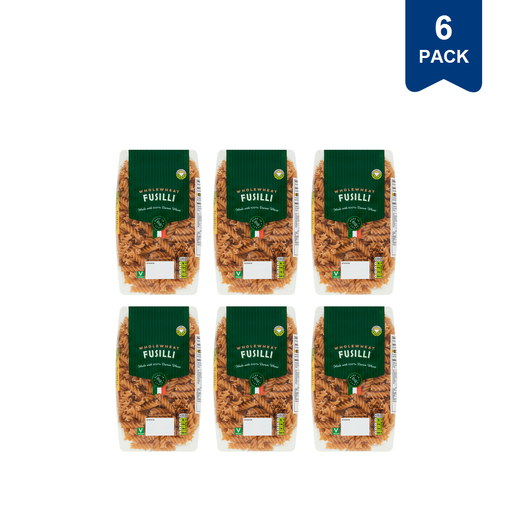 Image unavailable
Consider this bundle if you want wholewheat fusilli for repeated storecupboard meals. It contains six 500g packs. Wholewheat contains wheat, so this is not a wheat-free choice; check the current packs for vegan suitability and allergen information.
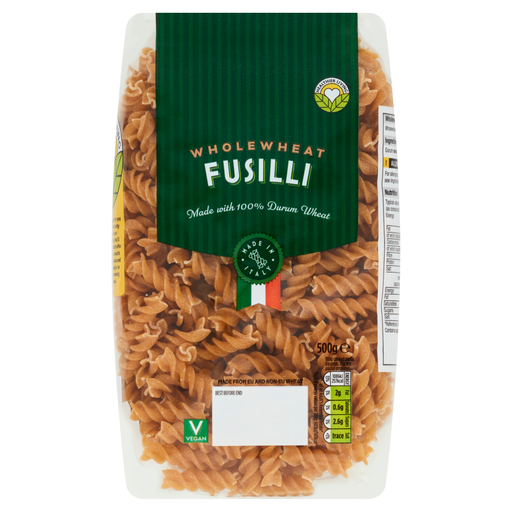 Image unavailable
Consider this 500g pack if you want wholewheat fusilli without choosing the six-pack bundle. It contains wheat; check the current pack’s vegan statement, ingredients and allergen information for your needs.
No. Check the current pack’s ingredients and dietary information rather than relying on the fact that pasta is dried. For example, M&S lists durum wheat semolina and water in its vegan-labelled Orzo Pasta, but that recipe does not establish the ingredients of other pasta products.
No. Vegan suitability does not establish allergy suitability. Read the product’s allergen declaration, any precautionary wording and any free-from claim that applies to the allergen you need to avoid.
Look for a product explicitly labelled for that restriction and check its current ingredients and allergen information. Standard durum-wheat and wholewheat pasta contain wheat; M&S describes its Made Without Wheat pasta as a maize-and-rice formulation.
Choose by the ingredient and nutrition information relevant to your meal, then check vegan suitability and allergens separately. The NHS Eatwell Guide identifies wholewheat pasta as a wholegrain or higher-fibre choice. M&S High Protein Spaghetti lists pea flour and pea protein isolate alongside durum wheat semolina, so pea-based does not necessarily mean wheat-free.