What to check before buying
Start with the ingredient you must avoid, then check the exact flavour and pack. After that, consider whether its portion and label warnings work for the journey.
| Priority |
What to check |
Your needs |
| Allergens |
Read the full ingredient list and flavour-specific precautionary statement. The Food Standards Agency says ‘may contain’ labelling signals possible unintended allergen presence. |
I need to know whether my excluded allergen is an ingredient or is named in a cross-contact warning before I pack the bar. |
| Free-from claim |
Match a dairy-free or vegan claim to the exclusion it actually addresses, then inspect other ingredients. Joybuy’s PhD Smart Plant Vanilla Fudge listing includes soya, peanut paste and malt extract containing gluten. |
A bar without animal-derived ingredients does not answer my separate questions about peanuts, soya or gluten. |
| Gluten-free label |
Look for ‘gluten free’ on the exact product and review its current allergen statement. Coeliac UK explains that the label denotes no more than 20 parts per million of gluten. |
If I require gluten-free food, I do not want to infer suitability just because wheat is not obvious in a short product description. |
| Journey use |
Check the individual portion, storage instructions and any sweetener warning. Relevant bars from Grenade, PhD and Myprotein carry warnings about laxative effects from excessive consumption. |
I want a portion I can carry and eat on the train, with warnings I have checked before travelling. |
Brands and ranges to check
Brand names are a starting point, not a substitute for the ingredients and allergen statement on a particular flavour.
Grenade
The Salted Caramel protein bar illustrates why a familiar travel-bar format still needs a flavour-specific allergen check.
- Grenade’s product information says it may contain traces of gluten, peanuts and nuts.
PhD
PhD describes its Smart Plant range as suitable for vegans and vegetarians.
- PhD states that Smart Plant provides 20g protein and less than 1g sugar per serving.
- The listed Vanilla Fudge variant includes soya, peanut paste and malt extract containing gluten.
Myprotein
Myprotein has a dairy-free protein-bar category for shoppers who need to start with milk avoidance.
- The brand describes its dairy-free bars as containing no milk-derived ingredients.
- Check the individual product for other excluded ingredients; the standard Impact Protein Bar is a separate product, not a dairy-free substitute.
Quest
Quest presents its Protein Bars as a gluten-free range.
- Quest states that its Protein Bars are gluten-free.
- Check the exact product and its current UK pack for any other ingredients you need to avoid.
Barebells
The Caramel Cashew bar is a useful reminder to check confectionery-style protein bars by flavour.
- Barebells lists milk, cashew and peanuts as allergens in Caramel Cashew.
Tesco
Tesco has a Free From snack, cereal and protein-bar shopping category, but a category label does not describe every item’s allergens.
- The separate Free From category can help narrow a pre-journey search.
- Tesco notes that formulations and allergen information can change, so read the physical pack.
Protein bars and flapjacks on Joybuy
These individually portioned bars and flapjacks offer starting points for train-journey shopping. Check each current pack against your own exclusions: the three products do not share one free-from profile.
 No image available
Trek Salted Caramel Protein Flapjacks, 3 x 50g
The three-bar pack offers individual portions for a train journey. This product contains soya; if you also need to avoid gluten or milk, check the current pack for the relevant claim, ingredients and precautionary statement.
Joybuy
 No image available
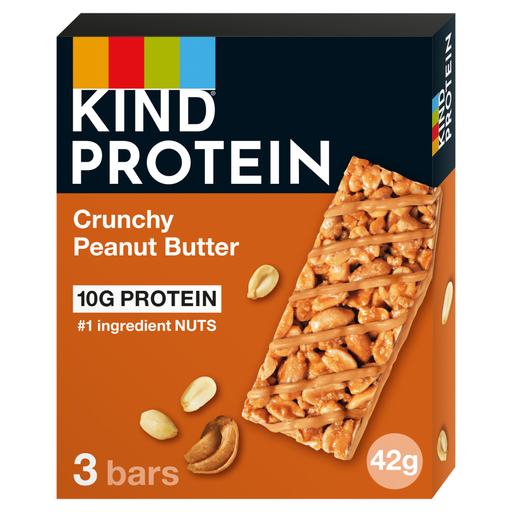
KIND Protein Crunchy Peanut Butter, 3 x 42g
The three-bar pack can be divided between journey days. It contains peanuts and soya, so it is not an option for someone avoiding either; check the current label for any other exclusion, including milk or gluten.
Joybuy
 No image available
Nature Valley Protein Peanut & Chocolate, 4 x 40g
The four-bar pack provides individual portions to carry. This product contains milk, peanuts and soya; check the current pack for its gluten-free claim and any precautionary statement if those details affect your choice.
Joybuy
Frequently asked questions
Does ‘vegan’ mean a protein bar is free from common allergens?
No. Vegan describes the absence of animal-derived ingredients, not every allergen. The listed PhD Smart Plant Vanilla Fudge bar includes soya, peanut paste and malt extract containing gluten, so check each allergen you must avoid on the exact pack.
What should I look for when I need a gluten-free bar?
Look for a ‘gluten free’ claim on the specific product and check its current ingredients and precautionary statement. Coeliac UK explains that foods labelled gluten free contain no more than 20 parts per million of gluten.
What does ‘may contain’ mean on a protein-bar wrapper?
It signals that the named allergen could be unintentionally present. The Food Standards Agency describes precautionary allergen labelling as a way to communicate that risk; read it alongside the ingredients for your exact bar.
Will every flavour in a range have the same allergens?
Do not assume so. Ingredients and warnings need checking by flavour, and Tesco notes that food formulations and allergen information can change. Read the physical pack you are buying, even if you have bought another flavour before.
Is a standard high-protein bar suitable if I avoid milk?
A high-protein claim does not establish that a bar is milk-free. Start with an explicitly dairy-free product, then check its own ingredient list and any other exclusions rather than treating the whole brand or range as suitable.


