Choose OLED when dark aquarium scenes and colour are your priorities and the screen will show varied content, rather than the same fixed elements for long periods. For an aquarium overlay that stays visible during desktop work, consider IPS LCD for wider viewing angles or VA LCD if you usually sit directly in front and favour deeper LCD blacks. Check the exact monitor’s connections, HDR certification and, for OLED, panel-care and warranty terms.
Who is this for?
Atmosphere-first aquarium viewers
If dark water, colourful fish and highlights are central to the experience, compare panel type and the exact HDR tier alongside the games you play. LG’s 27GS95QE-B, for instance, is specified by LG as a QHD OLED monitor with DisplayHDR True Black 400; that specification does not establish what any particular aquarium application outputs.
Long-session desktop-overlay users
Steam describes Virtual Aquarium - Overlay Desktop Game as an overlay above other windows. If you intend to leave it and other fixed desktop elements visible for extended periods, consider everyday desktop use and OLED panel care alongside image quality.
Mixed-device desk gamers
If the same monitor will serve an aquarium, games and a laptop or console, check the screen size and each device’s connection path. BenQ’s 27-inch EX271Q, for example, pairs QHD IPS with USB-C power delivery and a KVM switch according to BenQ’s specifications.
What matters when choosing?
Start with how long the aquarium and fixed desktop elements will stay on screen. Then weigh dark-scene appearance against screen size, desk fit and the connections needed for your other devices.
| Concern |
What to check |
Who this matters to |
| Dark scenes and HDR |
Compare panel type and the exact VESA DisplayHDR or True Black tier. Check whether the aquarium software outputs HDR before buying for that feature. |
If the appeal is dark water set against colourful fish and bright highlights, I want those differences to stand out. Around 31% of consumers put image atmosphere and HDR first. |
| Long-running overlays |
Consider how long fixed elements will remain visible; for OLED, read the model’s panel-care instructions and warranty terms. |
When the aquarium stays above my work windows for hours, I care about sustained desktop use as well as appearance. Roughly 31% of consumers make overlay practicality their primary concern. |
| Resolution and desk fit |
Check the screen’s dimensions and viewing distance, then match its resolution to your device’s capabilities. |
I need the aquarium and games to fit both my desk and the equipment driving the display. Around 23% of consumers place screen size and resolution first. |
| Games and connections |
Verify refresh rate at the intended resolution and input; check the ports, USB-C power delivery or KVM function your devices need. |
If I switch between games and another computer, I want the intended connection to handle each task. About 15% of consumers prioritise gaming motion and device switching. |
RTINGS describes the general LCD trade-off as wider viewing angles for IPS and higher contrast for VA. VESA says its DisplayHDR logo identifies a certified performance tier; an HDR label alone is not the same specification. Neither a monitor’s HDR tier nor its refresh rate establishes what a particular aquarium program supports.
Buying pitfalls
-
Choosing OLED without planning for fixed content
Steam describes the named aquarium game as an overlay above other windows. RTINGS’ long-duration static-content testing identifies burn-in risk for OLED-type displays, although it cannot predict what will happen to a particular monitor in your use.
If the aquarium or desktop controls will remain visible for long periods, compare LCD alternatives. If you choose OLED, follow the monitor’s panel-care guidance and read its warranty terms.
-
Treating every HDR label alike
An HDR label by itself does not identify a certified level of display performance. VESA’s DisplayHDR and True Black tiers provide defined certification levels.
When HDR is important to your choice, check the exact certification for the model and whether your intended content can output HDR.
-
Looking at refresh rate before the connection
A stated maximum refresh rate may depend on the input used. BenQ, for example, specifies up to 180Hz over DisplayPort for the EX271Q, while its USB-C connection offers 65W power delivery.
Match your computer or console to the monitor’s stated resolution, refresh rate and input; check laptop charging and switching features separately if you need them.
Brands to consider
LG UltraGear
The 27GS95QE-B is an example of LG’s 27-inch QHD OLED gaming-monitor route.
- LG specifies OLED, 2560 × 1440, DisplayHDR True Black 400 and 240Hz for this model.
- For a persistent overlay, consider static-content habits and the model’s panel-care and warranty terms before choosing OLED.
BenQ MOBIUZ
The EX271Q illustrates a 27-inch QHD IPS option for gaming and mixed-device desk use.
- BenQ specifies 180Hz over DisplayPort, USB-C with 65W power delivery and a KVM switch for the EX271Q.
- RTINGS identifies lower contrast than VA as a general IPS trade-off; compare the individual screens if dark-scene depth matters most.
Samsung Odyssey
Samsung’s Odyssey OLED G8 G80SD represents a larger 4K OLED gaming-monitor route.
- Samsung identifies the 32-inch LS32DG802SUXXU as a 4K, 240Hz OLED model.
- A larger 4K display needs suitable desk space and device capability; OLED-care features should not be treated as eliminating static-content risk.
Joybuy monitor options
These options cover IPS and VA LCD screens for mixed desk use, plus an OLED ultrawide for viewers considering a larger aquarium display. Compare the listed variant and your intended connections rather than assuming that monitor features are requirements of the aquarium software.
 Image unavailable
LG UltraGear G8 27G850A, 27-inch 4K Nano IPS
Consider this 27-inch IPS model if you want a 4K aquarium display that also serves a gaming desk.
The title lists dual-mode 240Hz/480Hz operation, DisplayHDR 600, DisplayPort 2.1 and HDMI 2.1. Check which resolution and connection support the mode you intend to use.
View on Joybuy
 Image unavailable
HKC G27H2DPro, 27-inch QHD Fast IPS
This IPS option suits a desk where a QHD aquarium overlay shares the screen with gaming.
Its title specifies 2560 × 1440 and 220Hz. If dark-scene contrast or HDR is decisive, check the exact model’s specifications and certification before choosing it.
View on Joybuy
 Image unavailable
CRUA 32-inch 1500R curved QHD gaming monitor
Consider this larger VA LCD option if you normally view the aquarium from directly in front and want to compare LCD contrast with IPS alternatives.
The title specifies 2560 × 1440, 165Hz and HDMI and DisplayPort connections. Check desk space and the exact colour-gamut specification; the product information gives differing sRGB figures.
View on Joybuy
 Image unavailable
LG UltraGear 34GX900A-B, 34-inch OLED WQHD
This ultrawide OLED is an option for viewers prioritising a large display for the aquarium alongside gaming.
The title specifies 240Hz. Check desk fit and software support for the intended aspect ratio; if fixed content will stay on screen for long periods, also read the panel-care instructions and warranty terms.
View on Joybuy
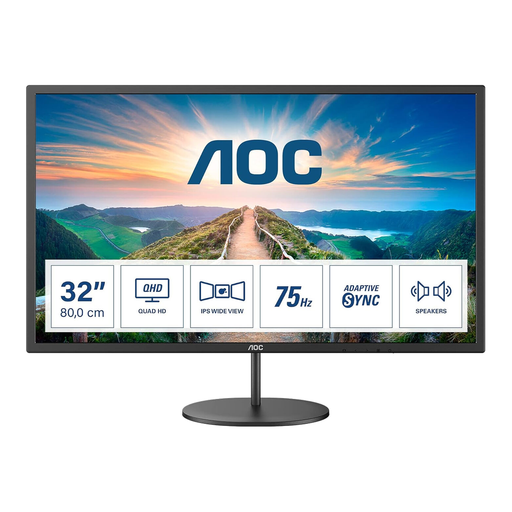 Image unavailable
AOC Q32V4, 31.5-inch IPS monitor
Consider this larger IPS LCD for an aquarium that will share the screen with everyday desktop use.
The title lists Adaptive-Sync and built-in speakers. Check the exact resolution and HDR specification for this variant if either will determine your choice.
View on Joybuy
Frequently asked questions
Does a virtual aquarium need a 240Hz monitor?
Do not choose 240Hz solely for the aquarium without checking your application’s current requirements. Steam describes Virtual Aquarium - Overlay Desktop Game as a desktop overlay; a high-refresh monitor may be relevant if you also play conventional games that can use it.
How do I check an HDR monitor’s certification?
Look for the exact VESA DisplayHDR or DisplayHDR True Black tier assigned to the model. VESA says its logo identifies a certified performance tier, whereas a general HDR label does not tell you which tier the display meets.
Can I return a monitor bought online in the UK?
A change-of-mind cancellation and a remedy for a faulty or misdescribed monitor are different matters. GOV.UK states that, for an eligible distance purchase, customers can tell the seller within 14 days of receiving the item that they want to cancel and then have another 14 days to return it. Check the conditions that apply to your purchase; do not treat a retailer’s voluntary policy as the limit of your statutory rights.
What should I do with an old monitor in the UK?
Use an appropriate electrical-equipment collection or recycling route rather than putting the monitor in general waste. GOV.UK explains that UK waste electrical and electronic equipment rules are intended to encourage recovery, reuse and recycling; check local-authority or retailer collection options available to you.


