Motion-first virtual drifters
If steering corrections and fast-moving scenery are your priorities, compare refresh rates, the stated response-time measurement and variable-refresh support before deciding how wide a screen you want.


Choose a 27-inch QHD monitor if a conventional desk setup and high refresh matter more to you than extra horizontal view. A 34-inch curved ultrawide gives you a wider single-screen cockpit, but takes more space and asks your PC to render more pixels. With either format, check the refresh rate available through your chosen connection, variable-refresh compatibility and where your headphones will connect.
If steering corrections and fast-moving scenery are your priorities, compare refresh rates, the stated response-time measurement and variable-refresh support before deciding how wide a screen you want.
If you want a wider view around the virtual car on one screen, a 21:9 curved monitor is worth considering. Allow for its desk footprint and the extra pixels your PC must render.
If your headphones are part of the driving setup, decide whether they will connect to the PC or console, or need an analogue output on the monitor. Check the refresh rate available through your intended cable and input too.
Choose it when: You want a conventional 16:9 desk display and place high refresh ahead of a wider cockpit view.
Trade-off: You see less horizontal game image than on a supported 21:9 setup. LG says the optional 200Hz mode on its 27GS85Q-B requires a DisplayPort 1.4-capable graphics card and cable.
Choose it when: A wider single-screen cockpit is your priority and your game supports the 21:9 format.
Trade-off: A 3440 × 1440 screen needs more physical width and has more pixels to render than 2560 × 1440, so check desk fit and your PC’s frame rate at your preferred settings.
| Concern | What to check | Who this matters to |
|---|---|---|
| Smooth motion | Compare native and optional refresh modes, the response-time measurement and variable-refresh compatibility with your GPU. | If rapid steering corrections make moving scenery hard to follow, I would put refresh and compatible variable refresh ahead of screen width. Around 42% of consumers put motion handling first. |
| Cockpit width | Measure your desk or rig, confirm game support for 21:9 and assess PC performance at 3440 × 1440. | I would accept a larger display and rendering workload if a wider view around the virtual car matters most. For around 33% of consumers, that cockpit view is the primary concern. |
| Connection fit | Check the refresh mode for your chosen input and cable, GPU compatibility and where wired or wireless headphones will connect. | If my existing PC and headset determine how I can wire the setup, I need the intended display mode and audio path to work together. Connection fit comes first for around 25% of consumers. |
The available refresh rate can change with the input. Dell specifies 3440 × 1440 at 144Hz over DisplayPort but 100Hz over HDMI for its S3422DWG; LG makes the 27GS85Q-B’s optional 200Hz mode conditional on a DisplayPort 1.4-capable graphics card and cable.
Check the exact monitor’s resolution-and-refresh information for the port you plan to use, then match the cable and source device to that mode.
LG labels the 27GS85Q-B’s figure as 1ms grey-to-grey (GtG), while Samsung labels the Odyssey G5 G55T’s as 1ms moving-picture response time (MPRT). The matching numbers do not establish matching motion behaviour.
Keep the measurement method alongside the figure, and consult model-specific measured testing if motion performance will decide your purchase.
Samsung’s 34-inch Odyssey G5 G55T uses 3440 × 1440 and a 21:9 format. That is wider and contains more pixels than the 2560 × 1440, 16:9 LG example, affecting both desk fit and the work asked of your PC.
Measure the available space, check your driving game’s aspect-ratio support and assess the frame rate your PC can deliver at the intended settings.
A monitor headphone socket matters when you plan to route audio through the display to wired headphones. Headphones connected directly to a PC, console or wireless receiver use a different path.
Decide where the headphones will connect before treating a monitor’s audio features as a selection criterion.
The 27GS85Q-B is a 27-inch QHD example for a conventional desk setup where high refresh is a priority.
The 34-inch Odyssey G5 G55T is a curved-ultrawide example for consumers who prioritise a wider single-screen cockpit.
The EX2710Q is a 27-inch QHD option to consider if you may route wired headphones through the monitor.
These monitors cover conventional-size high-refresh displays and a 34-inch curved ultrawide. They also include a 27-inch 4K dual-mode option, so compare each model’s resolution and connection requirements rather than treating them as interchangeable QHD choices.
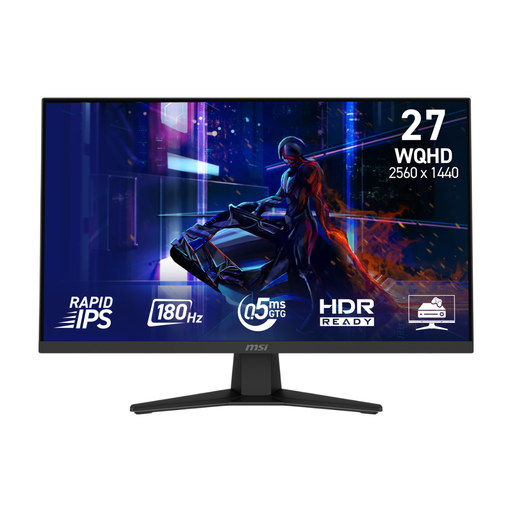 No image available
Consider this conventional-size display if fast-moving driving visuals matter more to you than an ultrawide view.
The product name states a 180 refresh rate, a 0.5ms response-time claim and Adaptive Sync. Check the mode available from your own device: the product information distinguishes 180Hz over DisplayPort from 144Hz over HDMI.
If you plan to connect wired headphones at the display, confirm the headphone output and your intended audio path. Check variable-refresh compatibility with your GPU.
 No image available
This is a conventional-size alternative if you are considering different resolution and refresh modes for your driving setup.
Its product name specifies a Nano IPS panel, 240Hz/480Hz dual-mode refresh, 1ms GtG, AMD FreeSync Premium Pro, DisplayPort 2.1 and HDMI 2.1. Check the resolution associated with each mode and the maximum refresh available through your intended input; the headline modes do not establish the frame rate your PC will achieve.
If you want to route headphones through the monitor, confirm the stated output suits your headset connection.
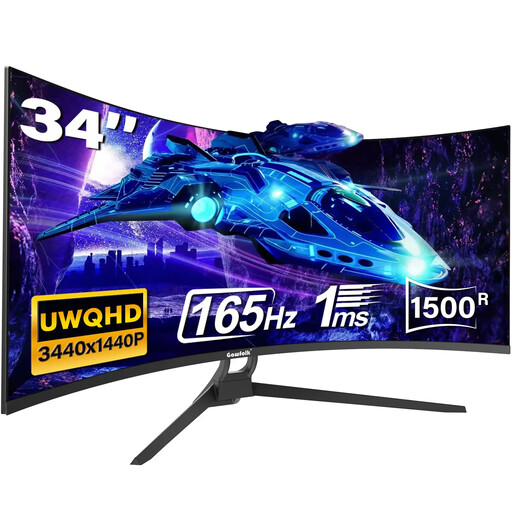 No image available
Consider this 21:9 screen if a wider single-screen view is worth the extra desk space and graphics workload for your setup.
The product name specifies a 1500R curve, 165Hz refresh and DisplayPort 1.4. Check whether your game and PC support your intended ultrawide resolution and frame rate.
Confirm the HDMI version and available refresh mode for your chosen connection: the product title and detailed information give differing HDMI versions.
 No image available
This conventional-size QHD option is relevant if you want to compare high-refresh displays without moving to an ultrawide format.
The product name specifies 2560 × 1440 resolution, 240Hz refresh, FreeSync Premium Pro and G-SYNC Compatible support. Check the refresh mode available from your GPU and chosen input before relying on the headline figure.
If your wired headphones must connect at the display, confirm that the monitor has the output you need.
 No image available
This is another conventional-size option for consumers comparing stated refresh rates for a virtual driving display.
The product name specifies 2560 × 1440 resolution and 220Hz refresh. Before choosing it for that mode, check the refresh available through your device, cable and selected input.
Confirm the variable-refresh compatibility you need and the response-time measurement method if either is important to your decision.
Choose 27-inch QHD if you prefer a conventional desk format and want to prioritise high refresh with fewer pixels to render than 3440 × 1440. Choose a 34-inch ultrawide if a wider cockpit view matters more, you have the space, and your game and PC support its aspect ratio and resolution at settings you find acceptable.
No. Variable refresh needs a compatible monitor, GPU and connection, as well as the appropriate settings. NVIDIA describes G-SYNC variable refresh as matching monitor refresh to GPU frame rate; AMD’s FreeSync likewise depends on a compatible setup. Neither feature establishes what frame rate your driving game will reach.
Only if you intend to send audio through the monitor to wired headphones. If your headset connects directly to the PC, console, controller or wireless receiver, plan around that connection instead. For monitor-routed audio, check the exact model’s socket and whether your chosen input carries audio.
Not necessarily; check the limit for the exact model, resolution and input. Dell specifies 3440 × 1440 at 144Hz over DisplayPort and 100Hz over HDMI for the S3422DWG, while LG says the optional 200Hz mode on its 27GS85Q-B requires a DisplayPort 1.4-capable graphics card and cable.