For seated virtual hill climbs, start with a monitor you can position directly in front of the bike; a 27-inch QHD model with an adjustable stand or a suitable VESA mount is one option. Check what the device running the cycling app can output before prioritising a high refresh rate, and check trainer compatibility separately: the monitor displays the route but does not control resistance.
Who this setup suits
Seated riders planning their screen position
If the bike and desk put a fixed-stand monitor too low or off-centre, look at stand adjustment or a mount that fits the available space. The Health and Safety Executive’s workplace display guidance offers a general reference for screen position, rather than cycling-specific advice.
PC riders checking graphics capability
A QHD display may give you more room for route visuals and ride information, but check what your PC can run at the intended resolution and refresh rate. Zwift Support says graphics performance depends heavily on the GPU.
Riders sharing a display with other devices
If the monitor will also serve games, a laptop or a console, compare its inputs and switching features against those devices. USB-C and KVM functions are relevant only when the connections and functions you need are supported.
What to check when buying
For seated virtual climbing, establish what the app-running device and trainer can do, then plan the screen position before deciding how much refresh capability you need for other games.
| Concern |
Buying checks |
Who this matters to |
| Device and trainer compatibility |
Check the app-running device’s QHD output mode and the trainer’s data and resistance-control functions separately. |
I need the route on screen and the trainer to respond as intended, without assuming the display controls a climb; around 45% of consumers put device and trainer compatibility first. |
| Seated screen position |
Measure the bike-to-screen layout, then check stand adjustment or the VESA pattern and mount fit. |
When riding seated, I want route cues and metrics in front of me rather than on a low or off-centre screen; roughly 33% of consumers place screen positioning first. |
| Motion for other games |
Match the desired refresh mode and adaptive-sync connection to your graphics device and cable. |
I also play fast games on this display, so smooth motion matters beyond cycling sessions; about 22% of consumers put mixed-use smoothness first. |
Buying pitfalls
-
Choosing a refresh rate before checking the source device
Zwift Support says a lower-end GPU can affect visual quality and frame rate. A monitor’s highest refresh mode may also have connection requirements: LG says the 200 Hz overclock mode on its 27GS75QN-B requires a DisplayPort 1.4-capable graphics card and cable.
Check the device’s output ports and supported modes against the monitor manual before choosing the refresh setting you intend to use.
An adapter or replacement cable may be needed if the existing connection cannot carry that mode.
-
Expecting the monitor to simulate hill resistance
The monitor shows the route; it cannot add trainer functions. Zwift Support identifies resistance control in compatible cycling hardware as the function that simulates terrain changes.
Check the exact trainer model’s data transmission and resistance-control functions separately from the display.
-
Picking a panel without planning its position
A fast panel does not resolve a screen that sits low, close or off-centre relative to the bike. The Health and Safety Executive’s workplace display guidance is a useful general reference for placing a screen ahead at a workable height and distance.
Measure the riding position and available space, then check the stand’s adjustment range or the proposed mount’s fit.
Achieving that position may call for a monitor arm, a different stand or a trainer desk.
Brands to consider
BenQ MOBIUZ
The EX2710Q is relevant if you want a 27-inch QHD gaming monitor with stand adjustment and built-in audio.
- BenQ UK lists a 2560 × 1440 IPS panel, 165 Hz refresh rate, 100 mm height adjustment, 100 × 100 mm VESA mounting and built-in 2.1-channel speakers for the EX2710Q.
- Check whether its stand range or a compatible mount will place the screen where your bike setup needs it; these specifications describe the EX2710Q, not every MOBIUZ monitor.
Gigabyte
The M27Q P is relevant when the same screen must switch between a cycling device and other desktop equipment.
- Gigabyte’s M27Q P specification lists a 27-inch QHD IPS panel, 130 mm height adjustment, USB-C alternate mode and KVM functionality.
- Gigabyte specifies USB-C power delivery of up to 18 W, so check a laptop’s charging requirements separately. Gigabyte marks the M27Q P as a legacy model; check current availability before planning around it.
LG UltraGear
The 27GS75QN-B is relevant if the screen will also be used for games where a higher refresh mode matters.
- LG UK lists a 27-inch 2560 × 1440 IPS panel, 180 Hz native refresh rate and adaptive-sync support for the 27GS75QN-B.
- LG says its 200 Hz overclock mode requires a DisplayPort 1.4-capable graphics card and cable. Check screen adjustment separately against your seated layout.
Joybuy product choices
These QHD displays cover adjustable-screen options and higher-refresh gaming use for a seated cycling setup. Choose by the position you can achieve and the output your device supports; trainer resistance remains a separate hardware decision.
 No image available
Samsung Odyssey G6 S27DG612 27-inch QHD OLED 240 Hz monitor
Consider this model if the display will serve both seated cycling and games where you want a higher refresh mode.
The product name specifies a 27-inch QHD OLED panel, 240 Hz refresh rate and 0.03 ms response-time figure; check which mode your device and connection can deliver.
The listing warns that its OLED screen is susceptible to burn-in, so review the screen-care guidance if your cycling app keeps interface elements in place for long sessions.
View on Joybuy
 No image available
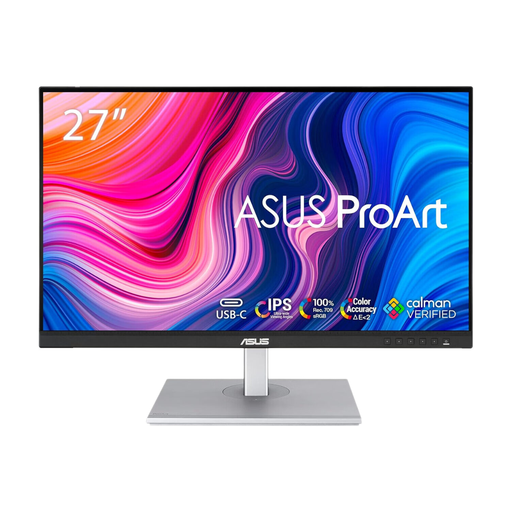
ASUS ProArt PA278CFRV QHD IPS 100 Hz monitor
Consider this model when placing the display for seated riding takes priority over a very high refresh figure.
Its product name specifies a QHD IPS panel and 100 Hz refresh rate. Check that the stand or proposed mount achieves the position you need.
If you plan to use USB-C, confirm the exact unit’s display mode and power-delivery capability, as the listing says these vary by region.
View on Joybuy
 No image available
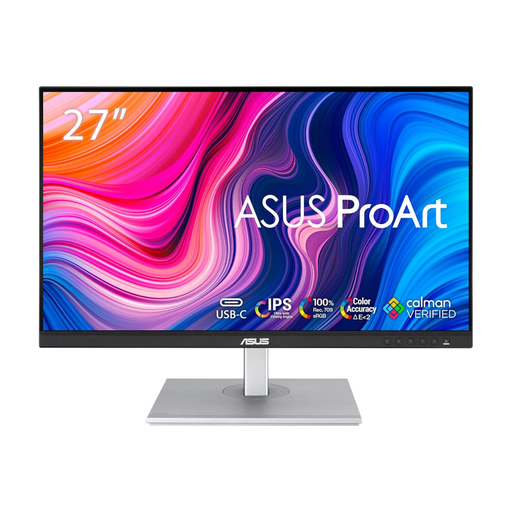
ASUS ProArt PA278CV WQHD IPS monitor
Consider this model if screen placement and a QHD-class display matter more to your seated setup than a high-refresh gaming mode.
The product name identifies a WQHD IPS monitor. Check that its stand or a suitable mount fits your bike-and-desk layout.
If you intend to power a laptop through USB-C, confirm that the unit’s power delivery meets the laptop’s requirements.
View on Joybuy
 No image available
HKC G27H2DPro 27-inch QHD Fast IPS 220 Hz monitor
Consider this model if you also want a higher-refresh display for conventional gaming.
The product name specifies a 27-inch 2560 × 1440 Fast IPS panel and 220 Hz refresh rate. Confirm which connection and source-device mode you would use.
Before choosing it for a seated bike layout, check whether its stand or mounting options can place the screen at the height you need.
View on Joybuy
Common questions
Will a gaming monitor make virtual hills change my trainer’s resistance?
No: the monitor displays the route, while compatible cycling hardware must provide resistance control. For Zwift, check the exact trainer model’s supported data and resistance functions rather than relying on a monitor feature.
Do I need a 200 Hz monitor for seated virtual hill climbs?
No, 200 Hz is not a requirement for displaying a virtual climb; it may be relevant if you also play fast games. Check the app-running device and connection before choosing such a mode: LG says the 200 Hz overclock mode on its 27GS75QN-B requires a DisplayPort 1.4-capable graphics card and cable.
Where should the screen go when I ride seated?
Plan for a screen directly in front of the bike, then check whether the stand or a compatible mount can achieve that position. As a general workplace display reference, the Health and Safety Executive advises placing the top of a screen around eye level and the screen about an arm’s length away; adapt the layout to your equipment rather than treating that guidance as cycling-specific medical advice.


