For a dedicated virtual-truck setup, choose a 49-inch 32:9 monitor if a broad single-screen cockpit view is the priority and your space, PC and simulator can accommodate it. A 34-inch 21:9 monitor is a less physically wide route, while a 45-inch 5K2K 21:9 monitor suits consumers prioritising native image detail and prepared to check the greater graphics workload. None of these formats establishes how your particular game will handle its field of view, interface or frame rate.
Who each format suits
Panoramic cockpit-view seekers
You want a broad view on one screen for a fixed driving rig and have room for a 49-inch curved display. Samsung UK’s G91F specifications illustrate the 32:9 format; check your simulator and mounting space before choosing it.
Balanced ultrawide PC drivers
You want a curved 3440×1440 view and adaptive-sync options without moving to a 49-inch screen. Dell UK lists these characteristics for the 34-inch Alienware AW3425DW, although game performance still depends on your PC.
High-detail dedicated-room builders
You prioritise a large 5K2K image for a permanent setup and are willing to check graphics performance at native resolution. LG UK’s 45GX950A is an example of this 45-inch route.
What to check before choosing
For one monitor in a dedicated virtual-truck games room, decide whether cockpit width, a more manageable ultrawide setup or native detail matters most. Then check the named simulator, your PC’s outputs and the physical space before committing to a format.
49-inch 32:9
Choose when: a broad single-screen driving view is your priority and the desk or mount can accommodate the display.
Trade-off: the wider format takes more room, and your simulator may need field-of-view or interface adjustments.
34-inch 21:9
Choose when: you want an ultrawide driving view without the physical width of a 49-inch screen.
Trade-off: it offers less peripheral screen width than 32:9; a high refresh-rate specification alone does not establish your in-game frame rate.
45-inch 5K2K 21:9
Choose when: native resolution and a large image matter more to you than minimising graphics workload.
Trade-off: rendering at 5120×2160 calls for a careful check of your GPU, connection and intended game settings.
| Concern |
Buying checks |
Who this matters to |
| Panoramic view |
Check aspect ratio, native resolution, desk or mount fit and the simulator’s field-of-view and interface behaviour. |
If I want to see more of the cab and road on one screen, I can make room for a wide display but need the game view to work at that ratio. Around 33% of consumers put cockpit width first. |
| Smooth ultrawide play |
Match the chosen resolution and refresh mode to your GPU output, port and cable; check the game’s achievable frame rate. |
I would rather have a practical ultrawide arrangement with adaptive-sync options than pursue the widest screen. For around 25% of consumers, that balanced setup is the primary need. |
| Native image detail |
Compare native resolutions and check graphics performance at your intended settings, rather than judging by screen size alone. |
Dashboard instruments and scenery matter more to me than keeping the rendering workload down. That priority comes first for around 25% of consumers. |
| Long-session screen care |
If considering OLED, read the exact model’s panel-care guidance and image-retention warranty terms. |
With maps and gauges staying in place during long drives, I want to understand how to care for the screen. Around 17% of consumers make that ownership concern their first priority. |
Buying pitfalls
-
Choosing the widest screen before checking the game
A monitor’s 32:9 capability does not establish how a particular simulator places its field of view, mirrors or interface at that ratio.
Identify the simulator and check its current behaviour at the exact resolution you intend to use, particularly 5120×1440.
-
Reading maximum refresh rate as an in-game promise
The panel’s stated refresh rate is separate from the frames your PC and game can deliver. Samsung UK also qualifies its G91F refresh-rate and response-time results by input-source performance.
Check the GPU output, selected port, cable and expected performance at the monitor’s native resolution.
-
Overlooking a persistent interface on OLED
Driving sessions can leave navigation and dashboard elements in fixed positions. LG UK advises that prolonged static images may cause faint marks on its OLED monitors.
Follow the exact model’s panel-care instructions, vary content where practical and read its written image-retention warranty terms.
-
Assuming matching model text settles conflicting specifications
A Joybuy listing for Samsung LS49FG910EUXXU states 240Hz, while Samsung UK specifies 144Hz for that model identifier. The listing also says the item is no longer available.
Before ordering a monitor elsewhere, reconcile its complete model and regional variant against the manufacturer’s specifications and the current product page.
Relevant brands for reference
Samsung
Samsung UK’s Odyssey G91F illustrates the large, curved 32:9 route for a fixed single-screen driving setup.
- Samsung UK specifies a 49-inch, 1000R curved Dual QHD panel at 144Hz for the G91F.
- Allow room for the 49-inch format and confirm that your PC and simulator handle 5120×1440 as intended.
Alienware
Dell UK’s AW3425DW illustrates a 34-inch 21:9 route with high-refresh and adaptive-sync specifications.
- Dell UK lists 3440×1440, 240Hz, DisplayPort 1.4, HDMI 2.1 and adaptive-sync support for the AW3425DW.
- Its 240Hz specification does not mean a particular truck simulator will run at 240 frames per second on your PC.
LG UltraGear
LG UK’s 45GX950A illustrates the large, high-resolution 21:9 OLED route.
- LG UK specifies 5120×2160 at 165Hz in the model’s high-resolution mode, alongside a lower-resolution 330Hz mode.
- Check performance at native resolution. LG UK also advises care with prolonged static images on its OLED monitors.
Joybuy monitor choices
These listings cover 49-inch panoramic screens and 34-inch ultrawides for a fixed driving setup. Compare their stated formats with your available space, then check the intended simulator and connection before choosing.
 No image available
Acer X Predator X49X 49-inch QD-OLED monitor
Consider this for a fixed setup where a broad 32:9 screen is the priority. Joybuy lists an 1800R curve, Double Quad HD resolution and a 240Hz refresh rate. Check the desk or mount rating, simulator behaviour and the model’s OLED care guidance.
View on Joybuy
 No image available
CRUA 49-inch curved DQHD gaming monitor
Consider this when a 49-inch single-screen cockpit view fits your room. Joybuy lists a 5120×1440, 32:9 VA panel with a 1500R curve and 165Hz refresh rate. Check desk capacity or mount suitability, plus the game and PC output at that resolution.
View on Joybuy
 No image available
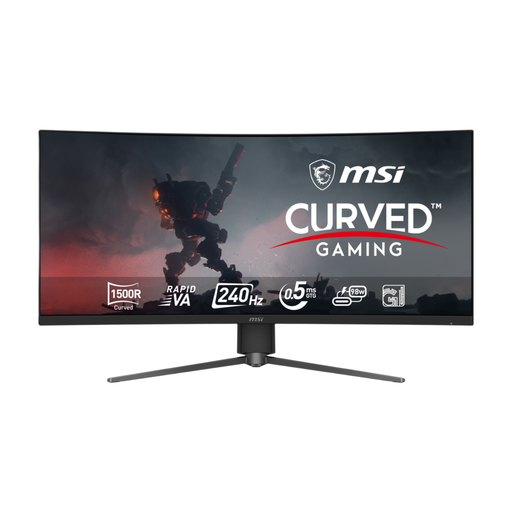
MSI MPG 346CQRF X24 34-inch UWQHD gaming monitor
Consider this for an ultrawide driving view without moving to a 49-inch display. Joybuy describes a curved Rapid VA monitor with Adaptive Sync. Confirm the simulator’s intended resolution and whether your PC and cable can deliver the refresh mode you want.
View on Joybuy
 No image available
LG UltraGear 34GX900A-B 34-inch OLED gaming monitor
Consider this for a 34-inch OLED ultrawide setup. Joybuy lists a 240Hz refresh rate for the 34GX900A-B. For long sessions with a fixed game interface, check this model’s screen-care instructions and image-retention warranty terms, as well as your PC’s output capability.
View on Joybuy
 No image available
Lenovo R34w-30 34-inch UWQHD gaming monitor
Consider this if a 34-inch curved ultrawide fits your driving position. Joybuy identifies it as a UWQHD model. Check which input and cable deliver your intended resolution and refresh mode, and confirm how the simulator handles the ultrawide view.
View on Joybuy
Common questions
Should I choose 32:9 or 21:9 for virtual-truck driving?
Choose 32:9 if a broad one-screen view is your priority and you have space for the monitor; choose 21:9 if you prefer a less physically wide ultrawide setup or are considering the higher native resolution of a 5K2K model. Check how your named simulator handles the exact aspect ratio and resolution before buying either format.
Do I need a 240Hz monitor for a truck simulator?
No particular refresh-rate figure is necessary for every truck-simulator setup. A monitor rated at 240Hz offers refresh headroom, but the result depends on your game settings, graphics output and connection; Samsung UK notes that refresh-rate results can vary with input-source performance.
What should I check before using OLED for long driving sessions?
Check the exact monitor’s panel-care instructions and image-retention warranty terms, especially if maps or interface elements will remain fixed for long periods. LG UK advises that prolonged static images may cause faint marks on its OLED monitors and describes Image Cleaning as a way to reduce them.
What should I do with an old monitor?
Check your local council’s electrical-waste arrangements or an available retailer take-back option rather than putting the monitor in general household waste. UK government guidance identifies electrical and electronic equipment as subject to the UK WEEE framework; the collection route available to you depends on your location and provider.


