
24/7 Customer Support

Free returns

Same-day & Next-day Delivery

Quality Guaranteed

Unlock Your Welcome Offers: FREE Delivery | Up to 80% OFF | Free 30-day JoyPlus trial
Download the APP
Choosing a freestyle stunt scooter for kids involves more than picking a striking colour or a product labelled “pro”. A scooter that feels suitable on a smooth driveway may become unstable at a skate park, while an unnecessarily heavy model can make basic tricks harder to learn.
The VOKUL K1 Pro stunt scooter range is aimed at children aged 8 and up, teens and adults who want to practise freestyle riding, street moves and skate park tricks. Before buying, it is worth checking the construction, rider limits and maintenance requirements rather than relying on marketing language alone.
An adjustable handlebar scooter can be useful for growing riders, but adjustment range matters. Some listings describe a handlebar as adjustable without making the minimum and maximum heights immediately clear. Check the stated dimensions and ensure the bars can sit comfortably around the rider’s waist or lower chest when standing on the deck.
A handlebar that is too high can affect control during turns and jumps. One that is too low may leave a taller teen riding in an uncomfortable position.
An ABEC-9 bearing scooter may glide smoothly when the bearings are clean and correctly installed. However, the ABEC number mainly describes manufacturing tolerance, not the scooter’s overall durability, wheel quality or suitability for tricks.
For freestyle use, also look for solid wheels, a rigid fork, a secure clamp and a deck designed for impact. Bearings can become noisy or rough when exposed to water, grit or poor storage, regardless of their rating.
A product may be marketed for children, teens and adults, but its weight limit still needs checking. The VOKUL K1 Pro listings state a maximum rider weight of 220 lb, approximately 100 kg. This is a stated product specification, not a recommendation to exceed the limit during jumps or repeated impacts.
The scooter’s own weight also affects handling. Listed VOKUL K1 Pro variants weigh approximately 4.1–4.36 kg, depending on colour and model listing. A lightweight aluminium scooter can be easier for younger riders to manoeuvre, but the frame must still provide sufficient rigidity for the intended use.
The VOKUL K1 Pro uses a T-6061 aluminium alloy deck on the listed variants. Aluminium is commonly selected for freestyle scooters because it can provide a relatively low weight while maintaining a rigid riding platform.
Look for a non-slip deck with enough standing space for the rider’s feet. A rigid, one-piece-style construction is generally more appropriate for tricks than a folding commuter scooter with multiple moving joints.
A one-piece T4T6 fork is listed on the K1 Pro models. A one-piece fork has fewer joining points than a multi-part design, which can simplify inspection before riding.
The K1 Pro listings also specify a three-bolt clamp and lightweight aluminium handlebars. Before each session, check the clamp and handlebar bolts for movement. If the bars twist independently from the front wheel, the scooter should not be ridden until secured.
The K1 Pro uses 110 mm solid wheels, with product information specifying high-rebound 88A polyurethane on several variants. These wheels are designed for smooth, dry surfaces and freestyle riding rather than rough, wet pavements.
A rear foot brake provides speed control, but it is not a substitute for safe riding practice. The supplied safety information advises using the scooter away from traffic, stairs and wet conditions. Riders should wear a suitable helmet, knee and elbow protection and inspect the scooter before each ride.
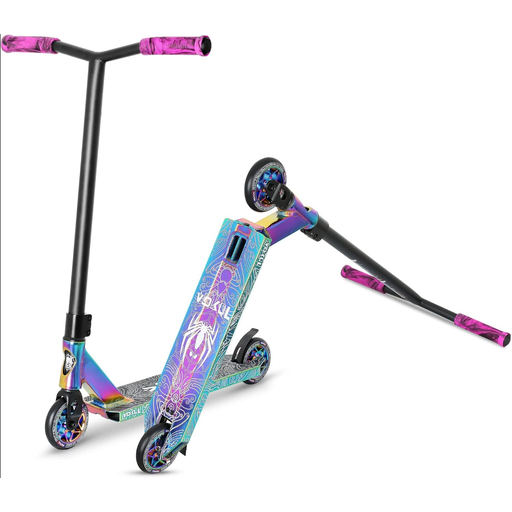
Why This Fits Their Persona: A practical starting point for an 8–18-year-old learning barspins, tailwhips and basic park techniques on smooth UK surfaces.
The listing provides a 100 kg weight limit, 110 mm wheel size and stated ABEC-9 bearings, making the core specifications easier to compare.
T-6061 aluminium alloy deck, one-piece T4T6 fork, soft 145 mm rubber grips and mostly pre-assembled setup.
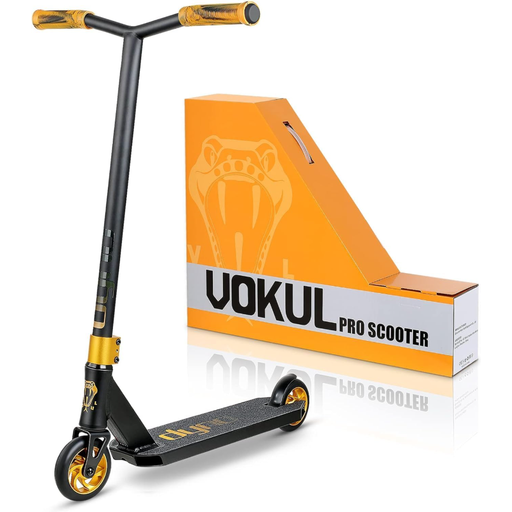
Why This Fits Their Persona: Suitable for riders who want a more dedicated pro scooter for teens, older children or adults and expect regular freestyle practice.
Its specification list identifies the aluminium construction, 110 mm wheels, adjustable T-bar, 220 lb limit and six-month manufacturing-defect warranty.
T-6061 aluminium alloy, high-rebound 88A polyurethane wheels, ABEC-9 bearings and a one-piece T4T6 fork.
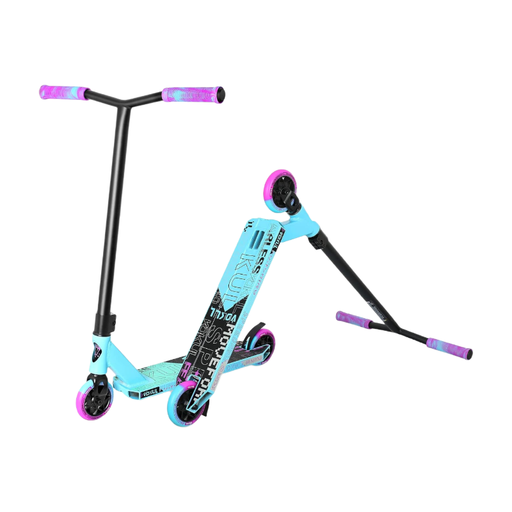
Why This Fits Their Persona: A skate park scooter option for riders aged 8 and up who want a rigid freestyle setup for repeated trick sessions.
The product information clearly states a rigid suspension, non-slip deck, rear brake and maximum rider weight, helping buyers assess suitability before purchase.
Solid 110 mm polyurethane wheels, 145 mm soft grips, adjustable handlebar and mostly pre-assembled delivery.
The VOKUL K1 Pro arrives mostly assembled. Setup generally involves tightening the three-bolt clamp around the handlebar stem, but always follow the supplied instructions and check every fastener before riding.
For UK conditions, care is particularly important:
These steps help reduce avoidable wear, although no stunt scooter is maintenance-free. Bearings, wheels and grips are consumable components and may eventually need replacement according to use.
We have compiled a complete, real-time list of products that fully satisfy these strict selection criteria and UK safety regulations.
The listed K1 Pro variants are described for beginner and intermediate riders aged 8 and up. Its rigid construction, rear foot brake and mostly assembled format can suit someone learning basic scooter control and early tricks. Beginners should start on a dry, open surface before attempting ramps or more demanding moves.
It can be, provided the available height range suits the rider. The K1 Pro listings describe an adjustable T-bar, but dimensions vary between product pages and colour variants. Check the specific listing before ordering, particularly if the scooter is intended for a taller teen or adult.
Routine checks are simple but should be regular. Tighten loose bolts, inspect the brake and fork, check wheels for damage and keep the bearings dry. There is no fuel or battery cost, but replacement grips, wheels or bearings may eventually be required if the scooter is used frequently for tricks.