
24/7 Customer Support

Free returns

Same-day & Next-day Delivery

Quality Guaranteed

Unlock Your Welcome Offers: FREE Delivery | Up to 80% OFF | Free 30-day JoyPlus trial
Download the APP
Replacing your car's standard halogen bulbs can feel like a simple job, but it often comes with unexpected frustrations. You might be tired of the dim, yellowish glow from your interior lights or sidelights. Perhaps you have already tried an LED upgrade, only to be met with a persistent dashboard warning light or flickering bulbs.
This guide is designed to help you navigate the options for a W5W 501 LED bulb upgrade. We will outline the key features to look for, ensuring your new bulbs are not only brighter and more modern but also fully compatible with your vehicle's electrical system.
Making the right choice goes beyond just picking a bulb that fits. Here are a few crucial factors to consider before you buy, helping you achieve a clean, error-free installation.
Many modern cars use a Controller Area Network (CAN bus) system to monitor the vehicle's functions, including its light bulbs. Standard halogen bulbs have a specific electrical resistance; when you replace one with a low-power LED, the system can misinterpret it as a blown bulb, triggering a dashboard error message.
A T10 canbus LED bulb has a built-in resistor that mimics the load of a traditional bulb, communicating correctly with your car's computer. For owners of most vehicles made in the last 15-20 years, choosing a 'Canbus Error Free' bulb is essential to avoid these issues.
The look and performance of your new bulbs are defined by two key measurements:
The W5W bulb, also known by its interchangeable codes T10, 501 and 194, is one of the most common 12v LED bulbs for cars. Its compact, wedge-base design means it is used in a wide variety of applications, including:
Always check your vehicle's owner's manual to confirm the fitment before purchasing, but the versatility of the W5W makes it a useful bulb to have on hand for any car enthusiast.
Here are our recommendations, selected to meet the needs of UK drivers looking for reliable and effective lighting upgrades.
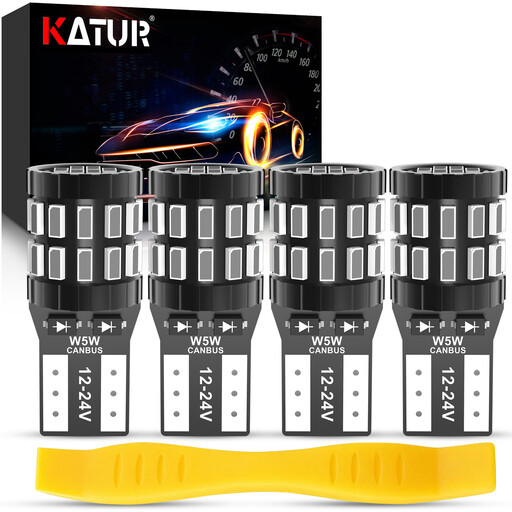
Why It Stands Out: These bulbs offer a vibrant, deep blue light, perfect for customising your car's interior. Each bulb is packed with 30 high-power 3014 LED chips, ensuring a bright and consistent 360-degree light output. The built-in Canbus support and wide 12-24V operating voltage make them a straightforward, plug-and-play option for a wide range of vehicles.
Pros:
Who is it for? This is for the car owner who wants to add a distinctive, decorative touch to their vehicle's interior, such as in the footwells or as courtesy lights. Note that blue light is not road-legal for exterior use in the UK.
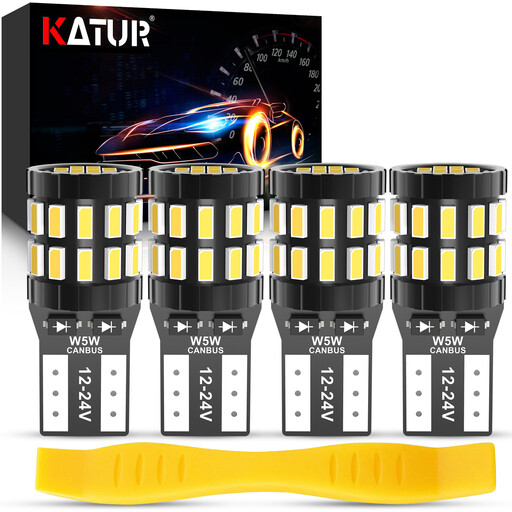
Why It Stands Out: Offering a powerful 450 lumens of brightness, this bulb is a significant upgrade over stock halogens. The xenon white 6500k colour temperature provides a clean, modern light that enhances visibility. It uses the same reliable design as its blue counterpart, featuring 30 LED chips and Canbus compatibility for a hassle-free experience.
Pros:
Who is it for? Ideal for drivers seeking a substantial and functional upgrade. Its brightness and colour make it a great choice for exterior applications like number plates and sidelights, as well as for brightly illuminating car interiors.
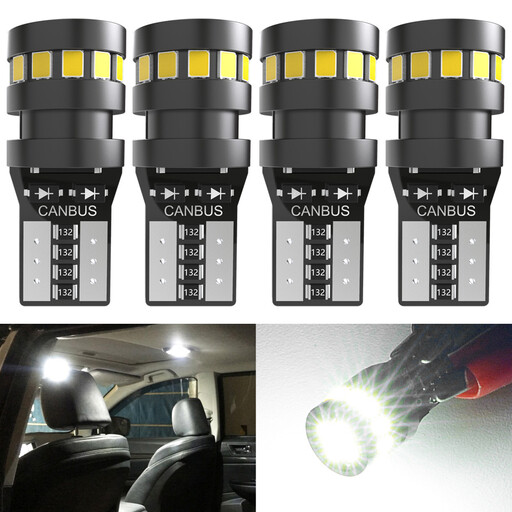
Why It Stands Out: This bulb is engineered with longevity in mind. Its full aluminium body is designed for rapid heat dissipation, which helps protect the LED chips and prolongs the bulb's lifespan. The manufacturer states it is error-free on 99% of vehicles, making it a very reliable choice for modern cars with sensitive Canbus systems.
Pros:
Who is it for? This is an excellent option for the DIY enthusiast who wants a 'fit and forget' solution. Its robust build and reliable Canbus performance are perfect for anyone who wants to avoid troubleshooting on a modern vehicle.
Upgrading your car's lighting, especially courtesy lights, often goes hand-in-hand with other enhancements. If you are looking for components related to your car's entry system, you can explore our range of parts for vehicle doors to continue your project.
Yes. These are all different codes for the same type of small, wedge-base bulb. If your car's manual specifies a T10, 501 or 194 bulb, a W5W 501 LED bulb will fit correctly.
This is almost always due to a compatibility issue with your car's Canbus system. The low power draw of an LED is detected as a fault. To prevent this, you must use a T10 canbus LED bulb, which has a built-in resistor to communicate properly with the car's computer.
It depends on the application. For the exterior of your vehicle, the law is very strict. Front sidelights must be white, rear lights must be red and indicators must be amber. A white number plate light bulb is also mandatory. Using blue, green or other colours on the exterior is illegal and will result in an MOT failure. However, coloured bulbs can be used legally for interior decorative lighting, such as in footwells or for map lights.