
24/7 Customer Support

Free returns

Same-day & Next-day Delivery

Quality Guaranteed

Unlock Your Welcome Offers: FREE Delivery | Up to 80% OFF | Free 30-day JoyPlus trial
Download the APP
Categories
Upgrading your car's lighting from the standard, yellowish halogen bulbs to modern LEDs can transform its appearance and improve visibility. However, for many UK drivers, this simple modification can trigger a frustrating dashboard warning light. This is where a W5W LED bulb canbus comes in. If you're tired of dim interior lights or want a crisp, modern look for your license plate without causing computer errors, you're in the right place.
As the Joybuy Product Recommendation Officer, my role is to help you navigate the options. This guide will explain the key features to look for and present a selection of reliable W5W Canbus bulbs that offer a straightforward, error-free upgrade for your vehicle.
Choosing the right bulb involves more than just picking the brightest one. Here are a few practical points to consider to ensure you get a compatible and effective upgrade.
Many modern vehicles use a Controller Area Network (Canbus) system to monitor the car's functions, including the lighting. Standard LED bulbs consume far less power than halogen bulbs. This low power draw can make the Canbus system think a bulb has failed, resulting in a "bulb out" error on your dashboard.
A W5W LED bulb canbus has a built-in resistor that reports the correct power consumption to the vehicle's computer, preventing these false errors. It's a crucial feature for a hassle-free installation on most European cars manufactured in the last 15-20 years.
The W5W bulb is one of the most common types used in vehicles, but it goes by many names. You will often see it referred to as a T10 LED bulb, 194 LED bulb, 168 car bulb or 501 led. These codes all refer to the same T10 wedge-style base. These bulbs are widely used for:
Before purchasing, it's always a good idea to check your vehicle's owner's manual or remove the existing bulb to confirm the fitment code. It might also be listed as a 2825 replacement bulb.
One of the main reasons for upgrading is to achieve a cleaner, more premium look. Colour temperature, measured in Kelvin (K), determines the shade of white light. Halogen bulbs are typically around 3200K, giving them a warm, yellow hue. Most automotive LEDs aim for a 6500K xenon white colour, which is a crisp, bright white with a slight blue tint, mimicking the look of high-end vehicle lighting.
Brightness is measured in lumens (LM). A quality 12v led bulb will be significantly brighter than its halogen equivalent, improving visibility inside the cabin or making your license plate clearer at night.
Here are our recommendations for W5W Canbus LED bulbs that balance brightness, reliability and compatibility.

Why It Stands Out: This bulb from OUSHI delivers a substantial brightness increase, rated at 300 lumens per bulb. Its design features 18 individual chipsets arranged for 360-degree light distribution, which helps to eliminate the dark spots often seen with lesser-quality LED replacements. The full aluminium body is a practical feature that aids in heat dissipation, contributing to a longer operational life.
Pros:
Who is it for? This is an excellent all-round choice for drivers wanting a significant and noticeable brightness upgrade for their car interior lights or license plate, combined with a crisp, modern colour.
View Product Details on Joybuy.co.uk
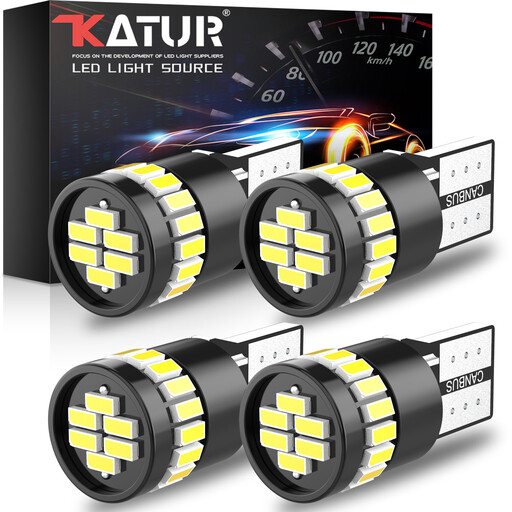
Why It Stands Out: The KATUR 194 bulb is notable for its 1:1 mini design, which means it has nearly the same dimensions as a standard halogen T10 bulb. This is particularly useful for installations in tight spaces where larger, more complex LED bulbs might not fit. The 6000K colour temperature offers a pure white light that is bright without being overly blue.
Pros:
Who is it for? Ideal for vehicle owners concerned about fitment in compact light housings. It's a reliable choice for those who prefer a pure white light over the slightly cooler 6500K xenon white.
View Product Details on Joybuy.co.uk
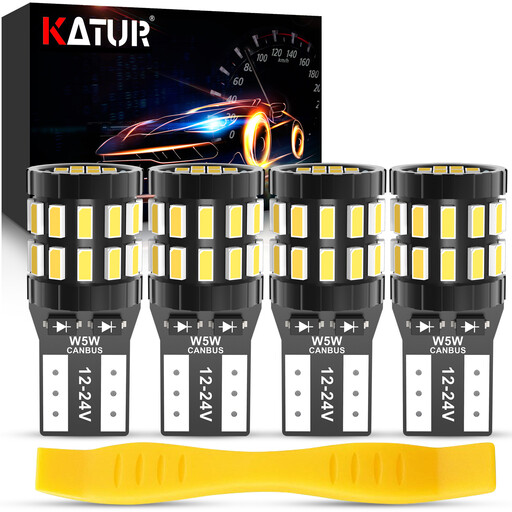
Why It Stands Out: For those who prioritise maximum light output, this KATUR bulb is a strong contender. It packs 30 high-power 3014 LED chipsets to produce an impressive 450 lumens per bulb. Another key feature is its wide operating voltage of 12-24V, making it suitable not only for cars but also for some lorries, motorhomes or boats without needing a different bulb.
Pros:
Who is it for? This bulb is for the DIY enthusiast who wants the highest possible brightness from a T10 LED bulb. It's particularly effective for larger interior spaces, boot lights or as a reversing light upgrade on vehicles that use this fitment.
View Product Details on Joybuy.co.uk
While these recommendations cover some of the most common needs, every vehicle is different. If you're looking for a different colour temperature, brightness level or a bulb for another part of your car, there are many other solutions available.
Explore our full range of Auto lighting canbus products to find the perfect match for your specific requirements.
Yes. The terms W5W, T10 LED bulb, 194 and 168 car bulb are often used interchangeably for the same wedge-base bulb. They share the same physical socket, making them cross-compatible in most cases. However, checking your owner's manual is always the most reliable way to confirm fitment.
'Canbus error free' indicates that the LED bulb has an integrated circuit or resistor. This component is designed to mimic the electrical resistance of a traditional halogen bulb. It prevents your car's computerised monitoring system (Canbus) from misinterpreting the LED's low power draw as a fault and displaying a "bulb out" warning on your dashboard.
No. W5W/T10 bulbs are small, low-power bulbs designed for auxiliary functions. They are perfect for car interior lights, a license plate light, parking lights or side markers. They do not produce nearly enough focused light to be used safely or legally as main or dipped beam headlights.