
24/7 Customer Support

Free returns

Same-day & Next-day Delivery

Quality Guaranteed

Unlock Your Welcome Offers: FREE Delivery | Up to 80% OFF | Free 30-day JoyPlus trial
Download the APP
Tired of that dim, yellowish glow from your car’s standard halogen bulbs? Whether it’s for your sidelights, number plate or interior cabin, a simple bulb swap can transform your vehicle’s appearance and improve visibility. However, the world of automotive lighting can be confusing, especially with modern cars that can throw up dashboard errors at the slightest change.
As the Joybuy Product Recommendation Officer, my role is to help you navigate these choices. This guide cuts through the technical jargon to help you find a reliable W5W LED bulb that fits your car and your needs without the guesswork. We'll look at what makes a good bulb and highlight a few options that stand out for their performance and compatibility.
Before you buy, a few key details can make all the difference between a simple upgrade and a frustrating afternoon.
You will often see several codes used for the same type of small, wedge-based bulb. W5W, T10 LED bulb and 501 LED bulb generally refer to the same physical fitment. Other common codes for this size include 194 LED and 168 bulb. While they are usually interchangeable, it's always a good practice to double-check your vehicle's owner's manual to confirm the exact fitment required for your specific application, be it for sidelight bulbs or interior map lights.
Many cars sold in the UK over the last 15 years use a Controller Area Network (CAN bus) system to monitor the vehicle's electronics, including the light bulbs. Because LED bulbs use significantly less power than old halogen bulbs, the system can mistakenly think a bulb has blown and trigger a "bulb out" warning on your dashboard. A canbus error free bulb has a built-in resistor that mimics the power draw of a standard bulb, preventing these annoying and misleading errors. For a hassle-free upgrade, this feature is highly recommended.
The two most popular colour choices are xenon white and amber. A crisp xenon white (usually around 6000K-6500K) provides a clean, modern look that is ideal for a number plate light, boot light or car interior lights. Amber is typically used for side indicators. All these bulbs are designed for a standard 12v led car electrical system. Brightness is measured in lumens (LM); a higher lumen count means a brighter light output.
Here are a few carefully selected options that offer a great combination of brightness, reliability and modern features.
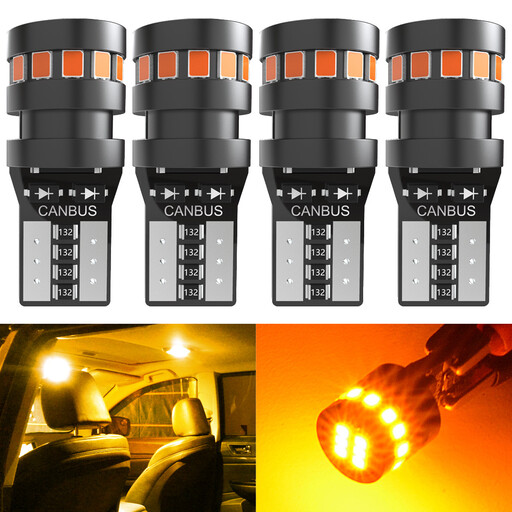
Why It Stands Out: This bulb is an excellent choice for applications requiring a specific amber/yellow colour, such as side repeaters or front indicators on some vehicles. Each bulb features 18 individual chipsets arranged for 360-degree light distribution, ensuring there are no dark spots. The full aluminium body aids in heat dissipation, which is crucial for longevity.
Pros:
Who is it for? This is for the driver who needs to replace or upgrade their indicator or marker lights with a bright, reliable amber LED that won't cause compatibility issues.
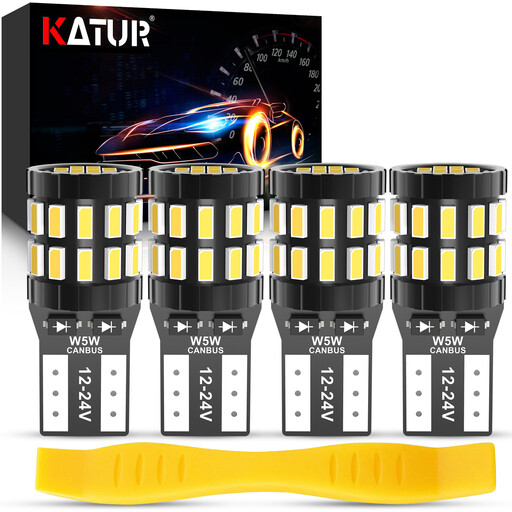
Why It Stands Out: If maximum brightness is your priority, this KATUR bulb is a strong contender. Packing 30 individual LED chipsets, it produces an impressive 450 lumens per bulb. The 6500K xenon white colour delivers that sharp, premium look, making it a significant upgrade for interior map lights, dome lights or number plate illumination.
Pros:
Who is it for? Ideal for car enthusiasts who want the brightest possible upgrade for their car interior lights or sidelight bulbs, providing a noticeable improvement in visibility and style.
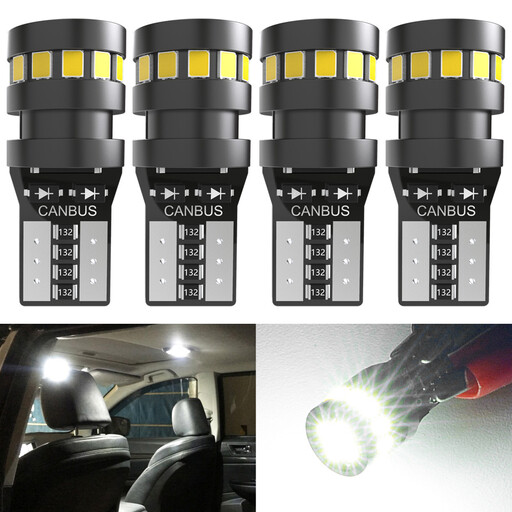
Why It Stands Out: This bulb offers a fantastic balance of performance and value. It provides a substantial brightness increase over halogen bulbs with a clean 6500K xenon white light, but in a slightly less intense package than the KATUR model. It shares the same reliable build quality as its amber counterpart, including the aluminium body and integrated Canbus circuitry.
Pros:
Who is it for? This is a great all-round choice for anyone looking for a straightforward and effective upgrade from dull halogen bulbs to a modern, white LED light without needing extreme brightness.
If these recommendations aren't quite what you need, or if you're planning other lighting enhancements, there is a wider selection available. Upgrading the small lights around your vehicle, such as those in the doors, can make a surprising difference to the overall feel and functionality of your car.
Explore our full range of Door lights and other automotive lighting solutions to find the perfect fit for your vehicle.
In most automotive applications, yes. These different codes all refer to the same T10 wedge-style base. If your car's manual specifies a W5W LED bulb, a T10 LED bulb or a 501 LED bulb, they are typically cross-compatible. However, it is always best to confirm with your manual before purchasing.
Your car's computer monitors the electrical circuits and expects to see the power consumption of a traditional halogen bulb. Since LEDs use far less power, the system may interpret this as a blown bulb. This often results in a 'bulb out' warning light on your dashboard. In some cars, the system may even cut power to the socket entirely. Choosing a canbus error free bulb is the simplest way to prevent this.
Yes, they are perfectly legal. UK law requires the rear number plate to be illuminated by white light to ensure it is clearly visible. A xenon white LED, which typically has a colour temperature of 6000K to 6500K, provides a clean white light that meets this requirement. Using blue, red or any other colour for your number plate light is not road legal and could fail an MOT.