For a shared kitchen, consider a compact waffle maker if cupboard space and one-person breakfasts matter most; look for overflow control or plates you can clean as instructed when washing-up causes friction. A two-waffle or interchangeable-plate machine makes more sense when housemates regularly eat together or use its other cooking functions, provided its dimensions, cleaning requirements and electrical suitability work for your kitchen.
Who needs what?
Flat sharers short on space
If the waffle maker has to leave the shared worktop after breakfast, check its stored dimensions and whether you can move it comfortably. A small cooking format may suit one-person breakfasts, but check its output if housemates often eat together.
Breakfast makers who want less washing-up
If spills or residue create work for the next kitchen user, compare overflow handling and the exact plate-cleaning instructions. Sage describes a batter moat on its No-Mess Waffle model, while Salter advises against sharp or abrasive utensils on its Deep Fill model’s non-stick surface.
Housemates cooking together
If two people usually want breakfast at the same time, check waffles produced per cycle. Salter describes dual plates for two waffles on its Deep Fill model; an interchangeable-plate machine may instead suit a household that regularly makes other snacks too.
What matters when choosing?
Start with the problem your shared kitchen encounters most often, then check whether the exact model’s size, plates and output address it.
| Concern | What to check | Who this matters to |
|---|
| Cleanup and spills |
Look for an overflow channel if batter spills are common, and check how the exact model’s plates must be cleaned. |
If batter spills leave work for the next person, I want cleanup to be manageable after breakfast; roughly 33% of consumers put spill control and cleaning first. |
| Storage space |
Measure the cupboard space and compare it with the appliance’s stored dimensions; allow space to open the lid when in use. |
When my shelf is already crowded, I need the waffle maker to fit back into it after breakfast; around 25% of consumers prioritise storage and worktop space. |
| Breakfast output |
Confirm the number of waffles made per cycle and compare the machine’s dimensions with the available worktop. |
If two housemates eat together, I would rather check portion output than assume a deep-fill label means two waffles; about 25% of consumers put shared breakfast output first. |
| Multiple uses |
Check which cooking plates are supplied and where any spare sets will be stored. |
If we regularly make toasties or paninis as well as waffles, I want one appliance to cover those uses; roughly 17% of consumers prioritise multiple uses. |
Mistakes to avoid
-
Choosing batch capacity without measuring the space
A machine that makes more waffles per cycle may still be awkward if it does not fit the cupboard or occupies a shared counter between uses. Lakeland lists substantially different dimensions for its compact 2-in-1 maker and larger No Mess model.
Measure the storage location and the space needed to open the lid. Base capacity on the number of people normally eating together.
A machine that cannot be put away takes up shared cupboard or worktop space.
-
Assuming non-stick plates can go in the dishwasher
Plate construction and cleaning instructions vary by model. Salter’s Deep Fill manual warns against sharp or abrasive items on its non-stick surface.
Check whether the exact model has fixed or removable plates, and follow its manual for washing and utensils.
-
Treating spare extension sockets as spare capacity
Electrical Safety First warns that plugging several appliances into an extension lead is not always safe, especially in a kitchen where water, hot surfaces and cables also need attention.
Keep the waffle maker on a dry, clear surface with its cable out of walkways. Check the appliance’s rating and instructions against the electrical supply and any extension arrangement before use.
-
Buying interchangeable plates for functions nobody uses
Other cooking modes are useful only if housemates will actually use them; changing plates also adds setup and washing-up.
Choose a multi-function machine when waffles and its other foods are regular plans, and account for storage of the spare plates.
Spare plates need storage space and may add cleaning between different foods.
Brands to consider for these formats
Sage
A dedicated waffle-maker option when batter overflow and browning control are priorities.
- Sage specifies a batter moat and seven browning settings for its GB No-Mess Waffle model.
- That model makes a single round waffle and does not provide interchangeable snack-making plates.
Salter
Deep-fill waffle makers and snack makers for households considering paired breakfasts or different cooking functions.
- Salter describes dual non-stick plates that cook two waffles at once on its Deep Fill waffle maker; some separate snack-maker models have interchangeable plates.
- Plate configuration and cleaning instructions need checking for the exact Salter model.
Breville
A choice between a dedicated deep-fill waffle maker and a snack maker with several plate sets.
- Breville describes deep-fill plates on the VST072 and waffle, toastie and panini plate sets on the VST098.
- The interchangeable-plate model requires plate changes; do not assume it makes the same waffle format as the dedicated model.
Lakeland
A compact waffle-and-pancake option alongside larger waffle-maker formats.
- Lakeland lists its compact 2-in-1 waffle and pancake maker at approximately 12.6 × 10.5 × 17.5 cm.
- Check the dimensions and waffle output of any larger Lakeland model separately before assigning it space in a shared cupboard.
Joybuy waffle maker choices
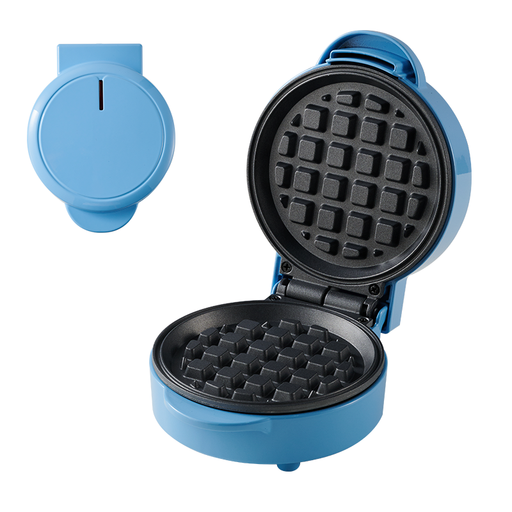
This mini waffle maker is a waffle-focused choice for shared-kitchen breakfasts. Measure the actual appliance before deciding whether it fits your storage space.
 No image available
ochama Mini Waffle Maker, non-stick, 550W
Consider this waffle-focused model for breakfast in a shared kitchen. Its product name specifies a non-stick finish, double-sided heating and a 550W rating; check its dimensions, waffles per cycle, cleaning instructions and UK electrical suitability before choosing it.
View on Joybuy
Frequently asked questions
Which waffle-maker feature matters most in a shared kitchen?
Choose the feature that addresses the kitchen’s recurring problem. An overflow channel matters if batter spills are common; the specified cleaning method matters if washing-up is the difficulty; and measured dimensions matter if cupboard space is tight.
Are removable waffle plates worth choosing?
Removable plates are worth considering if washing them separately would make cleanup easier, or if you regularly want other cooking functions. Check the exact model’s instructions rather than assuming removable or non-stick plates are dishwasher-safe.
Can I use a waffle maker on an extension lead?
Use an extension lead only if the arrangement is suitable for the waffle maker’s electrical rating and instructions. Electrical Safety First warns that spare sockets do not necessarily make it safe to plug in several appliances; keep the cable away from water and walkways too.
How should I clean and put away a waffle maker after breakfast?
Unplug it and let it cool before cleaning, then follow the exact model’s care instructions and put it away when dry. Avoid sharp or abrasive utensils on non-stick plates where the manual prohibits them, as Salter’s Deep Fill manual does.


