
24/7 Customer Support

Free returns

Same-day & Next-day Delivery

Quality Guaranteed

Unlock Your Welcome Offers: FREE Delivery | Up to 80% OFF | Free 30-day JoyPlus trial
Download the APP
A walking pad treadmill can make daily movement easier in a flat, home office or small bedroom. However, compact fitness equipment is often marketed with impressive motor ratings, “silent” operation and generous incline claims that do not always tell the full story.
Before choosing an under desk treadmill, check the details that affect everyday usability: the walking surface, actual speed range, storage dimensions, user weight limit and safety features. A low purchase price can become poor value if the belt feels cramped, the machine is difficult to move or the noise is disruptive during video calls.
Motor figures are not directly comparable across every listing. A claimed peak horsepower figure may not describe continuous operating performance. For walking and light jogging, look at the stated maximum speed, recommended user weight and intended use rather than relying on horsepower alone.
A treadmill designed for under-desk walking may be suitable at 1–6 km/h, while a model for walking and light jogging needs a suitable handrail, larger running area and a speed range that matches your routine.
Noise depends on the motor, belt, floor surface, footwear, user weight and speed. A product listing that states 45 dB provides a useful reference, but it is not a guarantee of the same result in every UK home.
A hard floor can amplify vibration, particularly in flats. A compatible treadmill mat may reduce movement and protect flooring, but check that it does not interfere with ventilation or belt alignment.
A walking pad may fit under a desk but still be awkward to lift or slide beneath a bed. Check the overall dimensions, machine weight and whether transport wheels are included. A folding walking pad or low-profile portable treadmill can be more practical where storage space is limited.
Also allow a clear area around the machine. One supplied product recommends a 1,000 × 2,000 mm barrier-free area behind the treadmill. Always follow the specific manual, keep children and pets away and use the safety key where provided.
A 40 × 100 cm running surface, as listed for one Lichico model, is compact and may suit controlled walking. Taller users or anyone planning light jogging may prefer a longer and wider belt. The supplied H100 model lists a 35.4 × 15.7-inch surface, equivalent to approximately 90 × 40 cm.
A narrow belt requires greater foot placement accuracy. For desk use at a slower pace this may be acceptable, but a larger surface generally gives more room for natural movement. Consider your height, stride length and whether you will use the treadmill while looking at a screen.
For desk walking, a range beginning around 1 km/h and reaching 6 km/h may be sufficient. If you want more demanding walking or light jogging, check whether the model includes a handrail and whether the top speed supports that use.
Incline can increase workout intensity, but marketing descriptions are not always consistent. For example, the second supplied product is described in its title as reaching 15% incline, while its detailed description states 10% manual incline. Confirm the specification on the product page before purchase.
An automatic incline, such as the 9% auto incline listed for the Merach model, can be adjusted with a remote control. A manual incline may require stopping and changing the setting by hand. Remote control operation is convenient, but keep the controller secure and understand whether speed and incline are adjusted independently.
Do not use the maximum load as a target. Leave a sensible margin between your body weight and the listed capacity, especially if you plan to jog. Several supplied models state capacities of 120 kg or 130 kg, while the H100 listing states 300 lb, approximately 136 kg.
A shock-absorbing treadmill may use layered belts, silicone absorbers or rubber pads. These features can make walking feel less harsh, but they do not remove all impact or replace suitable footwear. Look for a non-slip belt, stable handrail where needed, emergency stop or safety key and clear instructions for lubrication and belt alignment.
For UK use, check the product documentation, plug and electrical information, warranty terms and any relevant conformity marking supplied with the product. Product markings should not be treated as a substitute for following the user manual.
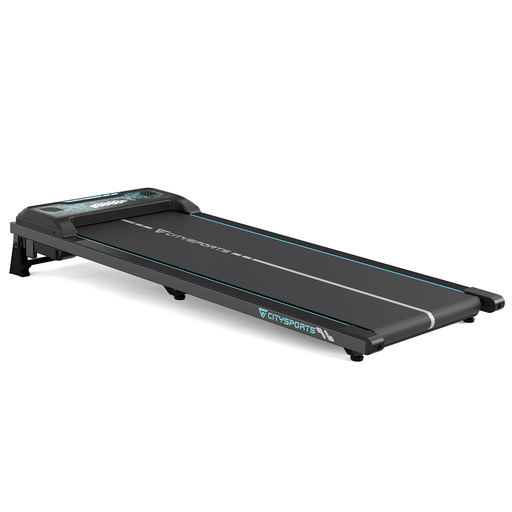
Why This Fits Their Persona: A straightforward option for beginners, remote workers and flat residents who mainly want indoor walking without assembling a full-sized treadmill.
The listing clearly states a 1–6 km/h range, 120 kg maximum capacity, remote control and no-assembly setup, making its intended walking use easier to assess.
Slim design with transport wheels; LED display shows time, speed, distance and calories.
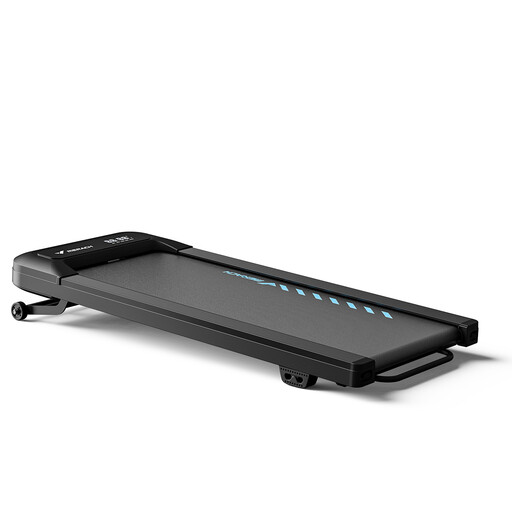
Why This Fits Their Persona: Suitable for users wanting incline control, app connectivity and several walking modes in a home office or compact flat.
Its listing specifies a 9% automatic incline, five-layer belt, cushioning components and a stated operating noise level under 45 dB.
1–6 km/h speed range; MERACH app compatibility and remote-control incline adjustment.
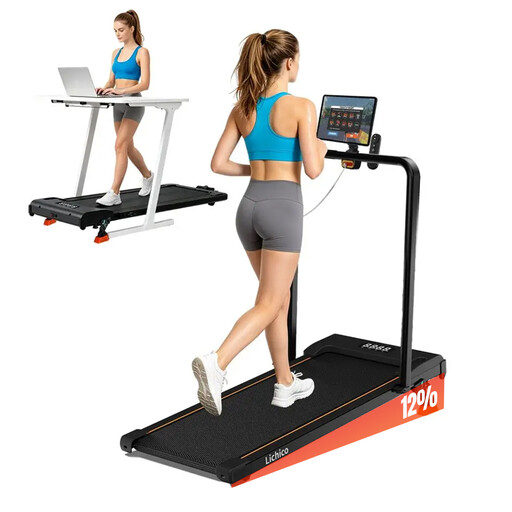
Why This Fits Their Persona: A practical match for users prioritising a stated 130 kg load capacity and incline options for regular home walking.
The listing gives a specific 40 × 100 cm running surface and 130 kg maximum load, rather than relying only on broad compact-treadmill wording.
0–9% incline range as listed; smart app and remote-control functionality.
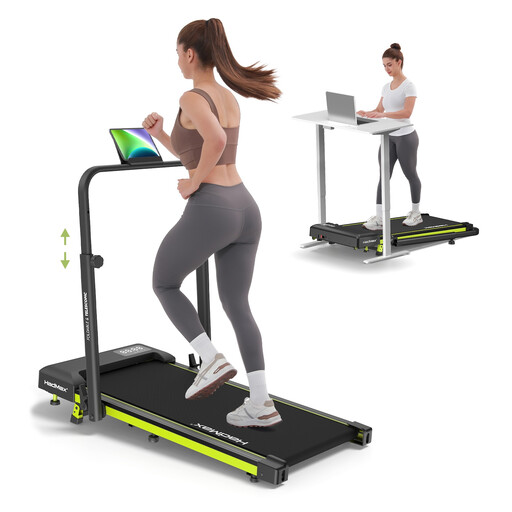
Why This Fits Their Persona: The adjustable handrail and tablet holder may suit users who want extra balance and a more structured walking routine at home.
The listing identifies a seven-layer belt, six silicone shock absorbers, a 45 dB motor claim and two handrail height settings. Check the incline specification before ordering because the listing contains differing incline figures.
Folding handrail; stated 300 lb capacity and 12 built-in programmes.
We have compiled a complete, real-time list of products that fully satisfy these strict selection criteria and UK safety regulations.
Place the machine on a firm, level surface with clearance behind and around it. A standing desk should be high enough to prevent leaning forward, and cables must be kept away from the moving belt. Start at a slow speed before increasing it.
Electricity cost depends on motor load, session length and your tariff. The basic calculation is:
Power in kW × hours used × electricity price per kWh = approximate running cost
The wattage shown on the rating plate or in the manual is more useful for estimating cost than the advertised horsepower. Incline, heavier users and faster speeds may increase energy consumption.
Many walking pads are designed primarily for walking. A model with a handrail, wider running surface and a stated speed suitable for light jogging may be more appropriate for occasional faster exercise. Check the manual and never exceed the recommended speed or user capacity.
Lifespan depends on frequency of use, user weight, belt tension, lubrication and storage conditions. Wipe the belt regularly, inspect alignment, check the power cable and lubricate it according to the manufacturer’s instructions. Grinding or squeaking should be investigated rather than ignored.
Check the manual first. Carpet can restrict ventilation and may affect stability or belt movement. A firm, level surface is generally preferable. If using a mat, ensure the treadmill remains stable and that airflow openings are not covered.