
24/7 Customer Support

Free returns

Same-day & Next-day Delivery

Quality Guaranteed

Unlock Your Welcome Offers: FREE Delivery | Up to 80% OFF | Free 30-day JoyPlus trial
Download the APP
As a Joybuy Product Recommendation Officer, my role is to help you navigate the crowded market of home fitness equipment. The rise of the walking pad has been a game-changer for many of us in the UK, especially those working from home or living in compact city flats. It promises a simple way to stay active without sacrificing space or time.
However, the surge in popularity has also led to a flood of options, many with marketing claims that don't hold up to real-world use. Before you invest, it's crucial to understand the common pitfalls that can lead to disappointment and a wasted purchase. This guide will walk you through what really matters.
Nearly every listing for an under desk treadmill claims it's "quiet". But what does that actually mean? A motor that sounds quiet in a showroom can be a disruptive hum in a silent home office or a flat with thin walls. Many manufacturers avoid listing a specific noise rating, leaving you to guess. A machine that's too loud will quickly become an expensive clothes rack.
A walking pad might look small in photos, but its practicality comes down to more than just its length and width. A "compact" model that weighs over 30 kg and lacks transport wheels is anything but convenient. You'll struggle to slide it under a sofa or move it between rooms, defeating the purpose of a portable treadmill. The ease of storage is just as important as the small footprint.
To hit a low price point, some models compromise on build quality. A low maximum user weight (e.g., under 100 kg) can be a red flag, suggesting a less robust frame that may wobble or creak under regular use. Likewise, an underpowered motor will not only struggle to provide a smooth walking experience but is also more likely to burn out, significantly shortening the lifespan of your investment.
To avoid these traps, focus on a few key specifications. These objective numbers cut through the marketing hype and tell you what you can truly expect from a folding walking pad.
This is the single most important factor for anyone planning to use their walking pad in a shared living or working space. Look for a specific decibel rating in the product specifications.
A truly quiet treadmill for office use will proudly display its low dB rating. If it's not listed, proceed with caution.
For a treadmill for small spaces, portability is key. Always check these three figures:
These two specifications are direct indicators of the machine's durability and performance.
Considering a walking pad with incline? This feature adds intensity to your workout but also puts more strain on the motor. Ensure any incline model you consider has a robust motor to handle the extra load.
Based on these practical criteria, here are a few options from our catalogue, matched to different user needs and living situations.
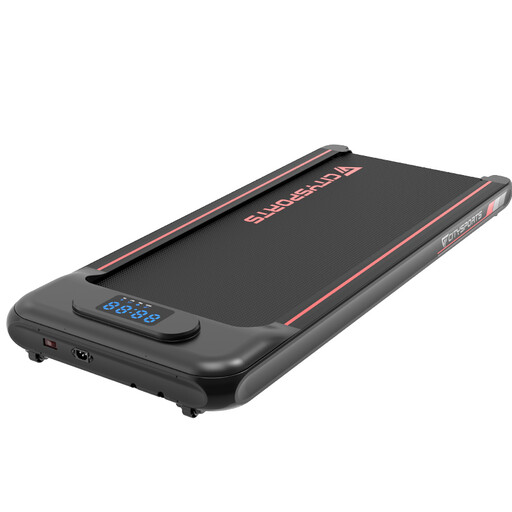
Why This Fits Their Persona: This is an ideal entry point for anyone wanting to try an under-desk treadmill without a large financial commitment. It offers all the core functionality needed to increase daily steps while working, with simple remote-control operation and no complex setup.
It addresses the "compact illusion" by being genuinely portable. At approx. 20 kg and equipped with transport wheels, it's manageable for one person to move and store. The 550W motor is sufficient for its 1-6 km/h walking speed range.
Ready to use straight out of the box with no assembly required. Its 5-layer shock-absorbing belt provides good cushioning for joints, a feature not always present at this price point.
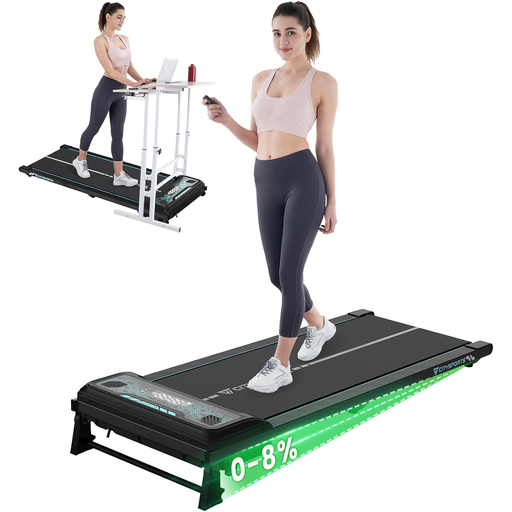
Why This Fits Their Persona: Perfect for those in flats or shared houses where noise and space are primary concerns. Its ultra-low noise level and slim profile (12.1 cm height) make it an unobtrusive addition to any room, easily stored under furniture.
It directly counters the "whisper-quiet" myth with a verifiable specification: a noise level below 45 dB. This is exceptionally quiet and suitable for almost any indoor environment without causing a disturbance.
The manual 6% incline setting adds significant workout versatility without adding bulk. It also has a high maximum user weight of 120 kg, indicating a sturdy frame despite its compact size.
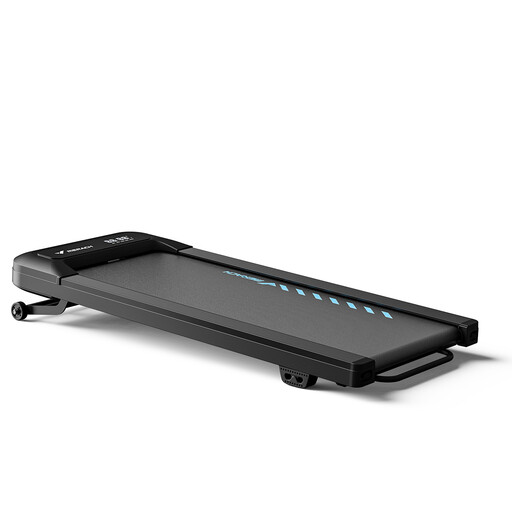
Why This Fits Their Persona: For those who want more than a simple walk. The automatic incline, controlled by remote, allows for varied and challenging workouts that target different muscle groups and increase calorie burn, mimicking a true hill walk.
It avoids the "flimsy frame" trap with a powerful 2.5 HP motor and robust alloy steel construction. This ensures it can handle the added strain of the incline function and consistent use without faltering, providing a smooth and stable experience.
The 9% auto incline is a premium feature that offers remote-controlled workout adjustments. It also features app connectivity for tracking progress and remains quiet at under 45 dB.
We have compiled a complete, real-time list of products that fully satisfy these strict selection criteria and UK safety regulations.
The running cost is surprisingly low. A typical walking pad with a 500W (0.5kW) motor, used for one hour, would consume 0.5 kilowatt-hours (kWh) of electricity. Based on average UK electricity prices, this translates to just a few pence per hour of use, making it a very cost-effective way to stay active.
A walking pad can be an effective tool for weight management when combined with a balanced diet. By helping you increase your daily step count and overall energy expenditure, it contributes to creating the calorie deficit needed for weight loss. It's an excellent way to combat a sedentary lifestyle and burn extra calories without scheduling a separate gym session.
The lifespan of a walking pad depends heavily on its build quality and how it's maintained. A model with a robust frame (indicated by a high user weight capacity) and a powerful motor (e.g., 2.0 HP or higher) is built for greater longevity. Regular maintenance, such as keeping the belt clean and lubricated according to the manufacturer's instructions, can significantly extend its life to several years of consistent use.