
24/7 Customer Support

Free returns

Same-day & Next-day Delivery

Quality Guaranteed

Unlock Your Welcome Offers: FREE Delivery | Up to 80% OFF | Free 30-day JoyPlus trial
Download the APP
Integrating more movement into a sedentary day is a common goal, and a walking pad seems like the perfect solution. However, the market is filled with models that promise much but deliver little. Adding an incline feature complicates the choice, with many buyers discovering their new purchase gathers dust due to a few critical, often overlooked, design flaws.
As a Joybuy Product Recommendation Officer, my role is to help you see past the marketing jargon. Before you invest, let's look at the common pitfalls that can turn a promising fitness tool into a piece of clutter.
compact treadmill with a small footprint, some designs compromise on frame rigidity and deck size. A low maximum user weight is often a red flag for a less robust build, leading to a wobbly, unnerving experience and a significantly shorter product lifespan.To ensure your investment pays off in daily steps, focus on these non-negotiable specifications. They are the true indicators of a quality walking pad with incline.
This is the single most important feature to verify.
walking pad with remote control or an app while you are walking. This feature transforms your session, enabling you to simulate hills and perform interval training for a much more effective workout.The motor is the heart of your walking pad. Look for a brushless motor, as they are generally more durable and produce less noise and friction than their brushed counterparts. For a quiet walking pad for office use or in a flat, aim for a machine with a stated operating noise level of under 50dB. This is roughly the sound of a quiet conversation, ensuring you won't disturb colleagues or family. The motor's horsepower (HP) should also align with your needs; 2.0HP or more is a good starting point for consistent daily use.
A product's durability is often revealed in its maximum user weight. A higher weight capacity (e.g., 120 kg or more) typically indicates a stronger, more stable frame. Also, check the dimensions of the walking belt. While a folding walking pad is excellent for storage, a belt that is too narrow or short can feel restrictive and unsafe. Finally, look for models with multi-layer cushioning or shock absorption systems. These are crucial for reducing the impact on your knees and joints, making for a more comfortable and sustainable exercise habit.
Based on these practical criteria, we've matched several models to different user needs.
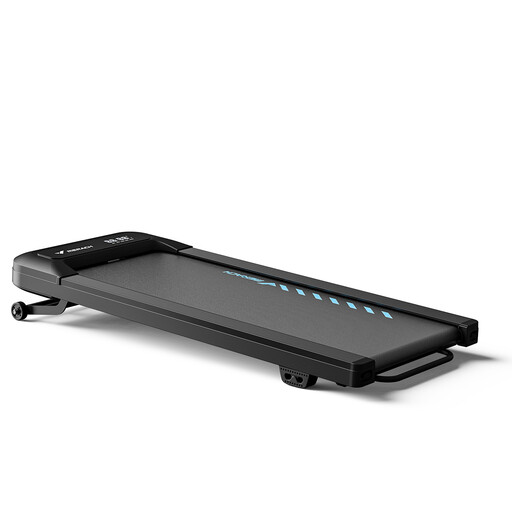
Why This Fits Their Persona: This user wants to do more than just walk; they want a proper workout. The app connectivity and varied modes provide structure, while the auto incline offers the challenge needed to see real fitness progress at home.
It features a true 9% auto incline, adjustable via remote control during the workout. This completely bypasses the inconvenience of manual adjustments, making the incline feature genuinely useful.
The combination of a quiet 2.5HP motor (under 45dB) and a dual shock absorption system provides a smooth, joint-friendly and effective workout experience without disturbing others.
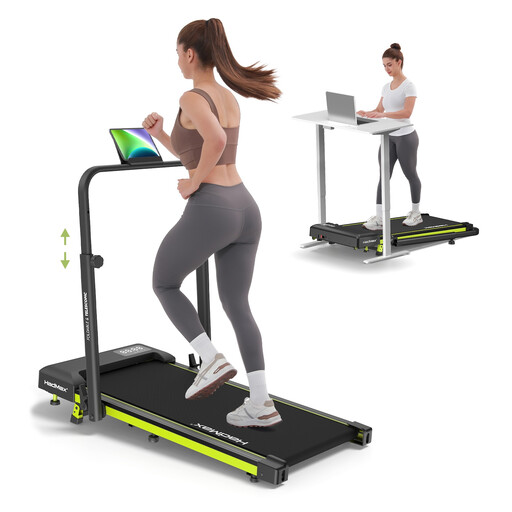
Why This Fits Their Persona: Ideal for older adults, those new to exercise or anyone prioritising safety. The adjustable handrail provides crucial support and balance, making it a much safer option than a standard handle-free walking pad.
This model directly counters the instability trap. Its adjustable safety handrail and high 300 lbs (approx. 136 kg) weight capacity point to a robust frame built for stability, not just compactness.
It is a true treadmill with handles for home use that remains portable. The handrail folds down for storage, offering the best of both worlds: safety during use and convenience when stored.
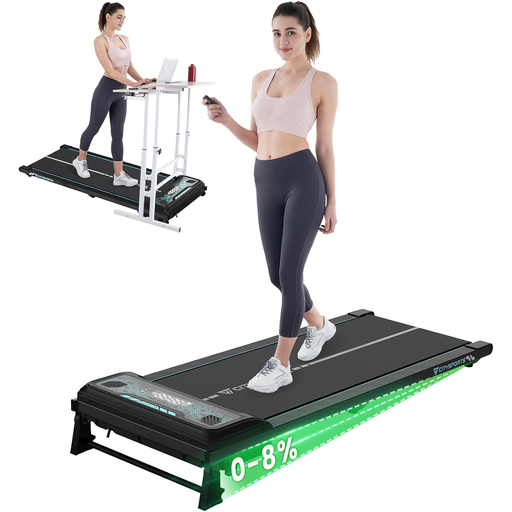
Why This Fits Their Persona: This user needs a machine that fits seamlessly into their life. It must be quiet enough for use during calls, compact enough to store in a small flat and ready to go without complex setup. This model is a practical `under desk treadmill with incline`.
It tackles the noise issue head-on with a motor that operates at under 45dB. This is a realistic, verifiable metric that makes it genuinely suitable for an office or shared living space without causing disruption.
This is a true `portable treadmill for home` use. It arrives fully assembled and features built-in wheels, making it effortless to move and store under a sofa or bed after your workout.
We have compiled a complete, real-time list of products that fully satisfy these strict selection criteria and UK safety regulations.
Yes, but with consideration. Choose a model with a good shock absorption system and a stated noise level below 50dB. To further minimise vibration and noise transfer to your neighbours below, placing the machine on a high-density rubber equipment mat is highly recommended.
The main differences are size, speed and features. Walking pads are designed to be a compact treadmill with a small footprint, focusing on walking and light jogging speeds (typically up to 6-8 km/h). They are smaller, lighter and often lack the large console and handrails of a traditional treadmill. Full-size treadmills are built for running, offer higher speeds and are much larger and heavier.
A walking pad is generally energy-efficient. A typical model with a 2.5HP motor running for one hour will consume approximately 0.75 kilowatt-hours (kWh) of electricity. Based on current UK energy prices, this translates to a very low running cost per workout, making it an economical way to stay active indoors.