
24/7 Customer Support

Free returns

Same-day & Next-day Delivery

Quality Guaranteed

Unlock Your Welcome Offers: FREE Delivery | Up to 80% OFF | Free 30-day JoyPlus trial
Download the APP
As our homes increasingly double as our offices, the battle against paper clutter is constant. From household bills and school notices to important work documents, loose papers can quickly overwhelm a desk, kitchen counter or entryway. A quality wall file organiser promises a simple, space-saving solution.
However, the market is filled with options that look appealing online but fail in practice. Before you buy, it's crucial to understand the common pitfalls that lead to disappointment and a wasted purchase. As a Joybuy Product Recommendation Officer, my role is to help you see past the marketing and focus on what truly matters for a functional and lasting organisation system.
Many organisers end up being more frustrating than helpful. Watch out for these three common design flaws that often aren't obvious until you've already mounted the unit on your wall:
To ensure you choose a durable and practical office wall organiser, focus on these key parameters. They are the difference between a short-term fix and a long-term solution.
The longevity of your organiser depends almost entirely on its material. Look for units constructed from high-quality, sturdy metal rather than thin, pliable sheet metal. The finish is equally important. A powder-coated finish is a significant indicator of quality. This type of finish is applied as a dry powder and then cured with heat, creating a hard, durable layer that is far more resistant to chipping, scratching and rust than conventional liquid paint. It ensures your hanging file organiser maintains its appearance and integrity for years.
Before browsing, measure the wall space you have available. A tall, vertical document holder can make excellent use of a narrow patch of wall. However, the most critical measurement is the internal width of each slot.
For an A4 paper sorter to be truly functional, the internal width should be significantly wider than the 210mm width of an A4 sheet. Look for a width of at least 310mm (around 31.5cm). This provides ample room for standard cardboard folders, ring binders and plastic document wallets without bending or forcing them in. Also, consider the number of tiers you need. A home office managing multiple projects will require more tiers than a simple entryway mail sorter.
The best designs incorporate small details that enhance daily use. Integrated label plates on each tier are invaluable for creating a clear, organised system where you can find what you need at a glance. Check if the unit comes with the necessary mounting hardware (screws and wall plugs). Some versatile models also offer a dual-purpose design, allowing them to be used as a freestanding desktop unit or mounted on the wall, providing flexibility as your needs change.
Based on these practical criteria, we've identified several organisers that are well-suited to different needs and user profiles. Instead of a one-size-fits-all approach, this selection matches specific features to common UK household and office scenarios.
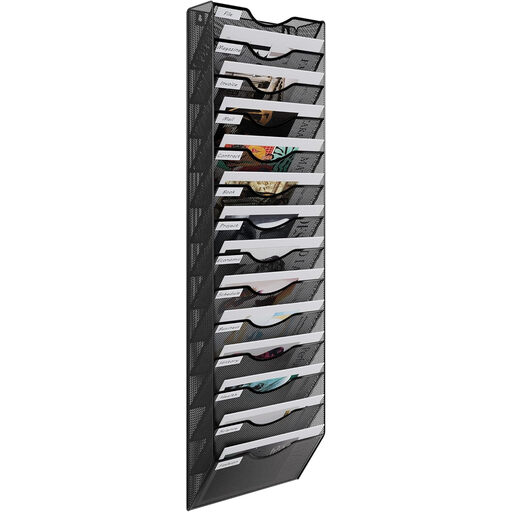
Why This Fits Their Persona: Ideal for professionals or small business owners who need to manage a high volume of paperwork. Its extensive vertical design is perfect for organising client files, invoices and project documents without consuming valuable desk space.
The robust metal construction and powder-coated finish directly counter the problem of flimsy, sagging tiers. With 14 separate slots, it provides the high capacity that less substantial organisers fail to deliver.
Massive 14-tier capacity for comprehensive sorting. Each tier includes an integrated label plate for clear categorisation.
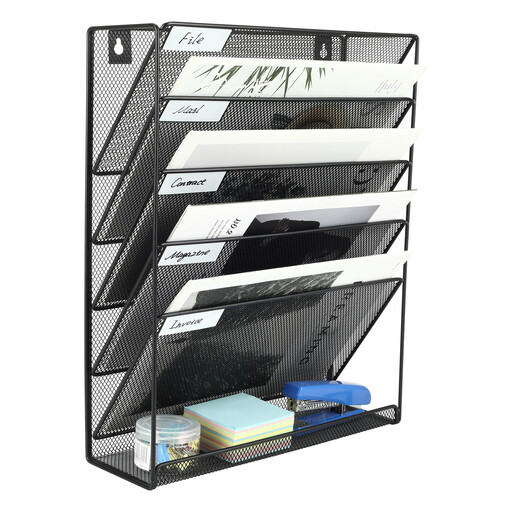
Why This Fits Their Persona: An excellent choice for managing the daily flow of household mail, bills and school paperwork. Its compact 6-tier design is large enough to be useful but small enough to fit neatly in a kitchen, hallway or study.
The generous 315mm internal width easily accommodates A4 folders, avoiding the common "too narrow" slot problem. Its powder-coated finish ensures it withstands the wear and tear of a busy family environment.
A great balance of capacity and compact size. The durable metal construction provides a reliable, long-term organisational hub for the home.
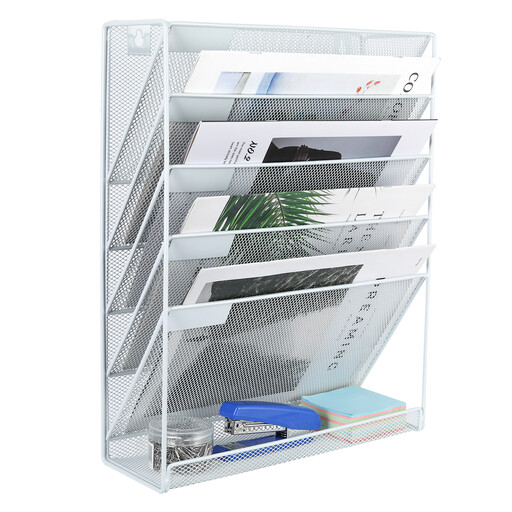
Why This Fits Their Persona: Perfect for those in smaller flats or with dynamic work setups. This organiser can be mounted to the wall to free up desk space or used as a freestanding unit, offering unmatched versatility. The bottom tray is a clever addition for pens and stationery.
Its dual-purpose design offers a level of adaptability that fixed, single-function organisers lack. The integrated tray and label plates add practical value, moving it beyond a simple paper holder to a complete organisational tool.
Dual-use design (wall-mounted or freestanding). Features a handy built-in bottom tray for small items like pens, keys and rulers.
This depends on two factors: the organiser's construction and the quality of the wall installation. A sturdy metal unit, when correctly fastened to a solid brick wall or into wooden studs within a plasterboard wall, can typically support several kilograms of paper and files. Always refer to the manufacturer's guidance and use the appropriate wall anchors for your wall type to ensure a secure fit.
This is largely a matter of personal preference and function. Mesh designs offer the advantage of visibility, allowing you to see the edges of documents for quicker identification. They also promote airflow, which can be beneficial in some environments. Solid metal designs may provide a sleeker, more uniform appearance and prevent very small items from slipping through. For either style, the most important factor is the gauge of the metal and the overall build quality.
Maintenance is straightforward. For regular dusting, a soft, dry microfibre cloth is all that is needed. To remove fingerprints or grime, use a cloth lightly dampened with water and a mild, non-abrasive detergent. Afterwards, wipe it completely dry. Avoid using harsh chemical cleaners or abrasive scouring pads, as these can damage the protective powder-coated surface.