
24/7 Customer Support

Free returns

Same-day & Next-day Delivery

Quality Guaranteed

Unlock Your Welcome Offers: FREE Delivery | Up to 80% OFF | Free 30-day JoyPlus trial
Download the APP
A cluttered hallway is a common sight in many UK homes. Piles of coats, scarves and bags by the door can make even a spacious entryway feel cramped and chaotic. A well-chosen wall mounted coat rack promises a simple, space-saving solution. However, the market is filled with options that look good online but fail to perform in a real-world setting.
As a Joybuy Product Recommendation Officer, my role is to help you see past the marketing and focus on what truly matters. Before you buy, be aware of these common pitfalls that lead to disappointment and wasted money.
heavy duty coat rack but are supplied with inadequate wall fixings or are made from materials that bend under the weight of a few winter jackets. This not only leads to a fallen rack but can also cause significant damage to your walls.rustic wall hook can lose its charm quickly. Poorly applied varnish or paint on a wooden coat rail can chip and peel from the daily friction of hanging and removing items, making your stylish investment look worn and shabby within months.entryway coat storage solution.To ensure your new coat rack is a lasting and functional addition to your home, focus on these three core parameters.
The material dictates the rack's strength and longevity. For a truly durable solution, look for options made from solid wood (such as rubberwood or maple) or high-quality metals like aluminium alloy. These materials offer far greater strength compared to cheaper particleboard or MDF, which can sag or break under load.
Always check the manufacturer's stated maximum load capacity. A capacity of 15-20 kg is suitable for lighter jackets and accessories, but for a family's worth of heavy winter coats, look for a rack rated for 30 kg (66 lbs) or more. This figure is your most reliable indicator of whether a product can genuinely function as a heavy duty coat rack.
The effectiveness of hallway hooks for coats comes down to their design. Look for hooks with sufficient depth and a defined curve or a dual-hook design to securely hold items without them slipping. Rounded or smooth edges are also important to prevent snagging or damaging delicate fabrics.
Pay attention to the spacing between hooks. A minimum of 10-15 cm between each hook is advisable to allow enough room for bulky items like padded jackets and backpacks to hang freely without being crammed together.
Even the strongest coat rack is only as secure as its mounting. A quality product should come with clear installation instructions. However, the supplied screws and wall plugs may not be suitable for all UK wall types. For plasterboard walls, which are common in modern homes, you will need to purchase specialist plasterboard anchors (like toggle bolts or self-drilling anchors) to ensure a secure fit. For maximum stability, the ideal method is to locate the wooden studs within the wall and fix the rack directly to them.
Here are a few options that address the common pitfalls by focusing on quality materials, practical design, and robust construction.

Why This Fits Their Persona: This is for someone who wants their entryway coat storage to be a decorative feature. The combination of shelves and hooks provides a versatile hub for coats, keys, mail and small decorative items, blending organisation with home styling.
It avoids the "finish flaw" by using FSC-certified solid rubberwood with a clear lacquer and powder-coated steel, materials chosen for durability. The guardrails on the shelves also prevent items from falling, addressing a common practical design flaw.
The 3-in-1 design offers two tiers of shelving plus 5 hooks, maximising vertical storage. According to the brand, it has won a 2023 New York Design Award for its metal-and-wood combination.

Why This Fits Their Persona: Ideal for a busy family home where function and durability are paramount. This is a no-nonsense wooden coat rail built to handle the daily onslaught of school bags, heavy winter coats and sports kits without complaint.
It directly counters the "heavy duty deception" with a clearly stated maximum load capacity of 66 lbs (30 kg). The construction from solid FSC-certified rubberwood and aluminium alloy hooks ensures it can withstand heavy, long-term use.
Its primary advantage is its exceptional strength-to-size ratio. The hooks feature rounded edges to protect clothing, and the varnish layer provides waterproof and rust-resistant properties, making it a reliable workhorse.
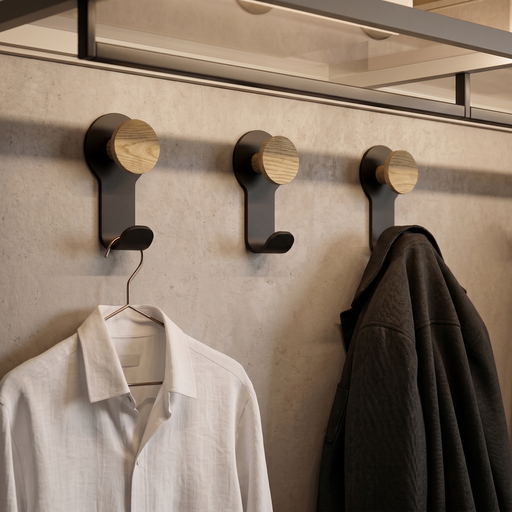
Why This Fits Their Persona: Perfect for renters or those with awkward spaces, like a narrow hallway, behind a door or in a small bedroom. This set of individual rustic wall hooks allows for a completely customisable layout to maximise storage in any area.
By being individual hooks, it completely solves the "impractical design" flaw of fixed-spacing racks. You decide how far apart to place them. The dual-hook design (wood and metal) also doubles the hanging potential of each point.
The key advantage is modularity. You can create a cluster, a straight line or a staggered pattern. Each hook is made from robust rubberwood and aluminium alloy, with a stated capacity of 11 lbs (5 kg) per dual hook.
We have compiled a complete, real-time list of products that fully satisfy these strict selection criteria and UK safety regulations.
A standard height for a wall mounted coat rack is approximately 1.5 metres (5 feet) from the floor to the hooks. This is comfortable for most adults. If you have young children, you might consider mounting it lower, at around 1-1.2 metres, or installing a second, lower rack for them to use.
Yes, but you must use the correct fixings. The standard wall plugs often included with products are not sufficient for plasterboard, especially for a rack intended to hold heavy items. You should use specialist plasterboard fixings, such as spring toggles, hollow wall anchors or heavy-duty self-drilling anchors. These are designed to spread the load across a wider area of the board. For the most secure installation, using a stud finder to locate and drill directly into the wooden studs behind the plasterboard is always the recommended method.
A solid wood coat hanger or rack is crafted from a single piece or multiple pieces of genuine timber, such as rubberwood, oak or pine. This provides excellent strength, durability and a natural aesthetic. A "wood-effect" rack is typically made from a composite material like MDF or particleboard, which is then covered with a thin layer of plastic laminate or wood veneer to mimic the appearance of real wood. While often more affordable, these materials are generally less durable, more susceptible to moisture damage and can be difficult to repair if chipped.