
24/7 Customer Support

Free returns

Same-day & Next-day Delivery

Quality Guaranteed

Unlock Your Welcome Offers: FREE Delivery | Up to 80% OFF | Free 30-day JoyPlus trial
Download the APP
A fixing that works in brick may fail in plasterboard, while a plasterboard anchor can be unsuitable for concrete. Choosing wall plugs and fixings by price, colour or pack size alone is a common way to waste money and damage a wall.
Three buying traps are particularly easy to overlook:
The practical approach is to identify the wall material, estimate the load and then match the fixing, drill size and screw specification.
Start by distinguishing between:
If you are unsure, tap the wall and drill a small exploratory hole in a safe location. A consistent solid resistance suggests masonry, while a thin surface followed by an empty space indicates a cavity. Always check for concealed cables and pipes before drilling.
The drill size is not interchangeable between products. For example:
Length matters too. The screw should pass through the item being mounted and engage the fixing sufficiently. For cavity anchors, check both the fixing length and the maximum fixture thickness.
A picture, curtain tie-back or smoke alarm places a different demand on the wall than a shelf, radiator, basin or wall cabinet. Consider:
For plumbing and bathroom work, use a purpose-designed kit where available. Basin fixings, for example, are made for the mounting arrangement of wash basins rather than general-purpose hanging.
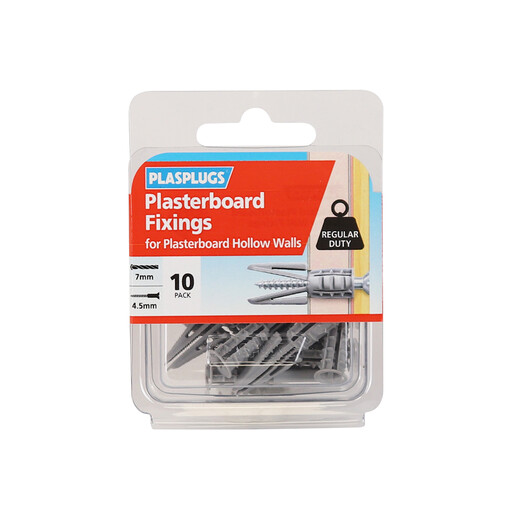
Why This Fits Their Persona: A straightforward option for occasional indoor jobs such as lightweight hooks, curtain tie-backs and smoke alarms in plasterboard.
The stated 7mm drill size and No. 8 screw compatibility help avoid guessing during installation.
Pack of 10; designed for general plasterboard use; suitable for lightweight applications.
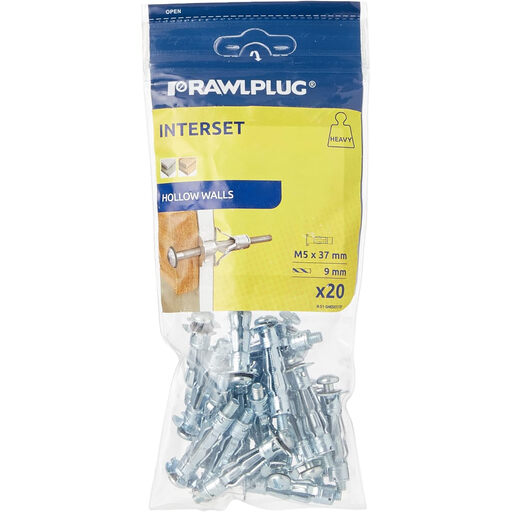
Why This Fits Their Persona: Suitable for planned installations on plasterboard, hardboard, plywood and soft-faced partition boards where a removable metal cavity fixing is useful.
Its stated M5 x 40mm size, 10mm drill requirement and 20mm fixing thickness provide clearer selection limits than vague load language.
Removable and reusable screw-and-fixture assembly; trade pack of 20; setting tool available for repetitive work.
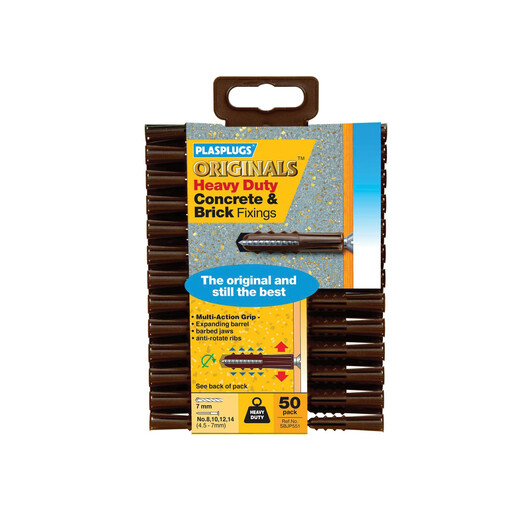
Why This Fits Their Persona: A practical bulk option for repeated work in brick, concrete, breeze block and stone, including shelves, brackets, curtain poles and mirrors.
The product specifies masonry substrates, a 7mm drill bit and No. 8–14 screw range instead of treating every wall as identical.
Multi-action grips, expanding barrels, barbed jaws and anti-rotate ribs; supplied as a pack of 50.
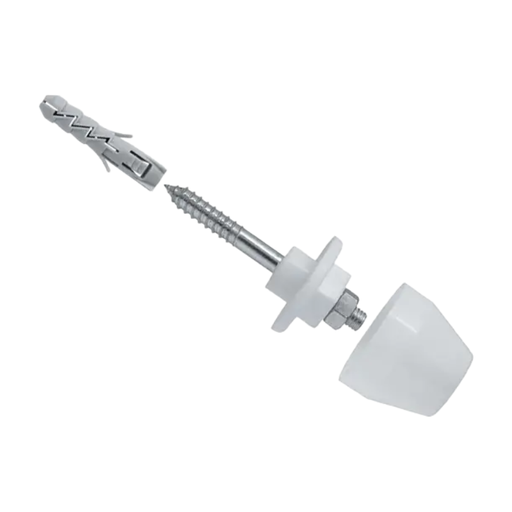
Why This Fits Their Persona: Designed for the mounting requirements of the majority of wash basins, making it more suitable than adapting general wall plugs for bathroom work.
It is a dedicated basin fixing kit, reducing the risk of using an unsuitable general-purpose plug for a sanitary fitting.
Purpose-designed for wash basin installation; suitable for the majority of wash basins.
For cavity walls and ceilings with low structural strength, spring toggle fixings can spread the load over a wider area. For lighter plasterboard jobs, standard plasterboard wall plugs may be sufficient. For solid brick or concrete, choose solid wall plugs matched to the screw and drill size.
We have compiled a complete, real-time list of products that fully satisfy these strict selection criteria and UK safety regulations.
Some universal wall plugs are specified for plasterboard as well as brick, concrete, stone and blockwork. However, suitability depends on the load, board thickness and screw size. For shelves, cabinets, radiators or other projecting items, a dedicated plasterboard or cavity fixing is usually more appropriate than relying on a general-purpose design.
A correctly selected fixing can remain in place for many years when the substrate is sound, the hole is correctly drilled and the load stays within the product guidance. Failure is more likely when the wall crumbles, moisture affects the substrate, the fixture is overloaded or the screw is repeatedly removed and replaced. Inspect fixings if an item becomes loose or the surrounding wall shows cracking.
Many masonry wall plugs are suitable for both brick and concrete, but the wall’s density and condition affect performance. Check the product specification before installation, use the stated drill size and avoid damaged mortar joints where possible. For uncertain or high-load applications, select a fixing with clear substrate guidance rather than assuming that a larger plug will automatically provide a safer hold.