What matters when choosing?
Start with the load that must finish dry, then check whether the machine can be installed and whether its programmes suit the uniforms. If drying will be frequent, compare complete wash-and-dry energy information rather than the washing rating alone.
| Concern |
What to check |
Who this matters to |
| Drying capacity |
Compare wash-only and wash-and-dry capacities on the exact model; check the programme’s load limit before planning a continuous cycle. |
When several uniforms must be ready for the next day, I need to know how much can finish dry without splitting the load. Around 33% of consumers put drying throughput first. |
| Fit and installation |
Measure depth with pipes and plugs in place, allow the clearance required by the manufacturer, and check whether the tenancy permits the installation. |
If there is just one kitchen gap, I cannot choose by machine width alone or assume I can change the existing setup. For around 27% of consumers, fit and installation are the primary concern. |
| Uniform care and urgent loads |
Check fabric-care guidance alongside stain, colour-care and small-load wash-and-dry programme limits. |
Stained or coloured uniforms need a suitable cycle, while an item needed tomorrow may call for a genuinely small continuous load. Around 20% of consumers prioritise those programme choices. |
| Running information and safe use |
Read complete wash-and-dry energy information as well as wash-only information; follow the manufacturer’s loading and electrical instructions. |
If the house dries uniforms regularly, I want to judge complete-cycle use and agree on safe shared-house habits. Safe use and running information come first for around 20% of consumers. |
Joybuy washer-dryer choices
These choices cover freestanding washer-dryers with 8 kg wash / 5 kg dry or 9 kg wash / 6 kg dry capacities, plus an integrated 9 kg / 6 kg model for a compatible fitted kitchen. Use the drying limit, installation format and the exact programme instructions to narrow the choice for shared uniform laundry.
 No image available
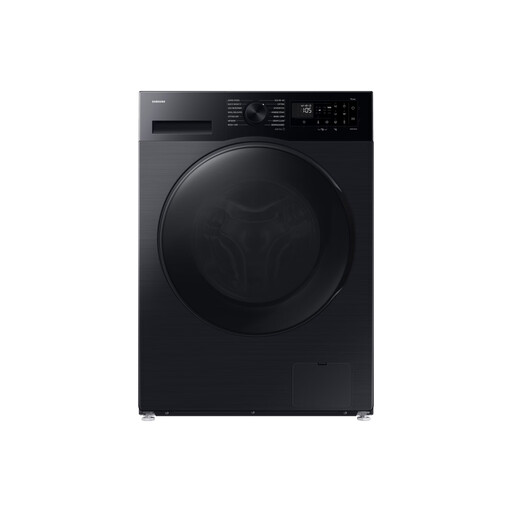
Samsung Series 5 AI Energy WD90DG5G34BBEU, 9 kg / 6 kg, black
Consider this freestanding model when the house needs one appliance for recurring loads. Its stated capacity is 9 kg for washing and 6 kg for drying, so a maximum wash load may need dividing before drying. Check the installation instructions and the programme limits for urgent or delicate uniform items.
View on Joybuy
 No image available
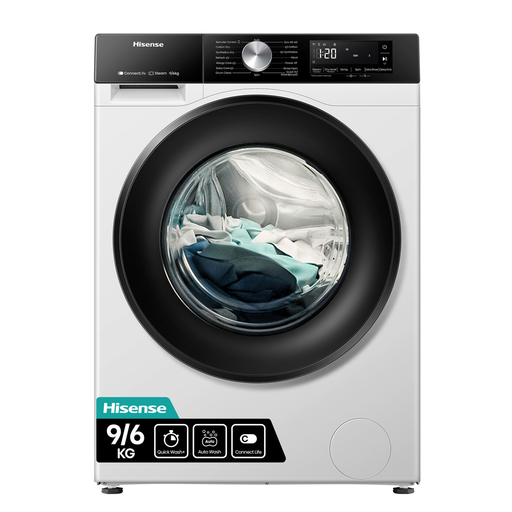
Hisense 3S Series WD3S9043BW3, 9 kg / 6 kg
This 9 kg wash / 6 kg dry model is an option for a shared house planning recurring uniform loads. Its title also specifies a 1400 rpm spin speed. Plan drying around the 6 kg limit and check the exact model’s installation and continuous-cycle programme instructions.
View on Joybuy
 No image available
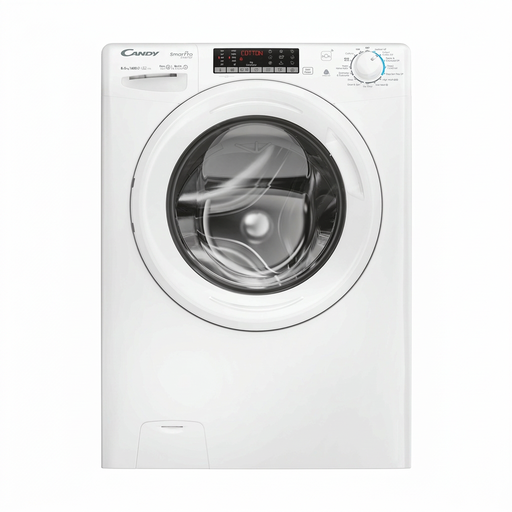
Candy Smart Pro Inverter CSOW4856TWM6-80, 8 kg / 5 kg, white
Consider this freestanding model if one appliance must handle washing and smaller drying loads. It is listed with 8 kg wash capacity, 5 kg dry capacity and a 1400 rpm spin speed. Check the installed fit and whether its wash-and-dry programmes accommodate the uniforms and time available.
View on Joybuy
 No image available
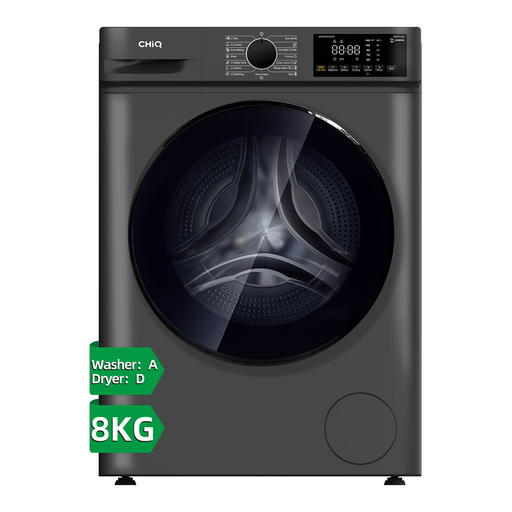
CHiQ JKW85882HG, 8 kg / 5 kg, dark graphite grey
This freestanding option is worth checking for a tighter appliance position and smaller drying loads. Joybuy lists 8 kg washing capacity, 5 kg drying capacity and a 520 mm body depth. Allow additional space for connections and door opening, and confirm the programme limits for the uniforms.
View on Joybuy
 No image available
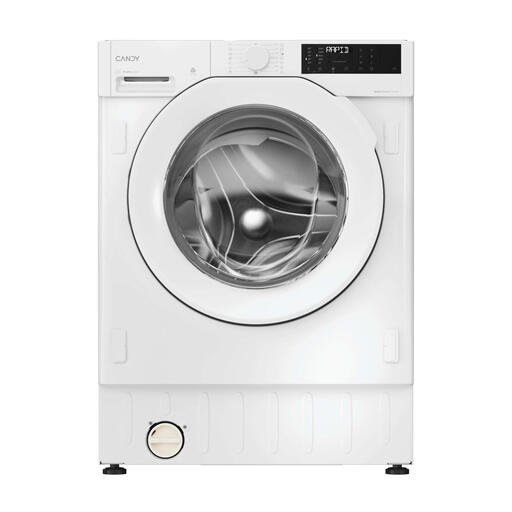
Candy BC4S496M6D8-80 integrated, 9 kg / 6 kg, white
Consider this model only for a kitchen designed to accommodate an integrated appliance. It is listed with 9 kg wash capacity, 6 kg dry capacity and a 1400 rpm spin speed. Confirm cabinet and door compatibility, any approval needed for the installation, and the exact wash-and-dry programme and energy-label details.
View on Joybuy
Common questions
Can I wash a full 9 kg or 10 kg load and dry all of it automatically?
Not on a model whose rated drying capacity is lower than its washing capacity. Bosch lists 10 kg wash / 6 kg wash-and-dry capacity for the WDU8H541GB, while the cited Hotpoint and Haier models are 9 kg / 6 kg; check the exact programme limit and divide a larger washed load before drying.
How much space does a freestanding washer-dryer need?
Allow for connections and the manufacturer’s required clearance, not just the machine’s body dimensions. Allow around 25 mm at either side and roughly 50–150 mm at the rear for pipes and plugs; measure the actual position and follow the exact installation instructions if they call for more room.
Can we use an extension lead in the student house?
Electrical Safety First advises against plugging a washing machine into an extension lead because of the risk of overloading it. Use a suitable fixed socket, follow the washer-dryer manufacturer’s instructions and arrange competent installation.
Is it sensible to run a wash-and-dry cycle while everyone is asleep?
Electrical Safety First advises against leaving laundry appliances running unattended, especially overnight or when the home is empty. Plan shared-house laundry so someone is awake and present while the machine runs.
Do the same rented-home electrical rules apply to every UK student house?
No single rule should be assumed for every student arrangement across the UK. GOV.UK’s electrical-safety guidance covers relevant rented residential premises in England and lists student halls of residence among its exclusions; check the rules that apply to the property and the tenancy arrangements before installing or replacing a machine.


