Choose a washer-dryer that fits the actual installation space, including room for connections and the open door, before comparing capacities. For cotton shorts, check the garment labels against the machine’s programmes and plan any continuous wash-and-dry load around the lower drying capacity. The energy label and spin-noise figure matter too when the appliance will run close to living space.
Who needs this approach?
Small-flat residents using one laundry appliance
If there is no practical space for both a washing machine and a tumble dryer, a washer-dryer keeps both functions in one appliance. Measure the installation space, connections and door opening rather than relying on the space the cabinet appears to offer.
People who regularly wash cotton shorts
Care labels and load size matter when shorts are washed frequently. CottonWorks explains that fabric construction and finishing affect changes in a cotton garment’s dimensions, so fibre content alone does not settle which wash and dry settings to use.
Flat dwellers concerned about noise and running costs
When the appliance is near a living or sleeping area, compare its spin-noise figure as well as the energy and water information on the label. Energy Saving Trust notes that appliance labels provide more than an efficiency class.
What matters when choosing?
Start with the space available and whether it calls for a freestanding or integrated appliance. Then match the drying load to your routine before comparing programmes and operating information.
| Concern |
What to check |
Who this matters to |
| Fit and installation |
Measure the usable height, width and depth, allowing for connections and the open door. Check whether an integrated model suits the existing cabinet. |
If my kitchen space is tight, the appliance has to fit and be usable once connected; roughly 36% of consumers put installation fit first. |
| Drying capacity |
Compare wash and dry capacities separately; size a continuous wash-and-dry load to the drying limit. |
When I need a load of shorts and other clothes ready without splitting it, the drying limit drives my choice. Around 29% of consumers prioritise that throughput. |
| Cotton care and turnaround |
Follow each garment’s care label, then check the cotton programme, adjustable settings and any short cycle’s load limit. |
I wash cotton shorts often and want settings that suit their labels, with a short cycle for suitable small loads; about 21% of consumers make this their main concern. |
| Noise and running costs |
Read the energy label’s usage information and compare spin noise in dB, alongside a capacity that suits normal loads. |
If the machine runs near where I live or sleep, spin disturbance and regular-use costs weigh heavily; for roughly 14% of consumers, they come first. |
Mistakes to avoid
-
Choosing by wash capacity alone
Which? explains that washer-dryers have a lower drying capacity than washing capacity. Filling the drum to its wash limit can leave more laundry than the machine is rated to dry in one continuous cycle.
Compare both capacity figures and use the drying figure when planning a load that must finish dry.
-
Measuring only the cabinet opening
A machine can match the visible gap yet leave too little room for pipes, plugs or the open door.
Measure the usable space and check the chosen model’s installation instructions. Allow space at the sides and rear of a freestanding machine for ventilation and connections.
-
Using one setting for every pair of cotton shorts
Cotton garments can differ in construction and finishing, which CottonWorks identifies as factors in dimensional change. A cotton programme or drying control does not override an individual garment’s care label.
Check each label before selecting temperature, spin and drying settings; use a short programme only within its stated load and garment conditions.
-
Comparing only the energy-rating letter
The headline class does not show every operating detail relevant to a small flat. Energy Saving Trust points to energy use, noise and performance information on appliance labels.
Read the product-specific label and compare its figures alongside the capacity you expect to use.
Brands and model lines to consider
Beko
Beko’s BMM5DFO5741 is a freestanding option to examine when a smaller kitchen calls for one wash-and-dry appliance.
- Beko describes this model as slim and specifies 7 kg washing and 5 kg drying capacity, with a wash-and-dry programme for up to five shirts in 60 minutes.
- Check its exact dimensions and the space needed for connections; the 5 kg drying limit still governs a continuous cycle.
Bosch
Bosch’s WKD28490GB is relevant where an integrated appliance suits the existing kitchen unit.
- Bosch specifies 8 kg wash and 5 kg wash-and-dry capacity for this model, alongside Auto Dry controls and dimensions of 820 × 596 × 525 mm.
- Its integrated format needs a compatible installation, and a full 8 kg wash load exceeds the stated 5 kg combined-cycle capacity.
AEG
AEG’s freestanding LWR7185M4B is relevant where its stated depth can be accommodated and a refresh function would be useful.
- AEG lists 8 kg washing, 5 kg drying, a cotton programme and a maximum depth of 599 mm for this model.
- Its steam refresh is for garments that do not need a full wash; it is not a substitute for laundering dirty shorts.
Samsung
Samsung’s WD90HG5U34BBEU is a model to examine if larger stated capacities and app-linked features matter more than choosing a compact 7 kg-class machine.
- Samsung UK lists 9 kg washing and 6 kg drying capacity for this model.
- Check its dimensions, energy label and app requirements against your own space and usage. Samsung says results for its AI Energy Mode claim vary with use.
Integrated washer-dryers on Joybuy
These integrated models are worth considering only if the flat has a compatible appliance cabinet and door arrangement. Compare their drying limits with the amount of laundry you want to finish in one cycle, then check the installation space and garment-care programmes.
 No image available
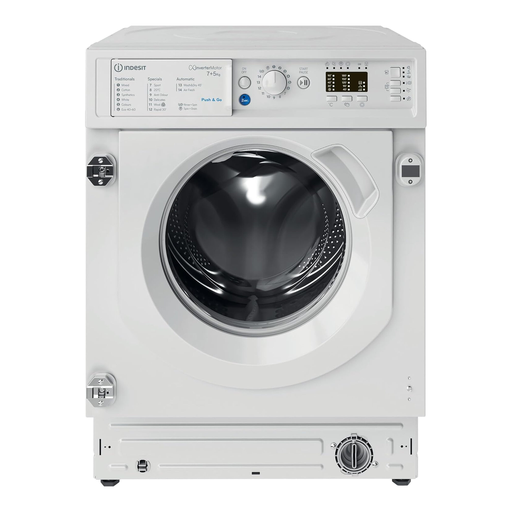
Hotpoint BI WDHG 75148 UK N integrated washer-dryer, 59.5 cm, 7 kg/5 kg
Consider this model if an integrated installation suits your flat and you want to wash and dry modest loads in one appliance.
Plan continuous cycles around its stated 5 kg drying capacity, and confirm cabinet, connection and door clearance. Check the programme list against your shorts’ care labels before choosing a cycle.
View on Joybuy
 No image available
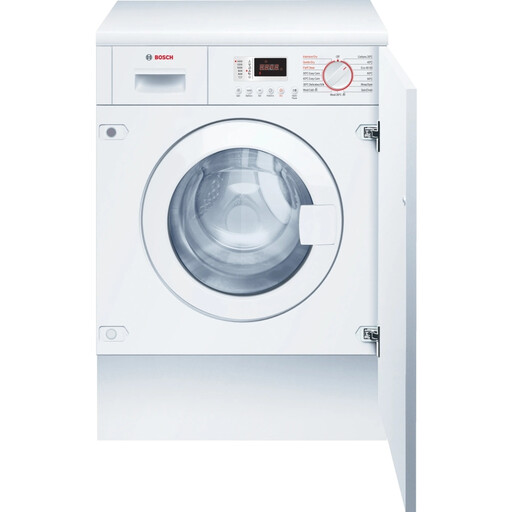
Bosch WKD28352GB Series 4 integrated washer-dryer, 7 kg/4 kg
Consider this model if you have a compatible integrated-appliance space and your usual wash-and-dry loads fit its stated 4 kg drying capacity.
Check cabinet and door compatibility, connection clearance and the available programmes before deciding whether it suits your cotton shorts.
View on Joybuy
Common questions
How much space should I leave around a washer-dryer?
Allow for the chosen machine’s installation clearances, connections and fully open door, not just its listed dimensions. For freestanding washer-dryers, allow roughly 25 mm at either side and 50–150 mm at the rear for pipes and plugs; follow the specific model’s instructions where they differ.
Can I dry a full wash load of cotton shorts without splitting it?
Only if that load is within the washer-dryer’s stated drying capacity. Which? notes that drying capacity is lower than washing capacity, so use the dry figure—not the wash figure—when deciding how much can finish in one combined cycle.
Which washer-dryer cycle should I use for cotton shorts?
Start with the sewn care label, then choose a programme and drying setting that the label permits. CottonWorks explains that construction and finishing affect dimensional change, so a cotton setting or sensor-drying feature cannot guarantee the same result for every pair of shorts.


