Households washing uniforms frequently
If shirts, trousers and PE kit need to be ready for the next school day, compare capacity against your regular laundry volume and check the conditions of any faster programme.


A freestanding washing machine is a sensible starting point for school-uniform laundry if the utility room has suitable connections and enough space for the appliance, pipes, ventilation and open door. Match drum capacity to your usual loads, then check whether a faster programme suits the uniform fabrics you wash. Choose an integrated machine for cabinetry designed around one, or consider a washer dryer when indoor drying space is the main constraint.
If shirts, trousers and PE kit need to be ready for the next school day, compare capacity against your regular laundry volume and check the conditions of any faster programme.
A worktop, nearby pipes or limited door-opening space can determine which appliance format fits. Measure the usable space, not just the gap between walls.
A washer dryer offers a combined route, but its drying capacity may be lower than its washing capacity. Plan around both ratings if uniforms need to be dry by the next day.
Decide whether the utility room calls for a freestanding machine, an integrated installation or a combined wash-and-dry appliance before comparing programmes.
Consider it when: The utility room has suitable connections and does not require a matching cabinet door.
Allow for: Space behind and beside the machine, as well as room to open its door.
Consider it when: The cabinetry is designed for an integrated appliance and furniture door.
Allow for: The specific cabinet opening and door arrangement; freestanding dimensions are not interchangeable with integrated dimensions.
Consider it when: Limited indoor drying space makes a combined appliance useful.
Allow for: A lower drying than washing capacity, which may mean splitting a washed load before drying.
| Concern | What to check | Who this matters to |
|---|---|---|
| Fit and installation | Measure the usable bay, including pipes, plugs and door opening. Allow around 25 mm at each side and roughly 50–150 mm behind a freestanding machine. | If a machine cannot fit or connect properly, its programmes will not help me wash uniforms. Around 42% of consumers put fit and installation first. |
| Capacity and turnaround | Compare rated capacity with your normal loads, then check the quick programme’s permitted load and fabrics. A 7–9 kg range suits medium households of three to four people. | With uniforms joining the household wash, I need enough room in the drum and a programme I can use when time is short; around 33% of consumers prioritise capacity and turnaround. |
| Indoor drying | Compare a washer dryer’s wash and dry ratings separately, and check its dimensions. Compare programme, energy-label and noise information for the way you expect to use it. | When I have little room to dry uniforms indoors, handling the drying is my main concern. For around 25% of consumers, that need comes first. |
Pipes, plugs and the open appliance door can make a machine impractical to install even when its stated width fits.
Measure the usable height, width and depth, then allow for the manufacturer’s installation requirements and the door swing.
A washer dryer can wash a larger load than it can dry at once, adding a separate drying run when uniforms are needed soon.
Read both kg ratings and plan to divide a full wash load if it exceeds the drying rating.
A stated quick cycle may apply only to particular loads or fabrics, while different uniform items need different care.
Check the programme’s load and fabric conditions against the uniform care labels before relying on it for next-day laundry.
Whitegoods Help warns that connecting appliance wastewater to a surface-water system is a drainage misconnection.
Confirm that the proposed connection leads to foul drainage. Ask a competent installer to assess the arrangement if the route or backflow protection is uncertain.
Bosch offers relevant freestanding and integrated examples for comparing utility-room layouts.
The F2X50S9NLB is relevant when comparing a 9 kg drum with a design LG markets as Counter-Depth MAX.
Samsung’s WD80TA046BE/EU illustrates the combined wash-and-dry option.
The WWE380 WCS is an 8 kg, 1400 rpm front-loader to consider when comparing faster-wash programmes.
These choices include washer dryers for households short of indoor drying space and freestanding washing machines with different stated capacities. Compare each one with your usual uniform loads and measured utility-room space.
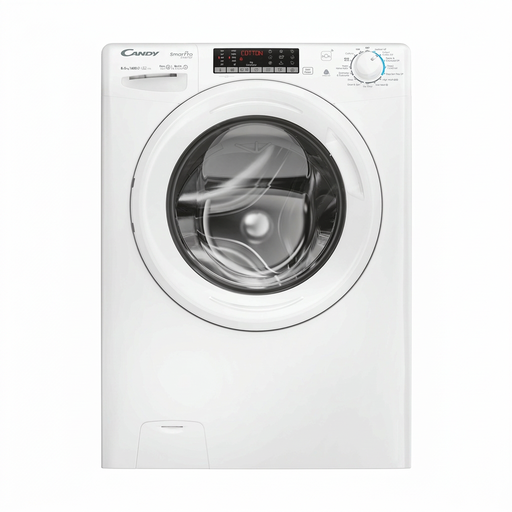 No image available
Consider this freestanding model when washing uniforms and drying them in the same appliance would help.
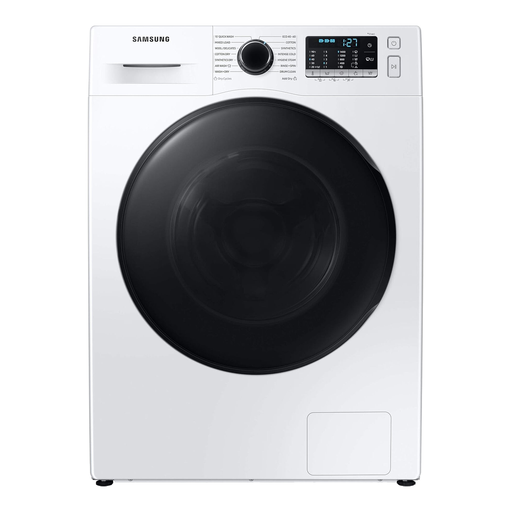 No image available
This freestanding washer dryer is an option when indoor drying space is limited.
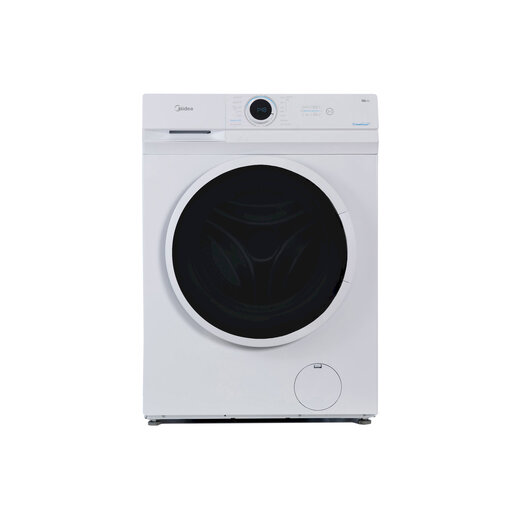 No image available
Consider its stated capacity against your regular laundry volume if uniform washes are relatively small.
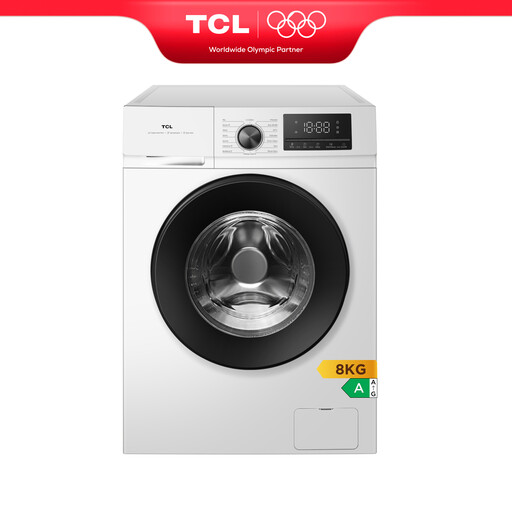 No image available
Its 8 kg capacity is worth comparing with the loads you normally wash together with school uniforms.
 No image available
The 10 kg capacity is an option to assess if your normal household loads are larger, rather than for an occasional large uniform wash.
Allow space for the machine, its connections and its open door. Allow around 25 mm at each side and roughly 50–150 mm behind for ventilation, pipes and plugs; measure from the front of protruding pipes and plugs rather than the wall alone.
An 8 kg machine may suit the household’s normal loads, but uniform items are only part of that calculation. A 7–9 kg range suits medium households of three to four people; compare the loads you actually wash before choosing a capacity.
No, not within its 5 kg drying rating. The Samsung WD80TA046BE/EU, for example, is rated for 8 kg washing and 5 kg drying, so a full rated wash load would need to be divided before drying.
Only use a connection confirmed as suitable for appliance wastewater; do not assume a nearby grate leads to foul drainage. Whitegoods Help warns that a connection to a surface-water system is a misconnection. Have an uncertain drainage route checked before installation.
No. Water Regs UK says some, but not all, appliances incorporate backflow protection that satisfies applicable requirements. Check the appliance documentation and have the proposed installation assessed by a competent installer or the relevant water supplier if protection is uncertain.