Small-kitchen apron washers
If aprons go through the wash regularly but kitchen or utility-room space is tight, pipe clearance and room to open the door matter alongside appliance dimensions.


For regular apron washing in a tight space, start with the full installation footprint, not just the machine’s stated depth. A shallow freestanding washer is worth considering when front-to-back space is the constraint; an integrated machine needs suitable cabinetry, while a washer-dryer combines two functions but may dry less than it washes. Check each apron’s care label against the exact programme and load limits before choosing.
If aprons go through the wash regularly but kitchen or utility-room space is tight, pipe clearance and room to open the door matter alongside appliance dimensions.
Cooking, craft or work aprons may call for a suitable fabric or stain-focused programme. The apron’s care label and the programme’s conditions determine whether it is appropriate.
Where separate washing and drying appliances will not fit, a washer-dryer offers both functions, though its drying capacity may be lower than its washing capacity.
Measure the installed space first, then check apron-care requirements and programme loads. If drying in the same appliance matters, compare washing and drying capacities separately.
| Concern | What to check | Who this matters to |
|---|---|---|
| Installation fit | Measure width, height, pipe and plug projection, and door-opening space. Allow around 25 mm at each side and roughly 50–150 mm behind a freestanding washer. | I need the washer to fit without obstructing the room once its connections and open door are accounted for. Around 36% of consumers put installation fit first. |
| Fabric and stain care | Match the apron’s care label to the available fabric, temperature and stain-programme conditions. | Spills are a regular part of my apron use, but I cannot choose a cycle that conflicts with its care instructions. Fabric and stain care comes first for around 29% of consumers. |
| Load turnaround | Check a quick programme’s permitted load and soil level, rather than relying on its advertised duration. | When I have only a few aprons ready to wash, a usable short cycle matters more to me than a headline time alone. Roughly 21% of consumers prioritise turnaround. |
| Washing and drying | Compare wash and dry capacities, appliance dimensions and the exact model’s combined-cycle information. | I need one appliance for both jobs because a separate dryer would take up space I cannot spare. For around 14% of consumers, combined washing and drying is the primary need. |
A shallow cabinet may still leave too little room for pipes, plugs, ventilation or the open door.
Measure the complete installed footprint before deciding whether a model fits.
Rapid programmes can have small-load or light-soil conditions; duration alone does not establish fabric or stain suitability.
Check the apron label and the programme’s temperature, load and soil limits.
Indesit lists 7 kg washing capacity but 5 kg drying capacity for its IDMA 75624 MY TIME UK washer-dryer.
Compare both capacities and the installed depth before choosing a combined appliance.
Drying a full washing load may require splitting it into smaller loads.
An energy class does not show every consumption or programme detail relevant to comparing exact models.
Compare the energy label and product information sheet for the models you are considering.
Indesit lists the 7 kg IMA 762 MY TIME UK freestanding washer at 46.5 cm deep, making its dimensions relevant to a tight-depth search.
Beko lists its 7 kg BW1O3721 freestanding washer at 47.4 cm deep.
Bosch lists a 7 kg freestanding WAJ28008GB at 54.6 cm deep and an 8 kg integrated WIW28302GB at 54.4 cm deep.
Hotpoint lists the 7 kg NSWM 7469 W UK freestanding washer at 54 cm deep.
These choices include freestanding washers, an integrated washer and integrated washer-dryers. Compare the space each needs and whether its programmes suit your aprons before selecting a model.
 No image available
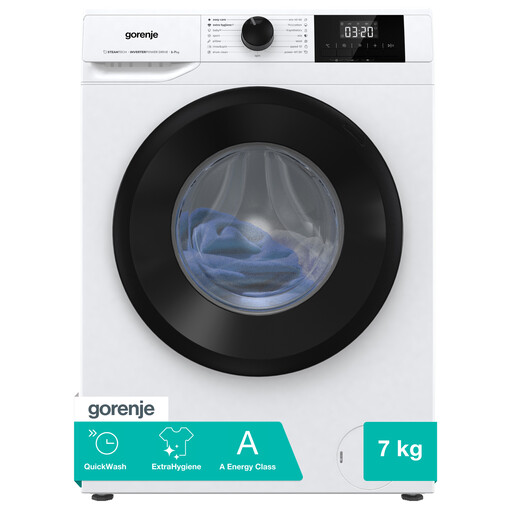
A freestanding washing-only option if you do not need an appliance to dry the aprons.
The product title lists 1200 Spin and an A energy rating. Check installed-space measurements and cycle conditions against your apron labels.
 No image available
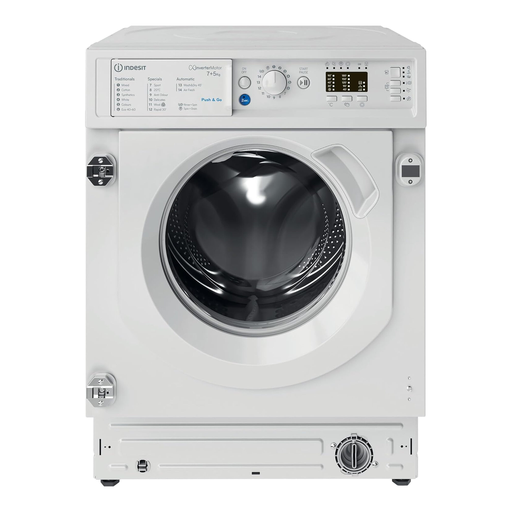
Consider this combined appliance if you need washing and drying in compatible kitchen cabinetry.
Its listed drying capacity is 5 kg, compared with 7 kg for washing. Check cabinet fit and the conditions for drying an apron load.
 No image available
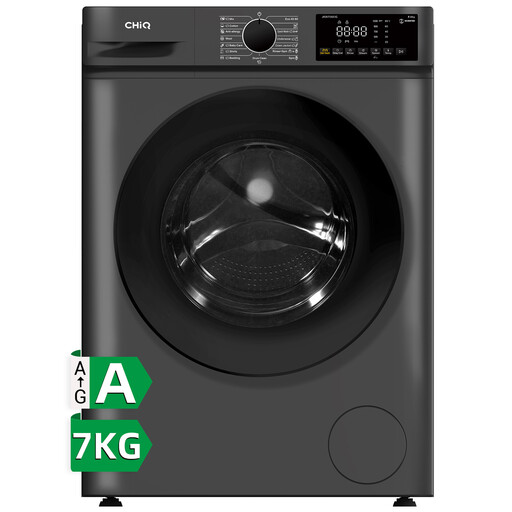
A washing-only choice for a space where a freestanding machine can be installed.
The product title lists 1200 Spin and an A energy rating. Confirm the installation footprint and suitable programme settings for your aprons.
 No image available
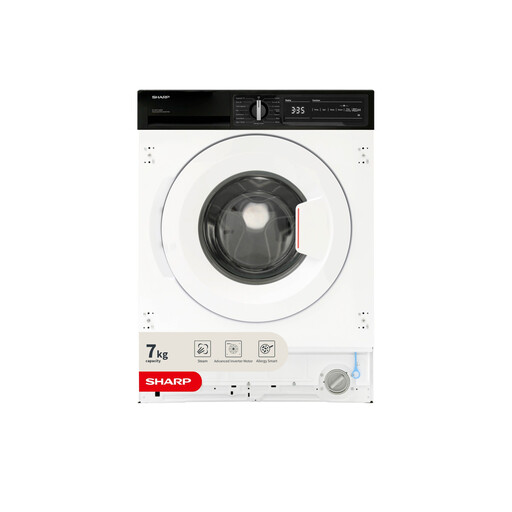
Consider an integrated washer if the kitchen already has compatible appliance cabinetry and drying in the machine is unnecessary.
The product title lists 1400 rpm and an A energy rating. Check the cabinet dimensions, installation requirements and apron-care compatibility.
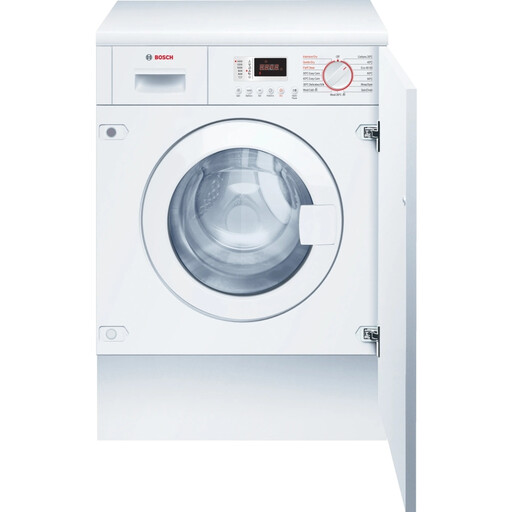 No image available
A combined option where compatible cabinetry is available and a separate dryer is impractical.
The product title lists 7 kg washing and 4 kg drying capacity. Check the installed depth and plan drying loads around the lower capacity.
Measure the usable space with pipes and plugs accounted for, not just the distance to the wall. Allow for the open door; Allow around 25 mm at each side and roughly 50–150 mm behind a freestanding washer for ventilation and connections.
No. A machine’s 7 kg rating does not mean every programme accepts that load; quick cycles can have separate limits. Check the selected cycle’s instructions and weigh the dry laundry accordingly.
A washer-dryer can provide both functions in one appliance, but its drying load may be smaller. Indesit lists 7 kg washing and 5 kg drying capacity for the IDMA 75624 MY TIME UK, so a full wash load may need splitting before drying.
Compare the exact models’ energy labels and product information sheets rather than their energy classes alone. GOV.UK guidance says products within the applicable energy-labelling scope must have an accurate label and be accompanied by a product information sheet.
No single stain or hot programme suits every apron. Check its care label for permitted temperature and fabric treatment, then confirm the machine programme’s load and soil conditions before using it.