Shallow-alcove households
You need a washer to fit a tight kitchen, utility-room or cupboard space while leaving room for rear connections and the door to open.


Choose a washing machine only after checking that its dimensions, connections and door opening fit the available space. For washable summer dresses, check each garment’s care label against the machine’s programmes, temperature and spin controls; a shallow cabinet alone does not make a machine suitable for delicate loads.
You need a washer to fit a tight kitchen, utility-room or cupboard space while leaving room for rear connections and the door to open.
You wash summer dresses with different care instructions and need to choose the temperature, programme and spin for each garment, rather than treating every washable dress alike.
You need the washer for dresses and ordinary household loads, so drum capacity still matters after you have established that the machine fits.
Start with the space the installed machine can actually occupy, then match its controls to your dresses’ labels and its capacity to your usual laundry.
| Concern | What to check | Who this matters to |
|---|---|---|
| Installation fit | Measure usable width, height and depth around pipes and plugs. Compare them with the exact model’s dimensions and installation clearances, including door-opening space. | If my washer must go into a shallow alcove, I need the connections and open door to fit too; roughly 46% of consumers put physical fit first. |
| Dress care | Read each dress label, then check the machine’s programme, temperature and spin options. A programme name does not override a hand-wash-only or do-not-wash label. | When my dresses call for mild or very mild washing, I need control over how each load is washed; around 36% of consumers prioritise garment care. |
| Drum capacity | Choose a rated capacity for your ordinary laundry, but follow any reduced-load instruction for a delicate cycle. | If the same washer must also handle household laundry, I cannot choose by dress loads alone; approximately 18% of consumers make capacity their primary concern. |
A shallow machine may still be too deep once its hoses, plug and required ventilation space are accounted for. The door also needs room to open.
Measure the usable space and follow the chosen model’s installation instructions. Allow around 25 mm at either side and roughly 50–150 mm at the back of a freestanding washer for ventilation, pipes and plugs.
GINETEX care symbols distinguish machine washing with milder treatment from hand washing and from garments that must not be washed. The number in the wash tub is a maximum temperature, not a suggested setting.
Check each garment’s label before selecting a cycle. For machine-washable dresses marked for mild or very mild treatment, choose suitable settings and reduce the load as the care instructions require.
A reference for compact freestanding washers when usable depth is the main constraint.
A reference if a deeper washer can fit and capacity for wider household laundry matters.
A buying-guide reference for comparing slimline and standard-depth machines against household laundry needs.
This washing machine is relevant to a shallow-space shortlist. Check its installation dimensions and programmes against your room and the care labels on your dresses before choosing it.
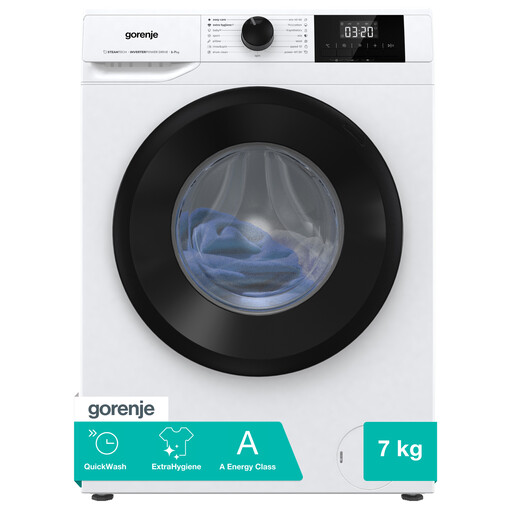 No image available
For a shallow laundry space, compare this machine’s installation requirements with your available depth before ordering.
The product name states a 7 kg capacity, 1200 Spin and an A energy rating.
Check the full programme details for settings that match each dress label, as well as the space needed for connections and the door.
No: check the individual garment’s care label before machine washing. GINETEX explains that the wash-tub number is a maximum temperature and that bars below the tub call for milder treatment; a machine programme labelled “hand wash” does not override a hand-wash-only or do-not-wash instruction.
Measure the usable width, height and depth while accounting for pipes, plugs and the space needed to open the door. Allow around 25 mm at either side and roughly 50–150 mm behind a freestanding machine; also follow the exact model’s installation instructions.
Choose a capacity that suits your normal household laundry and fits your space, then use the load size required by each dress-care instruction. For scale, Beko UK specifies 7 kg and 49.6 cm depth for the BM3WT3741, while Bosch UK specifies 8 kg and 550 mm depth for the WAN282X1GB; GINETEX advises reduced loads for mild and very mild washing.
Compare the energy label and product documentation for each exact model. Do not assume that a smaller drum automatically means lower running costs; check the stated information alongside the capacity and programmes you would use.