
24/7 Customer Support

Free returns

Same-day & Next-day Delivery

Quality Guaranteed

Unlock Your Welcome Offers: FREE Delivery | Up to 80% OFF | Free 30-day JoyPlus trial
Download the APP
Replacing a water filter cartridge should be straightforward, but choosing the wrong one can waste money and leave your filtration system underperforming. UK households use a wide range of jugs, tap filters, under-sink units, reverse osmosis systems and automatic coffee machines, and each requires a specific cartridge design.
The main issue is not simply finding a filter with an attractive claim on the packaging. You need to confirm compatibility, replacement timing and filtration technology before ordering.
Water filter cartridges can look almost identical while using different locking mechanisms, dimensions or internal flow paths. A cartridge intended for one reverse osmosis model may not seal correctly in another. This can cause leaks, poor water flow or an inability to install the filter at all.
Always check the exact model number printed on your existing cartridge, filtration system or coffee machine. “Compatible with” should refer to your precise model range, not just the manufacturer name.
A stated lifespan such as six, 12 or 24 months is normally dependent on water quality, household usage and the system’s capacity. A busy household may reach a litre limit before the calendar replacement date, while a lightly used filter may last longer in terms of volume.
For example, some cartridges specify both a time period and a volume limit. Replace the cartridge when either limit is reached, unless the system’s instructions state otherwise.
Total dissolved solids, or TDS, measures the concentration of dissolved substances in water. A low TDS reading does not automatically describe every aspect of filtration. Some activated carbon filters improve taste and reduce chlorine while retaining minerals; reverse osmosis systems are designed for a different type of filtration.
Choose according to your household’s needs rather than assuming a higher filtration number is always more suitable.
For an under-sink water filter replacement, check the system model, cartridge dimensions and connection method. Twist-and-lock cartridges are convenient, but the locking pattern must match the housing.
The same principle applies to coffee machine water filter replacement. A filter designed for a De’Longhi, Jura, Siemens or Philips machine may fit only particular model families. Check excluded models as carefully as compatible ones.
An activated carbon water filter commonly uses carbon to reduce chlorine, odours and compounds that affect taste. Some cartridges also include ion-exchange resin, polypropylene, sediment media or an ultrafiltration membrane.
Reverse osmosis cartridges contain an RO membrane and may be designed to reduce TDS. By contrast, some under-sink systems are specifically designed to retain minerals and do not reduce TDS. Read the product specification rather than relying on broad phrases such as “multi-stage”.
Compare both service life and filtration capacity. A cartridge described as lasting 12 months may have a separate litre or gallon limit. Local water conditions can also affect the replacement schedule.
Where certification is listed, check what it covers. NSF/ANSI 42 is generally associated with aesthetic effects such as taste and odour, while NSF/ANSI 53 relates to specific contaminant reduction claims. Certification does not mean that every possible contaminant is removed, so review the exact product scope.
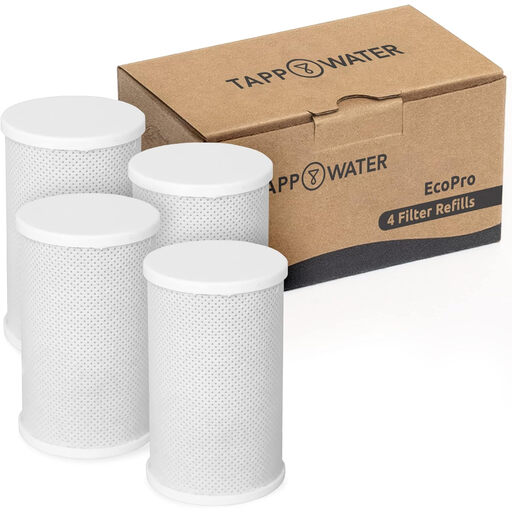
Why This Fits Their Persona: A four-cartridge pack suits renters and smaller households using a compatible tap filtration system and wanting to plan routine replacements in advance.
It clearly states exclusive compatibility with the EcoPro tap filter and gives a per-cartridge limit of up to three months or 400 litres, helping buyers avoid vague replacement expectations.
Four cartridges provide up to 12 months of stated use, with coconut-shell activated carbon and tool-free twist-and-lock fitting.
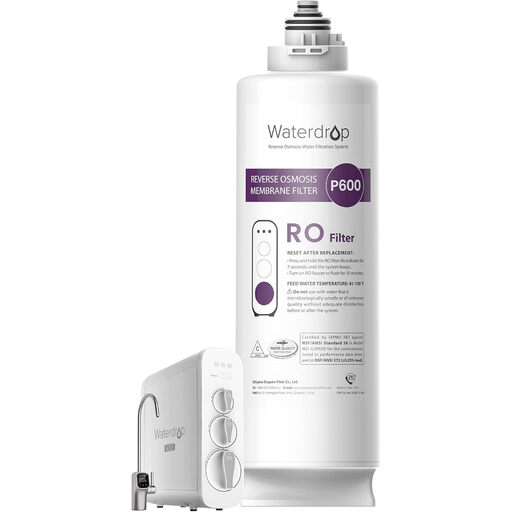
Why This Fits Their Persona: This suits homeowners with the WD-G3P600 system who prefer a clearly specified reverse osmosis filter replacement with a longer scheduled interval.
The listing identifies the exact compatible system and states that it is not intended for WD-G3P800-W or WD-G3-W models.
The product information lists NSF/ANSI 58 and 372 certification, plus a stated life of up to 24 months or 2,200 gallons.
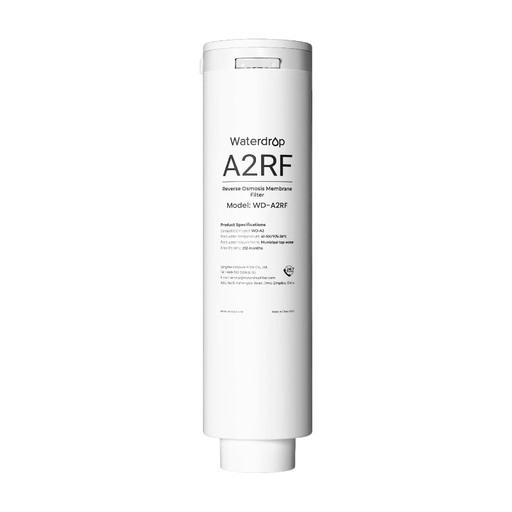
Why This Fits Their Persona: Designed for households using a WD-A2 countertop RO unit for regular drinking and cooking water without an under-sink installation.
Its 4-in-1 composite format is made specifically for the WD-A2, reducing the risk of buying separate stages that do not match the countertop system.
The cartridge uses PP cotton, carbon fibre and an RO membrane, with a stated 12-month schedule and tool-free replacement.
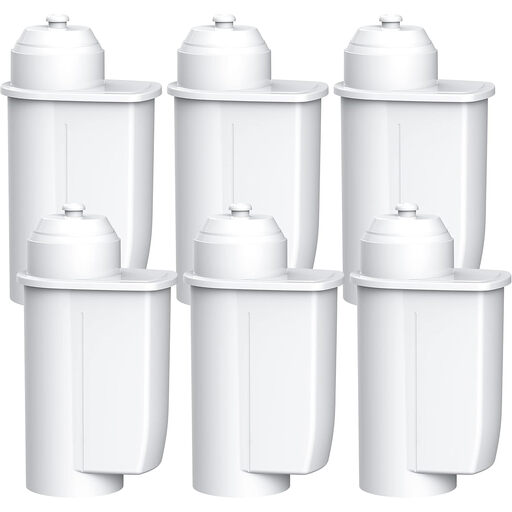
Why This Fits Their Persona: A six-pack is practical for regular coffee drinkers using selected Siemens EQ, Bosch and Brita Intenza-compatible machines.
The listing identifies compatible model families and states that each filter should be replaced every two months or around 100 litres.
Ion-exchange resin and granular activated carbon are listed, with TÜV SÜD certification and a six-filter pack.
We have compiled a complete, real-time list of products that fully satisfy these strict selection criteria and UK safety regulations.
Before fitting replacement water filter cartridges:
It depends on the cartridge and usage. Common schedules range from two months for coffee machine filters to six, 12 or 24 months for larger domestic systems. Always follow the earlier of the stated time or volume limit, and replace sooner if taste, flow or odour changes noticeably.
A compatible cartridge should be matched to the exact appliance or filtration system and used according to its instructions. Check the listed materials, certification details and model compatibility. Certification applies to specified claims and does not necessarily cover every contaminant.
They can reduce the number of replacement purchases, but compare the cartridge price with its stated capacity. A 12-month cartridge is not automatically lower-cost if your household reaches its litre limit quickly. For a fair comparison, calculate the price per month or per litre and include any required pre-filters or additional stages.