Who may benefit

People who struggle to reach their molars

If aiming behind upper or lower back teeth takes repeated changes of grip, look for a nozzle you can rotate or angle towards those areas. Waterpik UK and Philips UK list rotating tips on particular cordless models; check the feature on the exact model you choose.

People learning to control the water jet

Several pressure or intensity settings give you a choice of starting level while you practise aiming. Waterpik UK, Philips UK and Panasonic UK list adjustable settings on the models discussed below; the number of settings alone does not tell you which will feel comfortable.

People with braces or dental restorations

Check which specialist tips fit the exact model and ask your dentist or hygienist which interdental-cleaning method suits your braces, implants, crowns or bridges. Do not assume a standard water-jet tip replaces every other cleaning tool.

What to check before buying

For reaching back teeth, check nozzle direction before comparing pressure settings; then consider whether refilling, cleaning and charging will fit your routine.

Concern What to check Who this matters to
Aiming at back teeth Look for a rotating or angle-adjustable nozzle. Check that its direction can be changed while holding the device comfortably. When I struggle to direct the jet behind my molars, precise aiming matters more than a high-pressure claim; around 40% of consumers would put rear-tooth access first.
Comfort control Compare the available pressure or intensity settings and read the model’s starting instructions. If the jet feels uncomfortable while I learn, I want to begin on a gentler setting; roughly 30% of consumers would make comfort control their main concern.
Portability and upkeep Check tank capacity and cleaning instructions, plus the charging method and compatible replacement tips. With limited storage space or travel in mind, I want a device I can refill, clean and charge conveniently; about 30% of consumers would prioritise portability and upkeep.

Buying pitfalls

  • Choosing by pressure alone

    A high stated pressure does not tell you whether you can direct the nozzle towards the back-tooth gumline.

    Check nozzle movement first, then compare adjustable settings and how long the tank lasts at the setting you expect to use.

  • Using a water flosser instead of brushing

    NHS guidance recommends brushing twice daily with fluoride toothpaste. A water flosser is an additional tool for cleaning between teeth, not a substitute for brushing.

    Keep brushing and ask a dentist or hygienist whether a water flosser, floss, interdental brushes or a combination suits your mouth.

  • Turning up the pressure when gums hurt or bleed

    Bleeding, painful or swollen gums call for dental advice rather than attempts to resolve the symptoms with a stronger water jet. The NHS advises seeing a dentist if your gums bleed when you brush or eat hard foods.

    Arrange a dental assessment instead of relying on a different flosser setting to address persistent symptoms.

  • Forgetting about tips, cleaning and charging

    A model’s tank design, supplied tips and charging method affect how it fits into daily use; a tip made for one product line should not be assumed to fit another.

    Confirm the exact model’s supplied and compatible tips, tank-cleaning instructions and charging equipment before choosing it.

Relevant brands for reference

Waterpik

Waterpik UK offers cordless and countertop water flossers. Its Cordless Advanced is relevant to back-tooth access because Waterpik UK lists a 360° rotating tip, three pressure settings and specialist tip options for the model.

  • The rotating tip gives you a way to change the jet’s direction when aiming around molars.
  • Check the supplied tip types and whether the cordless tank suits your routine; the model’s features do not establish that it can replace other interdental tools.

Philips Sonicare

Philips UK lists a 360° rotating nozzle, two modes, three intensities and a 250 ml reservoir for its Cordless Power Flosser 3000 HX3826/33.

  • The rotating nozzle and intensity choices let you consider both aiming and comfort on this specific model.
  • You still need to guide the nozzle around each rear tooth and check that compatible replacement nozzles suit your plans for ongoing use.

Panasonic

Panasonic UK lists five pressure levels, a 200 ml tank and a removable, dishwasher-safe tank for its Series 300 EW-DJ26.

  • The pressure choices and removable tank are relevant if adjustment and tank cleaning are your priorities.
  • Confirm how you would aim the nozzle at your back teeth, along with the exact version’s supplied equipment and charging requirements.

Joybuy product choices

This cordless option has a listed rotating nozzle for aiming towards back teeth. Compare its tank and pressure settings with your comfort and upkeep needs.
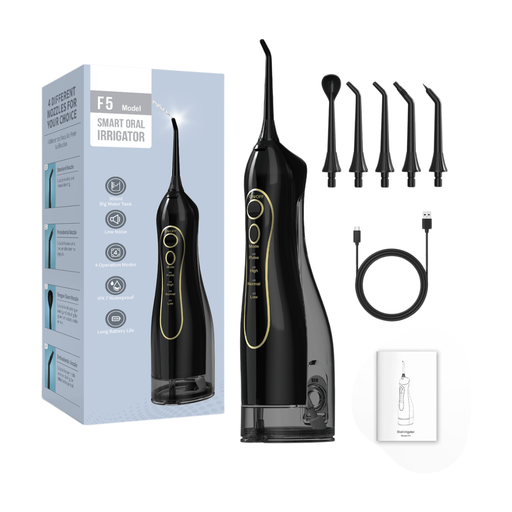
Sunluxy F5 Black cordless water flosser

Sunluxy F5 Black Cordless Water Flosser

Consider this model if directing the nozzle towards back teeth is your main concern. Its listed features include a 360° rotatable nozzle, five pressure modes, a detachable 300 ml tank and a stated 140 PSI pressure figure.

The product name lists four nozzle types. Check which compatible replacement nozzles and charging equipment you would need for your routine.

View on Joybuy

Frequently asked questions

Can a water flosser replace brushing?

No. The NHS recommends brushing twice daily with fluoride toothpaste; use an appropriate interdental-cleaning method in addition to brushing, not instead of it.

Can I use a water flosser instead of floss or interdental brushes?

Do not assume a water flosser is a substitute for every interdental tool. Guy’s and St Thomas’ NHS Foundation Trust advises that it can be useful for some people but should not be used instead of interdental brushes; ask your dentist or hygienist what suits your teeth and dental work.

Should I use the highest pressure to reach my back teeth?

No: choose a setting you can use comfortably while learning to aim the nozzle around your molars. If your gums hurt, swell or bleed, seek dental advice rather than increasing the pressure.

What should I do if my gums bleed or hurt?

See a dentist if your gums bleed when brushing or eating, or are painful and swollen. The NHS also advises urgent dental assessment for very sore, swollen gums accompanied by loose teeth, mouth ulcers or red patches, or a lump in the mouth or on the lip.