Bridge wearers seeking targeted access
You want to direct the stream around your bridge and need to know whether a tip is described for that use, rather than assuming any nozzle will do.


If cleaning around your bridge is the priority, start by finding a tip described for bridges and checking that it fits the exact device you plan to buy. If storing a device in a shared bathroom matters more, a cordless model may be easier to put away, but check its nozzle suitability, pressure settings, reservoir and cleaning instructions before choosing it.
You want to direct the stream around your bridge and need to know whether a tip is described for that use, rather than assuming any nozzle will do.
You need somewhere to put the device after use and a way to keep each person’s mouth-contact tip separate.
You want to begin with a gentler setting and adjust the stream to your comfort while establishing a cleaning routine.
Choose the tip and device together if bridge-focused rinsing comes first; then decide whether bathroom storage or longer use between refills matters more.
Consider it when: You have space near a socket and want to check compatibility with Waterpik UK’s Implant Denture Tip, which it describes for cleaning around bridges.
Trade-off: The tip requires a compatible model, and a countertop device needs a place to stand and be plugged in.
Consider it when: You need to put the device away after use and keep personal tips apart in a shared bathroom.
Trade-off: A compact reservoir may need refilling during a longer routine; a rotating or general-use nozzle does not establish bridge-specific suitability.
| Concern | What to check | Who this matters to |
|---|---|---|
| Access around a bridge | Check the exact device-to-tip compatibility and whether the desired tip is included. | If I need to direct water around my bridge, I want a tip described for that task rather than relying on its shape alone. Around 33% of consumers would put bridge access first. |
| Personal tips and storage | Look for removable tips, separate storage and instructions for cleaning the device. | In a shared bathroom, I want to put my equipment away without mixing up mouth-contact tips. Keeping personal tips and storage organised would come first for around 27% of consumers. |
| Pressure control | Compare the available settings and consider whether you can start at a comfortable intensity. | If a strong stream feels uncomfortable, I need room to adjust it rather than persevere with one setting. Pressure comfort would be the main concern for around 20% of consumers. |
| Refilling and upkeep | Check reservoir use time or capacity, alongside the model’s cleaning instructions. | When cleaning takes longer, I do not want frequent refills or upkeep that is awkward in a shared space. Around 20% of consumers would prioritise a manageable routine. |
Waterpik UK describes its Implant Denture Tip for bridges, but a general rotating nozzle is not necessarily equivalent to a tip intended for dental work.
Check the manufacturer’s compatibility information for both the exact tip and device. Follow your dentist’s or hygienist’s advice if your bridge calls for a particular cleaning method.
Choosing a specialist tip may also mean needing a compatible device or an accessory that is supplied separately.
Waterpik UK states up to 45 seconds of reservoir use for its Cordless Plus, while its countertop range guide describes reservoirs offering more than 90 seconds. Those figures apply to the cited ranges, not every cordless or countertop model.
If you prefer an unhurried routine, check the use time of the exact model and decide whether refilling is acceptable in return for easier storage.
South West Councils’ communal-accommodation guidance advises against sharing toothbrushes. Keeping water-flosser nozzles personal is a sensible precaution for another mouth-contact item, not a stated rule about those nozzles.
Give each user an identifiable tip, store tips separately and clean the device according to its manual.
The UK Office for Product Safety and Standards issued a recall concerning the Waterpik Nano Plus WP-320UK because of an electric-shock risk. That notice does not establish the same fault in other Waterpik models.
Check the full model and relevant product details against current UK safety notices before buying or using a device.
Waterpik UK describes an Implant Denture Tip for bridges and offers both countertop and cordless water flossers.
The cordless HX3826/33 is an option to examine when storage space and intensity adjustment matter.
Oral-B UK describes AquaCare models with sensitive, medium and intense pressure choices.
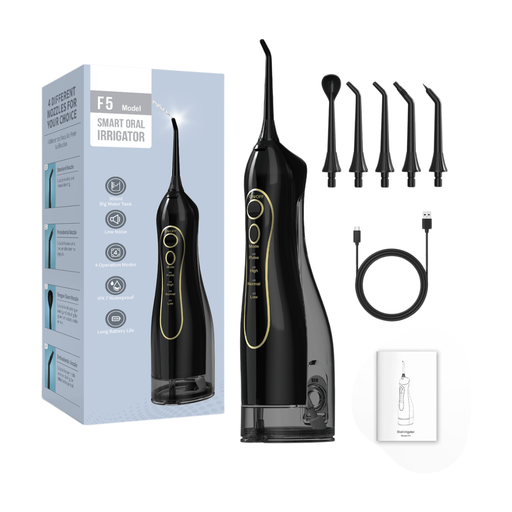
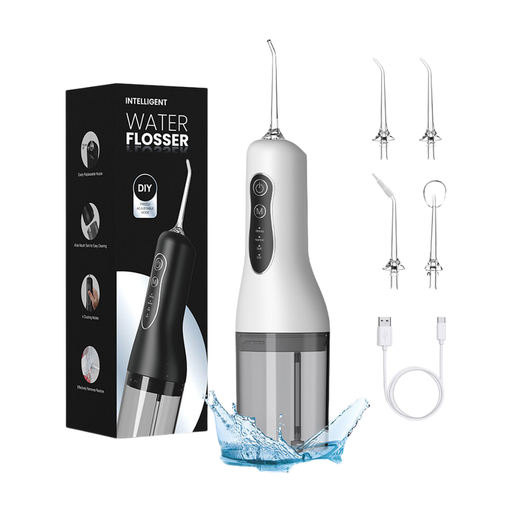
These two Sunluxy cordless models address storage and adjustable-setting needs in a shared bathroom. Before choosing either for a bridge, check whether its supplied nozzles suit the cleaning method recommended for you and how personal tips can be kept separate.
 No image available
Consider this cordless model if putting the device away after use and choosing among pressure modes matter to you.
The product name specifies a 300 ml tank, five modes, a 360° rotatable nozzle, four types of nozzles and a stated 140 PSI pressure.
Check whether a supplied nozzle suits your bridge and whether each user can store their tip separately.
 No image available
Consider this cordless model if compact storage and a choice of modes are important in your shared bathroom.
The product name specifies a 260 ml detachable tank, four modes, three types of nozzles and a stated 140 PSI pressure.
Check nozzle suitability for your bridge and plan how to identify and store each person’s tip.
Do not assume it replaces the method recommended for your bridge. The NHS advises daily cleaning between teeth with floss or an interdental brush, while Surrey Community Dental Services lists water flossers among interdental-cleaning options; ask your dentist or hygienist which method to use around and beneath your bridge.
Keep a separate nozzle for each person and store them apart. South West Councils advises against sharing toothbrushes in communal accommodation; applying that precaution to water-flosser nozzles is practical hygiene advice, not a specific rule stated in that guidance.
Follow the instructions for your exact model, including how to clean its reservoir and tips. Waterpik’s guidance describes cleaning its devices’ exterior, reservoir and internal parts, but its methods should not be applied to another brand unless that model’s manual permits them.
No. The UK Office for Product Safety and Standards’ recall identifies the Waterpik Nano Plus WP-320UK and an electric-shock risk; it is not a finding about every Waterpik device. Check the full model against current notices, along with any identifying details specified in the notice.
No: bridge-oriented use and device compatibility are separate questions. Waterpik UK describes its Implant Denture Tip for bridges; confirm its compatibility with the exact device before buying a tip or choosing a water flosser around it.