Parents choosing an everyday after-school drink
For a drink to serve with snacks instead of sugary fizzy drinks, squash or juice drinks. The NHS identifies water and milk as the drinks to give children.


For a regular after-school drink, start with plain water: the NHS identifies water and milk as the drinks to give children. If a child enjoys fizz and you want a flavoured can, check the ingredients rather than relying on a “sugar free” label. DASH says its Raspberry sparkling water has no sweeteners, while Volvic’s Mango Passion and Strawberry canned options list acesulfame K and sucralose; plain-water multipacks in the cited supermarket listings are mainly bottles.
For a drink to serve with snacks instead of sugary fizzy drinks, squash or juice drinks. The NHS identifies water and milk as the drinks to give children.
A 330ml can can be kept ready to serve with a snack. Pack sizes differ: DASH lists a 16-can mixed trial pack, while Volvic lists 4 x 330ml multipacks of its Mango Passion and Strawberry sparkling drinks.
Flavoured cans differ in their ingredients. DASH lists no sweeteners for its range, whereas Volvic’s Mango Passion and Strawberry canned drinks list acesulfame K and sucralose.
Choose between plain and flavoured water first; then check the ingredients, whether the drink is fizzy, and the pack format.
| Priority | What to check | Your needs |
|---|---|---|
| Everyday drink | Check whether the product is plain water or a flavoured sparkling drink. The NHS identifies water and milk as the drinks to give children. | I want a straightforward drink to serve regularly with an after-school snack. |
| Ingredients | Read the full ingredient list as well as the sugars figure. DASH lists 0g sugars per 330ml Raspberry can and says its range has no sweeteners; Volvic’s Mango Passion and Strawberry cans list acesulfame K and sucralose. | If I choose fruit flavour, I want to know whether the drink contains sweeteners, not just whether it is labelled sugar free. |
| Fizz and pack size | Confirm whether the drink is sparkling, the size of each can and the number in the pack. DASH lists a 16-can mixed trial pack; Volvic lists 4 x 330ml multipacks. | Will the child enjoy a fizzy drink, and will we use the whole pack? If not, I would consider a smaller pack or still water in bottles. |
| Disposal | Check your local collection instructions for empty cans. In England, metal is among the household dry recyclables that collectors must collect by default from 31 March 2026, according to the Department for Environment, Food & Rural Affairs. | I want to know how to dispose of the cans where I live, rather than assume every local collection works the same way. |
Flavoured sparkling drinks can contain flavourings, acids and sweeteners even when labelled sugar free. Volvic lists acesulfame K and sucralose in its Mango Passion and Strawberry cans.
Read the ingredient list on the exact flavour before deciding whether it fits your preference.
The cited Tesco and Sainsbury’s listings include plain-water multipacks in bottles. A multipack label alone does not establish the container format.
Check the product listing for can or bottle format, individual size and pack count before ordering.
DASH’s mixed trial pack contains 16 sparkling cans. That format may not suit a child who prefers still water.
Try a smaller quantity first where practical, or choose a still-water bottle multipack for a child who does not want carbonation.
The Department for Environment, Food & Rural Affairs describes a deposit return scheme scheduled for October 2027 for qualifying single-use plastic and metal drinks containers from 150ml to 3 litres.
Follow current local recycling instructions and check the scheme’s applicable rules when it begins; do not treat a future deposit as a charge on today’s pack.
These ranges illustrate different drink types and pack formats; a brand’s wider range does not mean every format is available in a multipack.
Fruit-flavoured sparkling water in cans, including a 16-can mixed trial pack with four cans each of Grapefruit, Peach, Lime and Raspberry.
Mango Passion and Strawberry flavoured sparkling drinks are listed by Volvic as 4 x 330ml can multipacks.
Highland Spring describes a range spanning still and sparkling water, cans, bottles and multipack options.
Evian appears in both single-can and bottled-water listings.
Buxton is an option to examine if bottles are acceptable instead of cans.
Tesco’s own-label British Natural Mineral Water provides a plain-water bottle-multipack option.
Sainsbury’s lists own-label bottled spring-water multipacks alongside canned sparkling-water products from other brands.
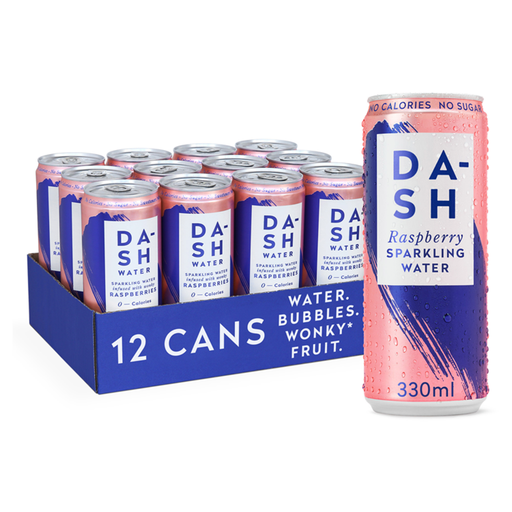
This raspberry-flavoured sparkling-water multipack is an option for after-school snacks when individual cans and fizz suit the household; it is not a plain-water option.
 No image available
This 12-pack of 330ml cans suits a snack-time serving for someone who enjoys raspberry flavour and fizz. The listed ingredients are carbonated spring water, raspberry extract, natural flavourings and citric acid; the Raspberry product lists 0g sugars per 330ml, and DASH says its range has no sweeteners. It is flavoured sparkling water rather than plain water, so check the current can label before serving.
Plain water is a straightforward choice. The NHS identifies water and milk as the drinks to give children and advises avoiding sugary fizzy drinks, squash and juice drinks.
No. Volvic’s Mango Passion and Strawberry 330ml sparkling cans list acesulfame K and sucralose, while DASH says its range has no sweeteners. Read the ingredient list for the exact drink and flavour.
No. The cited Tesco and Sainsbury’s plain-water multipacks include bottles, while Volvic lists 4 x 330ml sparkling-water cans and DASH lists a 16-can mixed trial pack. Confirm the container type, size and count on the exact listing.
No deposit should be assumed for a can bought now on the basis of the forthcoming scheme. The Department for Environment, Food & Rural Affairs says the scheme is scheduled for October 2027 and describes a size range of 150ml to 3 litres for qualifying single-use plastic and metal drinks containers; check the applicable rules when it begins.
Check your local collection instructions. In England, the Department for Environment, Food & Rural Affairs says waste collectors must collect metal among household dry recyclables by default from 31 March 2026; local arrangements can differ.