
24/7 Customer Support

Free returns

Same-day & Next-day Delivery

Quality Guaranteed

Unlock Your Welcome Offers: FREE Delivery | Up to 80% OFF | Free 30-day JoyPlus trial
Download the APP
Finding the right art supplies can feel overwhelming. You want the precision of a pencil for detailed drawing, but also the fluid, expressive finish of watercolour paint. This is where watercolour pencils come in, offering a versatile bridge between two distinct mediums. Whether you are an aspiring artist, a dedicated colouring enthusiast or looking for creative tools for your family, choosing the right set is key.
This guide is designed to help you navigate the options. We will outline what to look for when selecting a watercolour pencil set and present some carefully chosen recommendations to help you find the perfect tools for your next project.
To make an informed choice, it helps to understand a few key features. Focusing on these aspects will ensure you select a set that aligns with your artistic goals and budget.
The defining feature of water soluble colouring pencils is their ability to transform with water. The quality of the pigment and its binder determines how vibrant the colours are and how smoothly they dissolve. High-quality aquarelle pencils will have rich pigments that activate easily with a wet brush, allowing you to create seamless washes and gradients without leaving behind grainy pencil marks. Lower-quality pencils may not dissolve completely, resulting in a less polished finish.
A pencil's lead, or core, is its heart. For artists who enjoy detailed work, a durable lead that resists breaking under pressure is essential. Many artist watercolour pencils feature special bonding processes (often referred to as SV or secural bonding) that secure the lead within the wooden casing, significantly reducing breakage. The core's thickness also matters. A standard 2.8mm lead offers a good balance for both drawing fine lines and shading larger areas, while thicker cores are excellent for bold strokes and are often more robust for use by children.
Consider who will be using the pencils and for what purpose. Are you a hobbyist exploring new techniques? An art student needing reliable drawing pencils for artists? Or a parent seeking a multi-functional, non-toxic option for a child? Some sets are designed for professional-level blending and lightfastness, while others prioritise durability and versatility, even functioning as wax crayons or working on surfaces like glass.
Here are our recommendations, selected to cater to a range of artistic needs and skill levels.

Why It Stands Out: This set from the STABILO watercolour pencils ARTY line is a fantastic all-rounder. It provides a rich and vibrant palette that performs well both dry and wet. Its key strength lies in its versatility; you can apply it to dry or damp paper, or even lift colour directly from the pencil tip with a wet brush for more controlled watercolour effects.
Pros:
Who is it for: Hobby artists and students who want a reliable and versatile set for experimenting with various watercolour pencil techniques.

Why It Stands Out:Faber-Castell colouring pencils are known for their quality, and this set is no exception. The pencils feature fully water-soluble leads that produce brilliant colours and smooth gradients. A significant feature is the special SV bonding, which makes the leads highly break-resistant. The set also includes a brush and is made from wood sourced from sustainable forestry.
Pros:
Who is it for: Artists of all levels, from beginners to more experienced creators, who value durability, comfort and environmentally conscious materials.
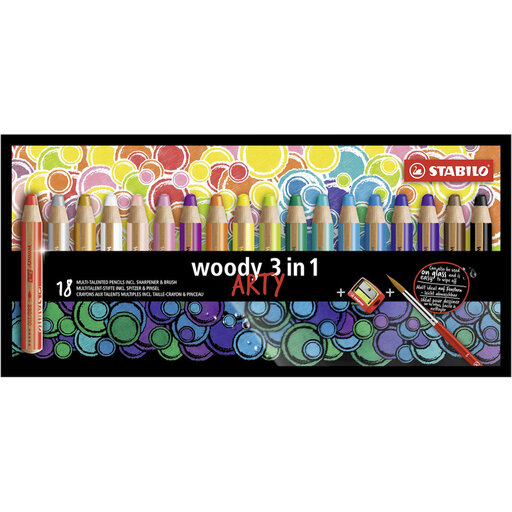
Why It Stands Out: The STABILO woody 3 in 1 is a true multi-tasker. It functions as a coloured pencil, a watercolour and a wax crayon all in one. Its chunky XXL core delivers an impressive amount of colour, equivalent to eight standard pencils, making it ideal for covering large areas. The high opacity means it shows up brilliantly even on dark paper and can be used on non-porous surfaces like glass, from which it is easily wiped away.
Pros:
Who is it for: Young children, crafters and anyone looking for a robust, multi-purpose colouring tool that encourages bold, experimental creativity.
If these recommendations aren't quite what you're looking for, or if you'd like to browse a wider variety, there are many other options available.
Explore our full range of assorted colour pencils to find the perfect set for your creative needs.
1. What is the difference between watercolour pencils and regular coloured pencils? The main difference is the binder used in the pencil's core. Regular coloured pencils use a wax or oil-based binder that is not water-soluble. Watercolour pencils use a water-soluble binder, which allows the pigment to dissolve and spread like watercolour paint when you add water with a brush.
2. How do you use watercolour pencils? There are several techniques. You can draw on your paper first and then go over the drawing with a wet brush to blend the colours. Alternatively, you can wet the paper first and draw on the damp surface for softer, more diffused lines. You can also lift pigment directly from the pencil tip with a wet brush and apply it to the paper like traditional paint.
3. Can you use watercolour pencils on any paper? While you can use them on standard drawing paper, you will get much better results with watercolour paper or heavy-grade mixed-media paper. These papers are designed to handle water without buckling, warping or pilling, which allows the colours to blend smoothly and absorb evenly.