
24/7 Customer Support

Free returns

Same-day & Next-day Delivery

Quality Guaranteed

Unlock Your Welcome Offers: FREE Delivery | Up to 80% OFF | Free 30-day JoyPlus trial
Download the APP
A waterproof motorcycle tail bag can make commuting, touring and adventure riding more practical, but the product listing does not always tell the full story. A large capacity figure may look appealing while the bag still proves awkward to fit, difficult to seal or unstable when loaded.
Before buying motorcycle rear seat luggage, check these common pitfalls:
For regular wet-weather riding, look for a substantial waterproof material such as PVC or TPU rather than relying on a generic “rainproof” description. PVC can provide a firm, structured feel, while TPU is commonly chosen for a more flexible dry-bag construction.
The closure is equally important. A roll-top design works by folding the opening several times before fastening the buckle. The 50L TPU model specifies rolling the top down four to five times before securing its magnetic buckle. This is a useful practical instruction, rather than a vague waterproof claim.
Remember that no soft luggage should be treated as permanently submersible. Keep sharp objects away from the inner surface, wipe off rain after use and store the bag dry. Avoid prolonged exposure to high temperatures, which may accelerate material ageing.
Choose capacity according to the items you carry, not simply the largest number available.
A 50L or 66L motorcycle tail bag is often easier to balance than an oversized bag when you do not need expedition-level storage. Large luggage can affect handling, especially if heavy items are placed high or far behind the rider.
A dependable mounting system should include adjustable straps, reinforced attachment areas or quick-release buckles. Before setting off, pull each strap tight and check that the bag cannot move sideways or forwards into the rider.
Reflective motorcycle luggage can add visible detailing in low-light conditions, but it should not replace the motorcycle’s required lights, reflectors or a properly visible registration plate. Do not cover indicators, rear lamps or number plates with the bag.
Pack heavier items low and towards the centre of the motorcycle. Keep delicate objects inside a separate pouch and avoid exceeding the stated capacity. A neat load is easier to compress under the roll-top and less likely to shift during cornering.
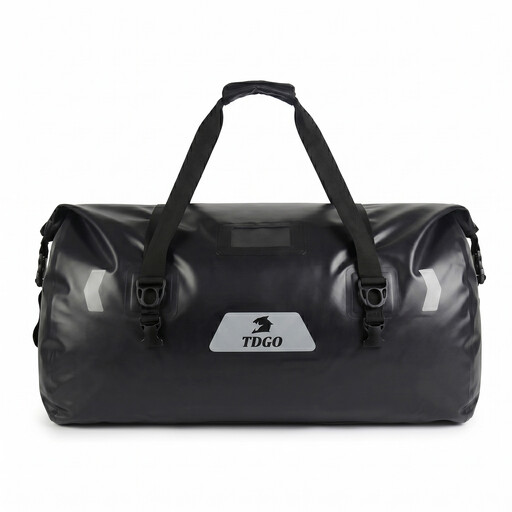
Why This Fits Their Persona: A practical size for UK commuting, scooter use and short trips where a pannier bag or rucksack offers insufficient weather protection.
Its 36L capacity reduces the temptation to overpack, while the PVC roll-top closure provides a defined sealing method.
Listed features include reflective warning detailing, quick-release straps and dimensions of 41 × 26 × 28cm.
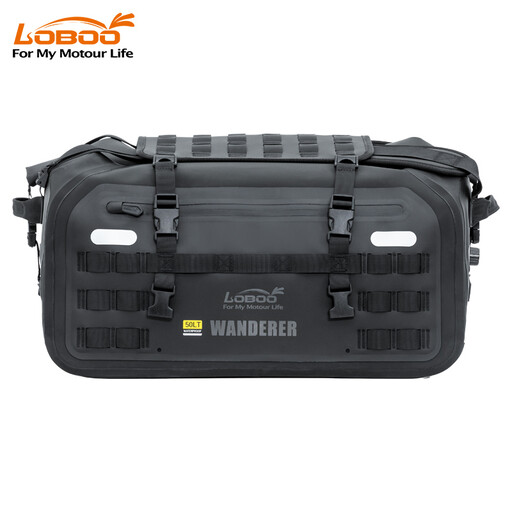
Why This Fits Their Persona: A considered choice for riders who want a flexible TPU construction and a moderate capacity for commuting, touring or adventure riding luggage.
The listing gives specific sealing instructions and a stated 35cm maximum rear-seat or rack width, helping buyers check fit before ordering.
Made from heavy-duty TPU and supplied with four adjustable buckle straps and backpack straps.
Why This Fits Their Persona: Its larger format suits long-distance touring, camping clothing and bulky outdoor equipment when a small motorcycle rear seat bag is not enough.
The product specifies a PVC roll-top, reinforced double bottom and four fixed straps, addressing sealing and attachment concerns.
The 66L size measures 60 × 32 × 33cm and includes reflective detailing plus quick-release strap compatibility.
Why This Fits Their Persona: The largest listed option is intended for riders carrying substantial camping kit, spare layers and travel supplies on longer outdoor journeys.
The stated 70 × 37 × 38cm dimensions make it easier to assess clearance and balance instead of relying on capacity alone.
Features include a PVC roll-top, reflective warning elements, reinforced panels and quick-release strap compatibility.
Use this routine whenever you install waterproof motorbike luggage:
We have compiled a complete, real-time list of products that fully satisfy these strict selection criteria and UK safety regulations.
Yes, provided its capacity matches your daily load and it can be secured without obstructing the motorcycle. A 36L model may suit office clothing and personal items, while a 50L option gives more room for footwear or wet-weather layers.
Keep the contents below the closure line, roll the top down several times and fasten the buckle firmly. Do not rely on the bag when it is submerged, and inspect it for punctures or damage after carrying sharp equipment.
Several designs are listed for motorcycles, scooters and off-road vehicles, but compatibility depends on the available rear seat or rack. Measure the mounting area first and confirm that the straps can be routed safely without touching hot or moving parts.