People demonstrating handwritten notes
If you move notebooks, worksheets or diagrams into view, check that the camera can point steadily at the page and keep your usual handwriting readable as its position changes.


Choose an autofocus webcam if you move pages during recording, and look for framing controls that keep the writing visible without showing more of the shared bedroom than necessary. A fixed-focus model can suit a stable overhead setup, but its stated focus range and connection requirements need to match your arrangement. In either case, plan the mount and preview the full recording frame before filming.
If you move notebooks, worksheets or diagrams into view, check that the camera can point steadily at the page and keep your usual handwriting readable as its position changes.
If someone else uses the bedroom, you may need a tighter view of the desk, a way to block the lens when idle and an arrangement that avoids recording the other occupant or their belongings.
If a tripod or arm can stay in one position, a fixed-focus camera may be an option. Measure the lens-to-page distance against that model’s stated focus range before choosing it.
Work out where the camera can sit and how much of the page it must show, then check focus and the surrounding room in a recording made with your intended app.
| Concern | What to check | Who this matters to |
|---|---|---|
| Readable handwriting | Check autofocus behaviour, or measure the stated fixed-focus range against the lens-to-page distance. Record a sample of your usual writing. | If I move sheets while explaining them, I need the writing to remain readable rather than relying on the resolution printed on the box. Around 36% of consumers would put handwriting clarity first. |
| Room framing and privacy | Check whether the field of view can be changed and preview the entire frame; confirm how the lens can be blocked when idle. | When I film at a shared desk, I want the page visible without including another person or their belongings. Keeping the room out of frame would be the primary concern for around 36% of consumers. |
| Overhead setup | Confirm a compatible, stable desk-facing mount and the connection needed for the recording mode you intend to use. | If my camera cannot stay aimed at the paper while I write, its other controls will not solve the setup problem. Roughly 28% of consumers would prioritise mounting and compatibility. |
A monitor position may not give you a steady view down onto the paper. Logitech documents a tripod attachment for the C920, while Elgato specifies a 1/4-inch mounting thread for Facecam MK.2.
Measure the position needed to fit your usual page in the frame, then check the camera, mount and focus distance together.
A separate tripod, desk arm or compatible adapter may be needed.
A wide frame can leave handwriting occupying less of the image and include more of the bedroom. AnkerWork lists 65°, 78° and 95° settings for PowerConf C200 through its software; Logitech lists a fixed 78° view for C920.
Use the narrowest view that still contains the page and intended hand movements, then inspect a short recording for readability and unwanted background.
Elgato states a 30–120 cm focus range for Facecam MK.2. An improvised camera position could put the page outside that range.
Measure from the lens to the paper before selecting a fixed-focus model, especially if you expect to change the camera height.
A different mount or a repositioned desk setup may be necessary to keep the page within range.
A closed cover blocks the lens when idle; it does not control what appears in an active recording. In its home-camera guidance, the Information Commissioner’s Office advises limiting capture of other people’s property where possible.
Preview the whole frame and agree the recording arrangement with anyone sharing the room. Close the cover or disconnect the camera when you have finished.
PowerConf C200 is worth considering when you want to adjust the view between a page and a person in a shared room.
C920 offers an autofocus route when a documented tripod attachment matters more to your setup than selectable lens framing.
Facecam MK.2 is a fixed-focus option for a desk rig whose camera-to-page distance can stay consistent.
These j5create webcams offer different controls to consider for filming a page. Check the recording frame and a stable desk-facing mounting arrangement for either model before choosing.
 No image available
Consider the JVCU435 if remote-controlled digital zoom would help you adjust how the page appears in frame; it is listed as a 4K webcam. Check focus at your intended lens-to-page distance and confirm a secure overhead mounting method.
 No image available
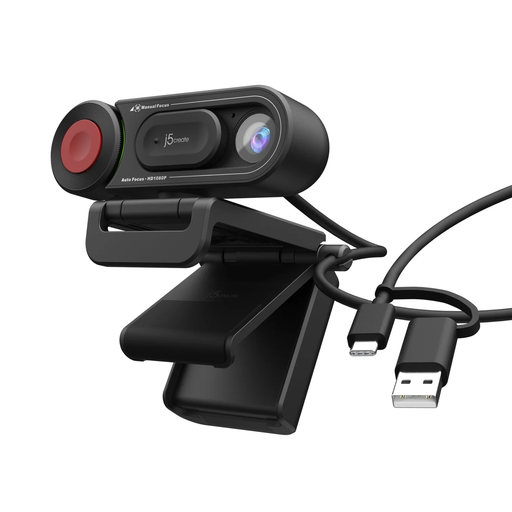
Consider the JVU250 if you want to switch between automatic and manual focus while positioning handwritten pages. Record a sample of your usual writing and confirm that you can aim the camera steadily at the desk without including unwanted background.
You need a stable way to aim the webcam down at the page; a tripod or arm is one way to do that. Check the camera’s attachment and the mount’s reach before buying, then make sure writing or turning a page does not shake the image.
Autofocus is more adaptable if you move notebooks or change camera height, while fixed focus can suit a repeatable measured position. For Elgato Facecam MK.2, check that the page remains within its stated 30–120 cm focus range.
Frame the page as tightly as your writing and hand movements allow, and check the full recorded image rather than only its centre. PowerConf C200 has field-of-view settings listed by AnkerWork; with a fixed-view camera such as Logitech C920, camera placement becomes particularly important.
Agree on the recording arrangement and reposition the camera to avoid capturing the other person or their belongings. The Information Commissioner’s Office advises limiting unnecessary capture in its guidance on home cameras, but that guidance is not a webcam-specific ruling on every shared-bedroom recording.