Interviewees dealing with office noise
If conversations, typing or ventilation will be audible during the call, prioritise a microphone setup that lets the interviewer follow your answers. Camera resolution alone will not address that need.


Choose how you will be heard before choosing video resolution. A webcam with a noise-reducing microphone may suit intermittent office noise, but for persistent nearby conversation or keyboard noise, use a webcam for video and a wired headset with a noise-cancelling boom microphone for speech. Test both devices in the interview app from the desk you plan to use.
If conversations, typing or ventilation will be audible during the call, prioritise a microphone setup that lets the interviewer follow your answers. Camera resolution alone will not address that need.
If the available desk has uneven lighting, consider light correction and framing alongside audio. Previewing the image from that desk will help you decide whether those camera controls matter.
If the webcam will remain attached between interviews, a physical shutter or cover lets you block the lens when it is not in use.
Consider it when: Office noise is intermittent, you can sit near the webcam and you want a one-device setup for video and speech.
Accept the limitation: A built-in microphone is farther from your mouth than a headset boom; noise-reduction claims do not guarantee clear speech over nearby conversations.
Consider it when: Nearby talkers, typing or ventilation are likely to continue throughout the interview and being heard is your main concern.
Accept the limitation: You will need to set up a second device and wear a visible cable and microphone boom.
| Concern | What to check | Who this matters to |
|---|---|---|
| Clear speech | Check the stated microphone features and make a test call with the interview app’s available noise controls. | If nearby conversations could obscure my answers, I need the interviewer to hear my voice clearly. Around 46% of consumers put reliable audio first. |
| Image and lighting | Check for Full HD or higher video, light correction and framing controls that work with your computer. | At a dim or backlit desk, I want my face to remain clear on screen once audio is manageable; around 36% of consumers prioritise the image. |
| Simple setup and privacy | Confirm the connection, whether framing controls need software, and whether a physical shutter or cover is built in. | If I use the camera only occasionally, I want to set it up without fuss and cover the lens afterwards. Around 18% of consumers put that simplicity and privacy first. |
Higher video resolution addresses image detail, not whether an interviewer can distinguish your speech from nearby sounds. Logitech describes its Zone Wired headset microphone as designed to suppress sounds including keyboard clicks, nearby talkers and ventilation noise.
Decide on the microphone setup first. Consider higher-resolution video for a separate image need, not as a substitute for an audio check.
The interview app may select a different microphone from the one you intend to use, and its noise controls may need adjusting.
Make a test call from the actual desk, select the intended microphone and check the available noise-suppression settings. Microsoft Support documents test calls and noise-suppression controls in Teams.
A wide view may include colleagues, screens or office clutter, while a fixed angle gives you less control over the background.
Preview the shot before joining. For a seated interview, check whether the camera’s fixed view suits your desk or whether adjustable framing would be useful.
Its webcam range includes Full HD models with different framing and privacy features, alongside separate office headsets.
Its work-focused webcams include models with selectable framing, privacy covers and manufacturer-described microphone processing.
The Kiyo Pro Ultra is an option to examine when desk lighting is a particular concern.
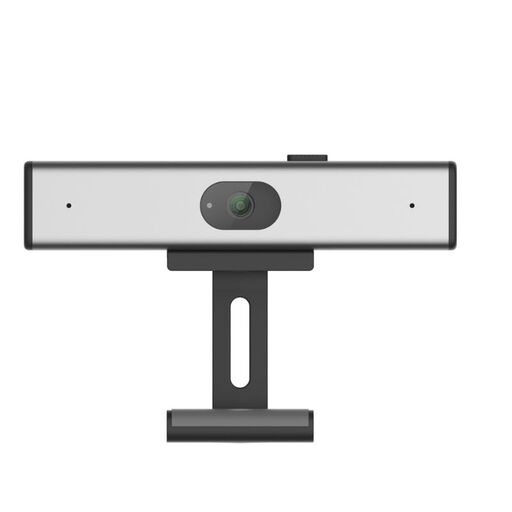
This webcam is a one-device option to consider when office noise is manageable. Test its microphone at your desk before relying on it for an interview; use a separate headset if speech remains difficult to hear.
 No image available
For an interview with manageable office noise, its stated noise-reduction microphone makes this a webcam-only setup to consider, provided a test call confirms that your voice is clear.
It may be enough when background noise is intermittent, you sit near the webcam and a test call confirms that your answers are clear. For persistent nearby speech or typing, consider a webcam for video and a wired headset with a noise-cancelling boom microphone for audio.
Make a test call from the desk you will use, with the intended camera and microphone selected in the interview app. Check brightness, framing and available noise controls; Microsoft Support documents test calls and noise-suppression settings for Teams.
A physical shutter or cover is useful if the webcam stays connected between calls because it blocks the lens when not in use. Check whether it is built into the particular model you are considering.
Ask the recruiter how the interview and your information will be used, and read the recruitment privacy information they provide. The Information Commissioner's Office explains that employers and recruiters have UK GDPR obligations when handling candidate information during recruitment.