What matters when choosing?
For a science observation in a shared studio, establish where the object will sit relative to the lens before choosing a camera position, lighting controls and capture mode.
| Concern |
What to check |
Who this matters to |
| Object focus and detail |
Measure the lens-to-object distance; check autofocus or the stated focus range at the intended resolution. |
I need small details to remain sharp as I reposition an observation; around 36% of consumers put object focus and detail first. |
| Shared framing |
Check the field of view and whether a stable mount can show the observation, hands and relevant presenters. |
When explaining from beside the work surface, I need viewers to see what my hands are doing without losing the presenter; roughly 29% of consumers prioritise shared framing. |
| Lighting and colour |
Check available exposure and white-balance controls against the planned studio lighting. |
If the appearance of a sample matters to my explanation, I need an image that remains usable under the room’s lighting; about 21% of consumers place lighting and colour first. |
| Connection and audio |
Confirm the USB port and capture-application requirements for the chosen video mode; plan for speakers’ distance from the microphone. |
I need the camera to work with my computer while people speak from their planned positions; around 14% of consumers give connection and audio practicality priority. |
Brands to consider
These product lines illustrate different approaches to focus, desk-facing capture and moving-subject framing; suitability depends on the exact model and setup.
Logitech
USB webcams with model-specific options for changing focus distance or presenting desk material.
- Logitech lists autofocus, 4K/30 capture, selectable 90°/78°/65° fields of view and a 1/4-inch tripod thread for Brio 4K.
- MX Brio’s Show Mode provides a desk-facing presentation option, but its close-focus suitability still needs checking for the intended observation.
Elgato
Creator-oriented webcams with published focus and connection requirements for planned capture positions.
- Elgato lists 2160p60 over USB 3 for Facecam 4K, with a fixed-focus range of 30–120 cm at 4K.
- That fixed range requires a measured object position; USB 2 does not provide Facecam 4K’s listed 4K modes.
OBSBOT
Tracking-camera options for studio setups where a presenter or subject changes position.
- OBSBOT lists human, animal and object tracking, 4K/30 and 1080p/60 for Tail Air.
- Check how Tail Air’s control, power and connection arrangements fit the studio before treating it as a substitute for a conventional USB webcam.
Joybuy webcams for demonstrations
These two j5create webcams offer different starting points for a demonstration: one has 4K capture and remote-controlled digital zoom; the other has an auto/manual focus switch. For either, check the observation at its planned distance before deciding whether it will show the required detail.
 Image unavailable
j5create JVCU435 4K webcam with remote control, black and silver
Consider this model if remote reframing would help you switch attention between a presenter and demonstration area. Its stated features include 4K video and 5x digital zoom; confirm its focus behaviour at your planned observation distance before choosing it for small details.
View on Joybuy
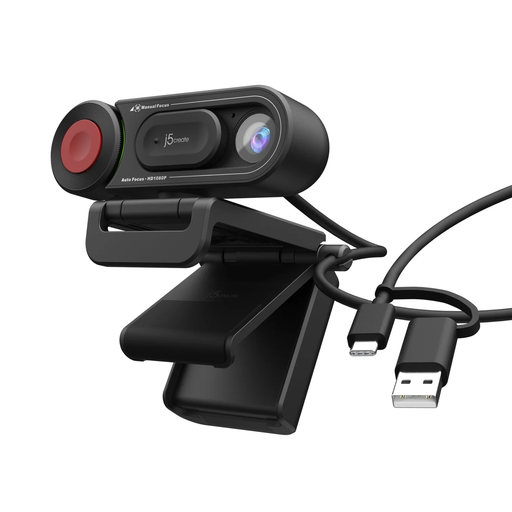 Image unavailable
j5create JVU250 HD webcam with auto and manual focus switch, black
Consider this model if you want to switch between auto and manual focus during a demonstration. Its listed video resolution is 720p, so check whether it shows the required detail, and confirm that the observation can be focused at its planned distance.
View on Joybuy
Frequently asked questions
Should I choose autofocus or fixed focus for a science observation?
Choose autofocus if the observation will move towards or away from the lens; fixed focus can work when its stated range covers a position you can maintain. For comparison, Logitech specifies autofocus for Brio 4K, while Elgato specifies a 30–120 cm fixed-focus range at 4K for Facecam 4K.
Will a 4K webcam show a small specimen clearly?
Not necessarily: 4K output does not establish close-focus capability. Check the model’s focus behaviour, the lens-to-specimen distance, camera position and lighting before relying on its resolution.
What do I need to run a webcam at 4K/60?
Check the exact camera mode alongside the computer connection and capture application. Elgato lists Facecam 4K’s 2160p60 MJPEG mode over USB 3, while its listed USB 2 modes reach 1080p60 or below.
Can a built-in webcam microphone pick up everyone in a shared studio?
Do not assume it will cover speakers across the room. Logitech specifies a range of up to 1.2 m for Brio 4K’s integrated microphones; compare that with each presenter’s position and consider separate audio if the camera needs to sit farther away.
What should I consider when replacing an old webcam?
Plan how to dispose of the old device as well as how to connect the new one. GOV.UK guidance explains that UK waste electrical and electronic equipment rules aim to reduce electrical waste through recovery, reuse and recycling; check the disposal options available to you.


