Hosts serving tea and coffee
If many guests are likely to use milk, compare bottle sizes with the amount you expect to serve and the fridge space available. A larger bottle is less useful if much of it will remain open after the event.


For a wedding buffet, choose larger bottles of fresh semi-skimmed milk when demand is predictable and refrigerated storage is dependable. Filtered semi-skimmed milk may give you more time to use leftovers: Marks & Spencer lists seven days after opening for its filtered 2L milk, compared with three days for its ordinary fresh 1L milk, provided both are kept at 0°C to +5°C. Check the pack instructions before planning around long-life milk, and offer skimmed milk as a clearly labelled separate choice if guests specifically request it.
If many guests are likely to use milk, compare bottle sizes with the amount you expect to serve and the fridge space available. A larger bottle is less useful if much of it will remain open after the event.
Consider when bottles will be opened, where they will be chilled and whether leftovers can be used within each pack's instructions. Filtered milk may offer more flexibility, but it still needs refrigerated storage.
Check whether guests mean semi-skimmed milk or specifically want skimmed milk. They are different product types, so a skimmed option should be identified separately at the buffet.
Set the milk type first, then match pack sizes and storage instructions to the expected service and likely leftovers.
| Priority | What to check | Your needs |
|---|---|---|
| Milk type | Read whether the pack says semi-skimmed or skimmed. Compare declared fat figures only with their stated per 100ml or per 100g basis. | I want semi-skimmed milk for general service, but I would provide a separately labelled skimmed choice if that is what a guest requested. |
| Pack size | Estimate uses across drinks and buffet foods. Choose how many bottles to open at once, rather than relying on pack size alone. | If demand is predictable, a larger bottle may be practical. With uncertain uptake, I would rather leave some smaller packs unopened. |
| Opened-pack life | Check each product's opened-life and use-by instructions. Marks & Spencer states three days after opening for its ordinary fresh 1L milk and seven days for its filtered 2L milk, both at 0°C to +5°C. | I need to know whether any milk left after the wedding can be used within the particular pack's instructions. |
| Storage and service | Plan chilled space from delivery through service. Check the exact long-life pack's instructions, particularly what to do after opening. | Milk must fit the venue's storage arrangements as well as the buffet setup; a filtered label does not remove the need to chill fresh milk. |
| Allergen information | Identify dairy milk clearly and keep it distinct from non-dairy alternatives. For catered service by a food business, check the arrangements for allergen information and cross-contact. | I want guests to be able to tell which jug contains milk without relying on its position beside the drinks. |
They are different milk types. Waitrose & Partners lists 0.4g fat per 100ml for Arla B.O.B skimmed milk, while Tesco Groceries lists 1.8g per 100ml for its British semi-skimmed 3.408L bottle.
Ask which type is wanted, and label a skimmed alternative separately rather than silently substituting it.
A large bottle can leave more milk to use after the event. Tesco Groceries says its 3.408L semi-skimmed bottle is best consumed within five days of opening and by its use-by date.
Estimate demand for drinks and food, open bottles as needed and follow each pack's refrigerated-storage directions.
Milk left in an opened bottle may have to be discarded if it cannot be used within those directions.
Marks & Spencer instructs shoppers to keep its filtered fresh semi-skimmed milk at 0°C to +5°C. A long-life designation alone does not establish how a particular pack should be handled after opening.
Arrange suitable chilled service for fresh milk and read the long-life pack's opened-storage instructions before using it at the buffet.
Milk is a listed allergen. GOV.UK and Food Standards Scotland say food businesses must provide allergen information for food and drink; Food Standards Scotland also emphasises separation, storage and labelling to manage cross-contact.
For a catered buffet, identify each option and keep its containers and utensils distinct.
These brand examples illustrate different milk formats; check the exact pack rather than applying one product's instructions to a whole range.
A standard fresh semi-skimmed example for a buffet with predictable demand.
Ordinary fresh and filtered semi-skimmed products with different stated opened lives.
Fresh, filtered and 1L long-life semi-skimmed formats appear in Waitrose & Partners category listings.
A filtered semi-skimmed option appearing in Tesco Groceries and Waitrose & Partners listings.
Arla B.O.B is a skimmed alternative when the request is for skimmed milk rather than semi-skimmed.
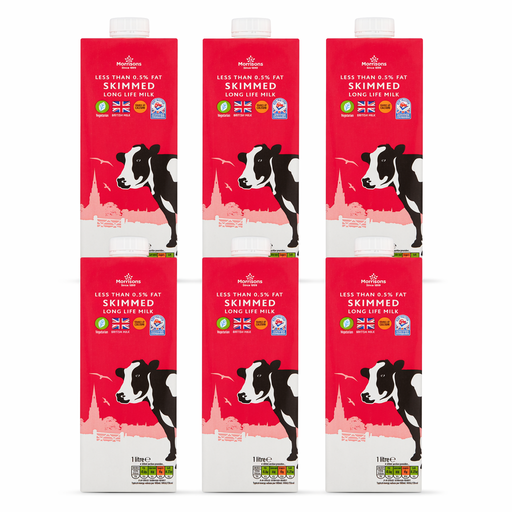
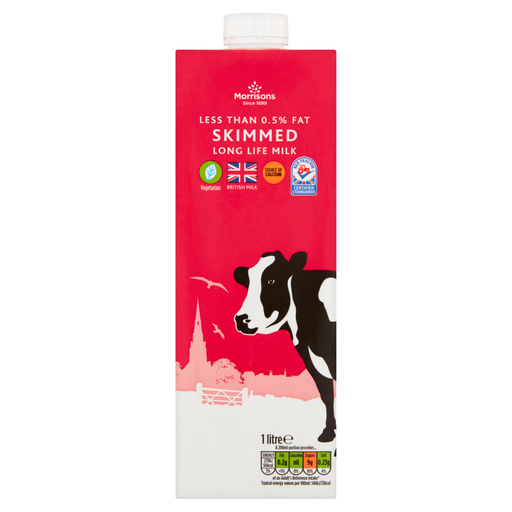
These Morrisons UHT products are skimmed-milk options for a separately labelled choice at the buffet. Neither is semi-skimmed milk, so they do not replace the fresh, filtered or long-life semi-skimmed formats discussed above.
 No image available
Six separate 1 litre packs allow cartons to be opened as needed for a separately labelled skimmed-milk choice. Refrigerate after opening and check the carton's use instructions. The product information states that this milk is not suitable for children under 5.
 No image available
A single 1 litre carton is an option when you want less skimmed milk alongside a semi-skimmed selection. Refrigerate after opening and check the carton's use instructions. The product information states that this milk is not suitable for children under 5.
No. They are labelled as different milk types. Tesco Groceries lists 1.8g fat per 100ml for its British semi-skimmed 3.408L bottle, while Waitrose & Partners lists 0.4g per 100ml for Arla B.O.B skimmed milk. Identify a skimmed option separately if you serve both.
Follow the exact pack's refrigeration instructions throughout delivery and service. Marks & Spencer specifies 0°C to +5°C for its ordinary and filtered fresh semi-skimmed examples. For food-business catering, Food Standards Agency MyHACCP guidance calls for adequate refrigeration and temperature monitoring where needed for food safety.
Yes, for the Marks & Spencer filtered 2L example: its instructions specify 0°C to +5°C. Its stated seven-day period after opening does not mean it can be left at room temperature during service.
Yes, when the buffet is provided by a food business. GOV.UK and Food Standards Scotland guidance says food businesses must provide allergen information for prepacked and non-prepacked food and drink; milk is one of the listed allergens. Keep the information clear when milk is decanted into serving jugs.
A separate jug alone does not address cross-contact. Food Standards Scotland stresses careful separation, storage and labelling of ingredients, so a caterer should also manage the utensils and serving area used for dairy and non-dairy options.