Hosts with a no-added-sugar brief
If the event requirement concerns added sugar, check the exact wording on the tin and its ingredient list. A sugars figure alone does not tell you whether sugar was added to the recipe.


If the buffet brief specifies no added sugar, choose a tin labelled no added sugar rather than assuming a low-sugar label means the same thing. Sainsbury's lists Heinz No Added Sugar Cream of Tomato Soup at 2.6 g sugars per 100 g, compared with 4.8 g for standard Heinz Cream of Tomato Soup, which lists sugar as an ingredient. Both contain milk; check the current tin before serving, and arrange suitable hot holding if a caterer or other food business will run the buffet.
If the event requirement concerns added sugar, check the exact wording on the tin and its ingredient list. A sugars figure alone does not tell you whether sugar was added to the recipe.
Cream of tomato soup can contain milk even when it is suitable for vegetarians. Sainsbury's lists milk ingredients in both Heinz tomato soups discussed here, so identify the exact recipe guests will be served.
A food business running a hot buffet needs suitable holding equipment and a replenishment plan. The Food Standards Agency advises keeping hot food at 63°C or above during hot holding.
Decide whether the brief is about added sugar or the total sugars figure, then check the exact tin against the serving and allergen requirements.
| Priority | What to check | Your needs |
|---|---|---|
| Sugar claims | Read the claim, ingredients and sugars per 100 g together. Sainsbury's lists 2.6 g sugars per 100 g for Heinz No Added Sugar Cream of Tomato Soup; its standard Heinz tomato soup lists sugar as an ingredient and 4.8 g per 100 g. | I need a soup that meets the buffet's actual wording: no added sugar is a different requirement from comparing total sugars. A no-added-sugar soup can still contain sugars. |
| Food labels | Use traffic-light labelling as a prompt to read the full nutrition panel, then compare sugars on the same per-100 g basis. Check the current tin rather than relying on an older listing. | I use food labels while shopping and want to compare the tins consistently. In the Food Standards Agency and Ipsos Northern Ireland's 2024 survey of 611 Northern Ireland respondents, conducted from September to November, 49% actively used traffic-light labelling when shopping for food; that figure does not describe wedding-buffet buyers. |
| Allergens | Check the exact tin's allergen declaration and any accompaniments. Government allergen guidance says retail and catering food businesses must provide allergen information for prepacked and non-prepacked food and drink. | If guests need to avoid milk, I cannot assume that a vegetarian cream of tomato soup is suitable. I also need guests to be able to identify the soup and its allergens at service. |
| Hot service | Plan suitable hot-holding capacity and a way to monitor temperature. The Food Standards Agency's guidance for caterers says hot food should be held at 63°C or above; hot-holding equipment is not a substitute for reheating. | I want the soup to remain suitable for service throughout the buffet, with fresh batches prepared and replenished without relying on the display equipment to heat them. |
| Portions | Choose the portion size, then calculate how many servings each tin provides. Check the chosen soup's preparation directions and whether its stated quantity is for the contents of the tin or for soup after preparation. | Small cups and starter bowls call for different quantities. I need a serving plan before turning the number of guests into a tin count. |
Standard Heinz Cream of Tomato Soup lists sugar as an ingredient, while Sainsbury's lists the Heinz no-added-sugar version at a different sugars figure. Neither a low-sugar label nor a no-added-sugar label means the soup contains no sugars.
Write the requirement precisely, then compare the claim, ingredients and sugars per 100 g on the exact tin.
Sainsbury's lists milk ingredients in both Heinz tomato soups, and M&S lists dried skimmed milk and double cream in its Cream of Tomato Soup.
Check the current pack, identify each soup clearly and keep its allergen information available to guests. Where more than one dish is served, consider separate utensils to reduce confusion.
The Food Standards Agency distinguishes reheating food from holding it hot. Putting soup into a soup kettle or bain-marie before it is properly heated does not establish that it has reached a suitable serving temperature.
Reheat it separately until steaming hot, then use preheated hot-holding equipment and monitor the soup during service.
M&S notes that its product information can change. A previous online ingredient or nutrition listing may not describe the tins delivered for the event.
Before finalising the order, check the current packs for sugars, ingredients, allergens, storage directions and best-before dates.
These references help distinguish particular soups and product listings; a retailer or brand name alone does not establish that a tin meets a no-added-sugar brief.
Sainsbury's lists both Heinz No Added Sugar Cream of Tomato Soup and standard Heinz Cream of Tomato Soup in 400 g tins.
Tesco's tinned-soup category lists Heinz tomato soup alongside Campbell's condensed soups.
Its Heinz product listings give per-100 g sugars figures and ingredient information for comparing the two 400 g tomato soups.
M&S Cream of Tomato Soup is another 400 g tomato-soup option, rather than an established no-added-sugar substitute.
Tesco lists Campbell's condensed cream of chicken and cream of mushroom soups in its tinned-soup category.
This spicy parsnip and carrot tin is a different flavour from the tomato soups compared above. If no added sugar is a firm buffet requirement, check the claim and nutrition panel on its current pack before choosing it.
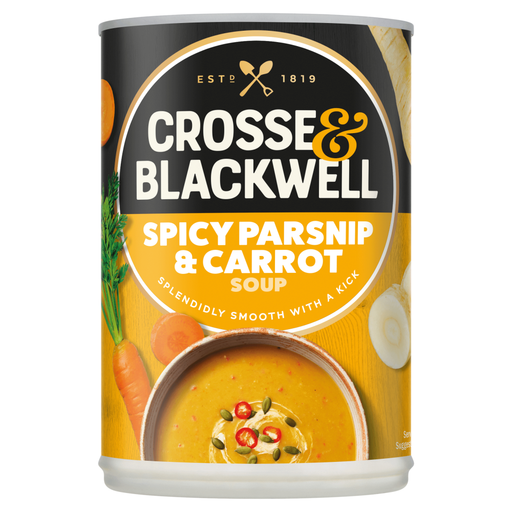 Image unavailable
A 400 g spicy parsnip and carrot soup to consider if the buffet menu can include a flavour other than tomato. Check the current tin for its sugars per 100 g and any no-added-sugar claim; also check its allergen declaration for celery, milk and wheat, plus its preparation instructions and serving yield.
No. Sainsbury's lists Heinz No Added Sugar Cream of Tomato Soup at 2.6 g sugars per 100 g. No added sugar describes what was added to the recipe, so read it alongside the nutrition panel rather than treating it as a claim of zero sugars.
That depends on the portion you serve: a 400 g tin would make two 200 g portions if each guest receives 200 g. Set the size of the tasting cup or starter bowl first, and check preparation and final yield for the particular soup before calculating the number of tins.
The Food Standards Agency's guidance for caterers says hot food should be held at 63°C or above. Heat the soup before placing it in suitable hot-holding equipment, and monitor it throughout buffet service rather than relying only on the equipment setting.
Yes, when the food is supplied by a food business. Government allergen guidance requires retail and catering food businesses to provide allergen information for prepacked and non-prepacked food and drink. Check the exact tins and identify the soup served: the Heinz and M&S cream of tomato soups described here contain milk ingredients.