Couples planning a mixed-guest buffet
A blended wrap may simplify the selection, while separate white and wholemeal wraps give guests a visible choice. Neither arrangement replaces a distinct option for anyone who needs to avoid gluten.


A wheat-and-white blend can serve as one compromise wrap; choose separate white and wholemeal wraps if you want guests to have those distinct options. Compare fibre on the exact packs rather than judging by colour, and plan any gluten-free food separately: the wheat-based options discussed here contain gluten. For a catered buffet operated as a food business, allergen information must cover the finished wraps, including their fillings.
A blended wrap may simplify the selection, while separate white and wholemeal wraps give guests a visible choice. Neither arrangement replaces a distinct option for anyone who needs to avoid gluten.
Check fibre per 100g as well as per wrap. Tesco Groceries lists 3.3g per 100g for Mission Deli Wheat & White and 6.9g per 100g for Mission Wholemeal; the exact product matters more than its colour alone.
Keep ingredient and allergen information for each assembled wrap, not only its tortilla. GOV.UK guidance says food businesses must provide allergen information for both prepacked and non-prepacked food; wheat is a cereal containing gluten.
Decide whether one blended wrap or distinct white and wholemeal choices suit the buffet, then check the labels and serving arrangements for every finished option.
| Priority | What to check | Your needs |
|---|---|---|
| Flour blend | Read the ingredients for both white wheat flour and wholemeal flour. Tesco Groceries describes Mission Deli Wheat & White as a wheat-flour wrap with wholemeal flour. | One wrap containing both flour types would simplify my buffet choice. |
| Distinct options | Choose separate products if guests should be able to select plain white or wholemeal. Check each pack’s ingredients rather than relying on its appearance. | I would rather let guests choose between white and wholemeal wraps than offer one blend. |
| Fibre comparison | Compare fibre per 100g first, then per wrap for the portion served. Tesco Groceries lists 3.7g per 100g for Tesco Plain White and 4.2g per 100g for Tesco Wholemeal; Sainsbury’s lists 10.1g per 100g for its Wholemeal Wraps. | Fibre content matters to my choice, so I want figures for the particular packs I plan to serve. |
| Allergen information | Check the current tortilla and filling labels, and account for sauces and preparation. GOV.UK guidance requires food businesses to provide allergen information for prepacked and non-prepacked food. | Guests need to identify allergens in each finished wrap before serving themselves; a wheat-based wrap cannot stand in for a specifically gluten-free one. |
| Serving plan | Check wrap size and pack count against the planned portions and fillings. Tesco Groceries lists six wraps for the Mission products cited here and eight for its plain white and wholemeal products. | I need portions that work with the planned fillings, rather than treating packs of different wraps as interchangeable. |
The wheat-based wholemeal and blended products described by Tesco Groceries contain wheat. Colour and grain wording cannot establish whether a wrap meets a gluten-free requirement.
Choose a separately labelled gluten-free product where needed, check its current label and plan preparation and serving to manage cross-contact.
A blend confirms flour composition, not a particular fibre level. Tesco Groceries lists 3.3g fibre per 100g for Mission Deli Wheat & White and 6.9g per 100g for Mission Wholemeal.
Use the ingredients to identify the blend, then compare the exact nutrition panels if fibre affects the decision.
Wraps can differ in size, so a per-wrap figure does not always compare equivalent amounts of food.
Compare fibre per 100g before using per-wrap figures to plan the portions guests will actually receive.
Fillings and sauces can introduce allergens absent from the tortilla. GOV.UK guidance requires food businesses to provide allergen information for the food they serve.
Keep an item-by-item record for finished wraps and update it when ingredients or suppliers change, so serving staff can give accurate information.
These labelled products illustrate different flour and fibre choices; check the current pack for the precise variant used at the buffet.
Its Deli Wheat & White and Wholemeal wraps illustrate the difference between a flour blend and a separately labelled wholemeal product.
Its Regular Flour Tortillas provide an example of the conventional wheat-flour route.
Its plain white and wholemeal eight-wrap products offer two separately labelled routes.
Its plain and wholemeal eight-wrap products provide another pair of separately labelled choices.
Its Wholemeal Tortilla Wraps are described by Marks & Spencer as a blend of white and wholemeal flour.
These options cover a conventional flour tortilla and a separately labelled gluten-free tortilla. Compare other exact packs if you want a wheat-and-white blend or a wholemeal wrap for the buffet.
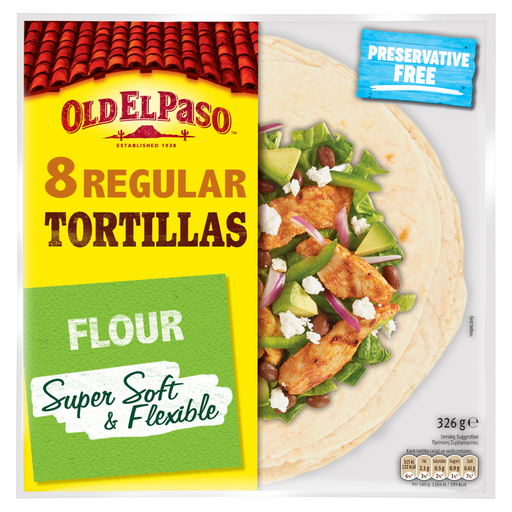 Image unavailable
A flour-tortilla option for guests who want that format. Check this pack’s ingredients and allergens before adding it to the buffet; the separate Old El Paso gluten-free product serves a different requirement.
 Image unavailable
A separately labelled gluten-free option rather than a white-and-wholemeal wheat blend. Check the current pack for other allergens, and keep its preparation and serving arrangements distinct where cross-contact matters.
Not necessarily: a wrap whose ingredients confirm both white wheat and wholemeal flour can provide one blended option. Buy separate products if you want guests to choose between plain white and wholemeal wraps; check their fibre panels if that distinction is part of your decision.
Not by virtue of their colour or name. The wheat-based wholemeal and blended products discussed here contain wheat; guests who need to avoid gluten require a specifically labelled alternative, with its current ingredients checked and cross-contact managed.
When the caterer or organiser is operating as a food business, GOV.UK guidance requires allergen information for prepacked and non-prepacked food. Record the ingredients and relevant allergens in each finished wrap, including fillings and sauces, rather than displaying only the tortilla packet details.
Compare the labelled fibre per 100g for a like-for-like quantity, then check per-wrap figures for the portions you intend to serve. Pack and wrap sizes vary, so a per-wrap figure alone can obscure the difference between products.