
24/7 Customer Support

Free returns

Same-day & Next-day Delivery

Quality Guaranteed

Unlock Your Welcome Offers: FREE Delivery | Up to 80% OFF | Free 30-day JoyPlus trial
Download the APP
Weeds rarely cause the same problem everywhere. Dandelions scattered through a lawn need different treatment from brambles in an overgrown border, moss between paving slabs or a stubborn tree stump. Choosing a weedkiller based only on a “fast action” claim can therefore lead to wasted money, damaged plants or repeated applications.
This guide explains the practical differences between garden weedkiller, lawn treatments, concentrates and ready-to-use sprays, then matches suitable options to common UK gardening situations.
A total weedkiller is designed to affect a broad range of vegetation. Applying it across grass can damage or kill the lawn as well as the weeds. For lawns, look for selective weed control specifically labelled for grass and check the permitted lawn types and application rates.
A large bottle does not automatically cover a large area. A ready-to-use weedkiller may be convenient but contain mostly water, while a weedkiller concentrate needs dilution but can cover a substantially larger area. Compare the stated coverage after mixing, not just the bottle size.
For example, the WEEDOL Tough Weedkiller Concentrate 500ml is listed with coverage of up to 250 m² when diluted according to its instructions. Actual results depend on correct mixing, weed density and application conditions.
Rapid weedkiller products can show visible deterioration quickly, particularly on actively growing foliage and in suitable weather. However, visible leaf damage is not always the same as complete root control. Deep-rooted perennial weeds may need careful treatment or repeat applications in line with the label.
Avoid spraying during rain, strong wind or conditions that could cause drift. Never assume a product is suitable for every surface or plant simply because it is marketed for general garden use.
The first decision is whether you want to preserve nearby plants.
Always read the product label to confirm the permitted application area. A path weedkiller should not automatically be used on lawns, flower beds or vegetable plots.
A ready-to-use weedkiller requires no measuring or dilution, making it useful for small areas and occasional spot treatment. It can also reduce preparation errors, although you still need to apply it evenly and avoid desirable plants.
Concentrates are generally more practical for larger gardens, allotments or repeated seasonal treatment. They require a suitable sprayer, accurate measurement and thorough cleaning after use. Pre-measured concentrate tubes can offer a middle ground by reducing the need to measure liquid manually.
Product labels should identify the active ingredient and give directions for use. Some options in this range are glyphosate-free weedkiller products using pelargonic acid, while others contain different active ingredients for lawn or systemic control.
Stated timings should be treated as product guidance rather than a guarantee. For instance, several rapid products list visible results in around three hours under suitable conditions, while a path weedkiller lists visible results in one to two days. Cold, wet or dry-stressed weeds may respond differently.
For UK use, follow the current label, keep products away from children and pets, avoid watercourses and comply with disposal instructions. Wear the protective clothing specified on the packaging, and do not spray edible crops unless the label specifically permits it.
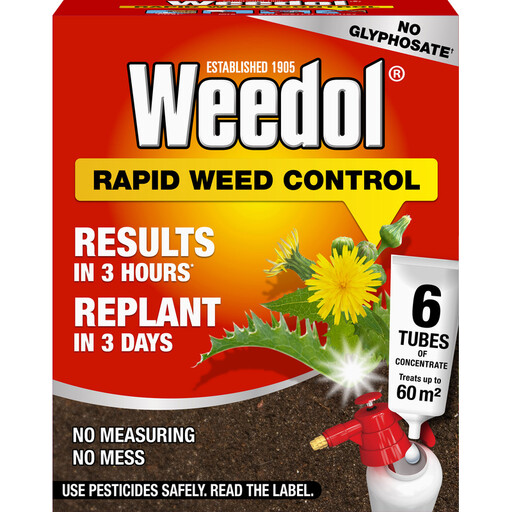
Why This Fits Their Persona: Pre-measured tubes suit first-time users handling occasional weeds around paths, beds and patios without buying a large bottle.
The six pre-measured tubes reduce guesswork when preparing a treatment and avoid paying for a large ready-mixed container for small jobs.
Pre-measured format; listed as rainproof after 10 minutes and suitable for several outdoor areas.
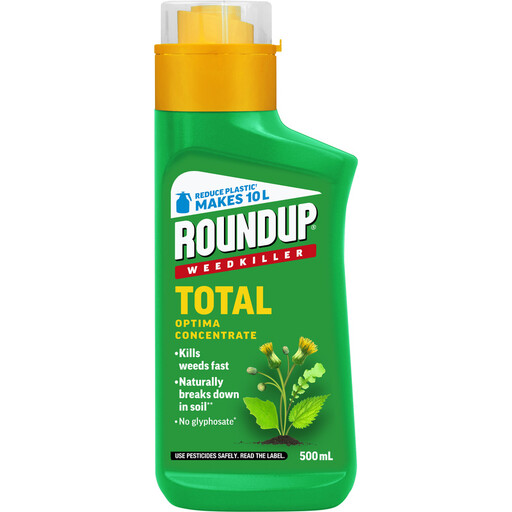
Why This Fits Their Persona: Suitable for gardeners wanting a glyphosate-free concentrate with broad garden applications and a stated coverage of up to 220 m².
The stated coverage makes the concentrate easier to compare with ready-to-use volumes, while the glyphosate-free formulation meets a specific ingredient preference.
Pelargonic acid formulation; concentrate format for larger areas and repeat treatments.
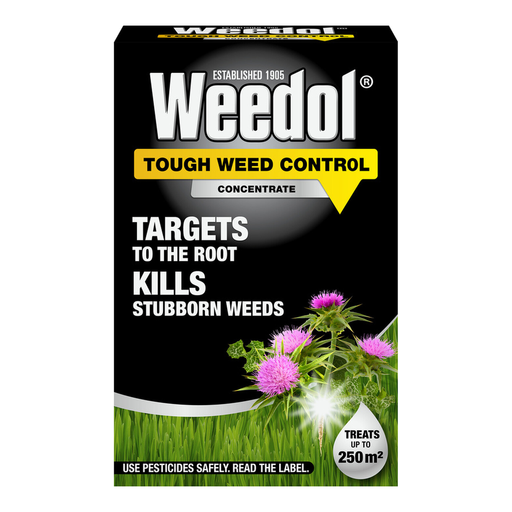
Why This Fits Their Persona: A practical match for larger gardens, allotments and areas affected by thistle, nettle, bramble and other tough weeds.
Its listed 250 m² coverage helps heavy users plan the quantity required instead of relying on several small spray bottles.
500ml concentrate; intended to target perennial and broadleaf weeds at the root when used as directed.
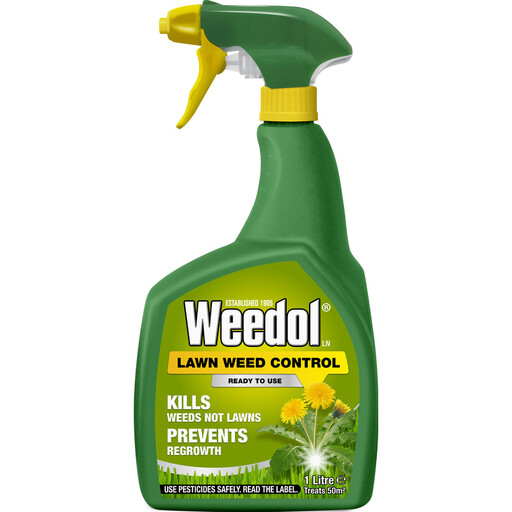
Why This Fits Their Persona: Designed for homeowners whose main concern is broadleaf weeds such as dandelions, daisies and clover growing through grass.
It is described as a selective lawn treatment, helping avoid the common mistake of applying total weed control over grass.
1-litre liquid format; lists fluroxypyr, clopyralid and MCPA as active ingredients.
For hard landscaping, select a product specifically labelled for non-porous surfaces. A ready-to-use weedkiller for patios and driveways avoids dilution and is convenient for spot treatment. The ROUNDUP Path Weedkiller 1l is listed for paths, drives and patios, with visible results stated in one to two days.
The glyphosate-free ROUNDUP Path Optima Weedkiller 1L is another ready-to-use option listed for weeds and moss on hard surfaces. Do not apply either type to lawns or planted areas unless the label explicitly allows it. Take particular care near drains, ponds and surface-water channels, where spray or runoff may create environmental risks.
For brambles, ivy, saplings or persistent perennial growth, check whether the product is intended for root or stump treatment. The ROUNDUP Tree Stump Killer 250ml is listed as a concentrated product that can make up to 25 litres of spray solution, with directions referring to brush application on freshly cut stumps and dilution for tough weeds.
Because stump and invasive-plant products can have specific restrictions, follow the exact label for cutting, application, protective equipment and replanting. Never increase the concentration to try to accelerate results.
We have compiled a complete, real-time list of products that fully satisfy these strict selection criteria and UK safety regulations.
There is no single lifespan for every product. Some formulas act on existing foliage but offer limited prevention of new seedlings. Root-targeting products may reduce regrowth from treated perennial plants, but new weeds can appear from wind-blown seed or untreated roots. Reapply only when the label permits it.
It can provide more treated area per bottle, but the comparison depends on dilution rate, coverage and the equipment needed. Ready-to-use products may cost more per square metre while saving preparation time. Use the label’s coverage figure to compare like for like.
Apply during calm, dry weather when weeds are actively growing, unless the label states otherwise. Avoid rain soon after treatment, strong wind and periods when desirable plants may be exposed. Keep people and pets away from treated areas for the period stated on the product label.