
24/7 全天候客户支持

免费退货

当日/次日达

品质保障

开启新人专享福利: 全场免邮 | 低至 2 折 | 免费试用 30 天 JoyPlus 会员
下载 Joybuy
A weekly pill organiser can make it easier to prepare medicines, vitamins and supplements, but the wrong design may create more problems than it solves. Compartments can be too shallow for larger capsules, lids may be difficult to operate and unclear day markings can lead to avoidable confusion.
Before buying a 7-day pill organiser, look beyond claims such as “large capacity” or “easy open”. The useful details are the compartment layout, closure design, dimensions, material and how well the case suits your daily routine.
Important: A pill organiser is for storage and organisation. Always follow the instructions supplied with your medicines and ask a pharmacist or prescriber whether transferring a medicine from its original packaging is suitable.
Capacity varies considerably between products. Fish oil capsules, bulky vitamins and large tablets can take up far more room than smaller medicines. A case with seven compartments may sound sufficient, yet leave little space for a full day’s doses.
Check the stated internal capacity where available and consider whether you need a standard daily pill case, a large pill box or several dose sections per day.
A lid that opens in a handbag is inconvenient, but one that requires excessive finger strength is equally unsuitable. This is particularly relevant when choosing a pill organiser for arthritis, older users or anyone with limited dexterity.
Look for push-button, ergonomic or snap-shut closures. The mechanism should balance easy access with resistance to accidental opening.
Small lettering and low-contrast colours can make it difficult to identify the correct day, particularly under indoor lighting. Printed labels may also become less clear through frequent handling.
Choose a weekly medicine organiser with clearly marked days and, where possible, labels designed to resist fading or peeling. For multiple daily doses, AM/PM or three- and four-time layouts may offer more useful separation than a single compartment per day.
Start by counting how many doses you need each day:
Measure or estimate the size of your regular tablets and capsules. The product description may state capacity using examples such as fish oils, vitamins or capsules, but these figures are not a substitute for checking your own items.
BPA-free plastic is commonly used for lightweight pill boxes. Look for a stated material, sturdy hinges and a closure that clicks or snaps into place. A moisture-resistant design can help limit exposure during ordinary carrying, but it should not be treated as waterproof unless the product specifically states this.
A portable pill container should also fit comfortably in a handbag, drawer, bedside cabinet or travel washbag. Dimensions matter more than promotional wording, especially for narrow luggage spaces.
A pill box should be easy to wipe clean and fully dry before refilling. Avoid harsh chemicals or abrasive cleaners if the care instructions advise against them. Store medicines according to their packaging instructions, as some products may need the original container or specific temperature and humidity conditions.
For travel, keep prescriptions, dosage information and medicines that require special storage in their original labelled packaging where appropriate. The organiser can be used for convenient planning only when this is suitable for your medicine.
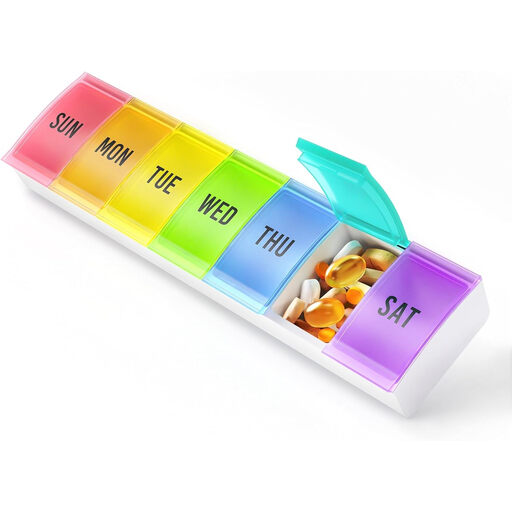
Why This Fits Their Persona: A straightforward seven-compartment format suits users beginning a weekly routine for medication, vitamins or supplements at home in the UK.
Colour covers and day labels make the compartments easier to distinguish than an unmarked container.
Seven compartments, ergonomic lids and stated space for up to eight fish oils or 17 capsules per compartment.
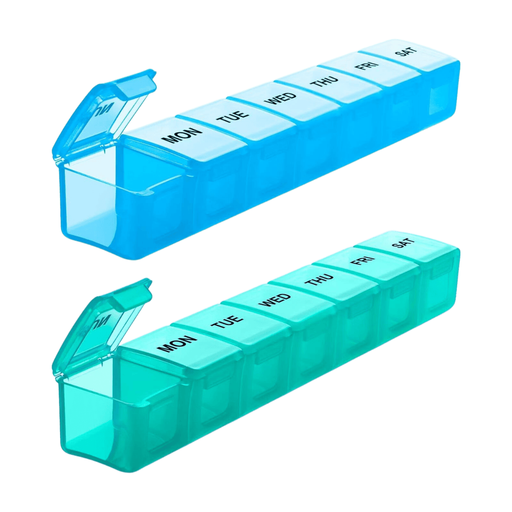
Why This Fits Their Persona: The two-pack format works for keeping one organiser at home and another in a work bag, overnight bag or travel case.
Its stated 1.6mm plastic thickness, reinforced hinges and moisture-proof construction address concerns about flimsy daily-use cases.
Extra-large compartments; each is described as holding up to 12 fish oils or 13 large vitamins. Dimensions are 9.1 x 1.3 x 1.1 inches.
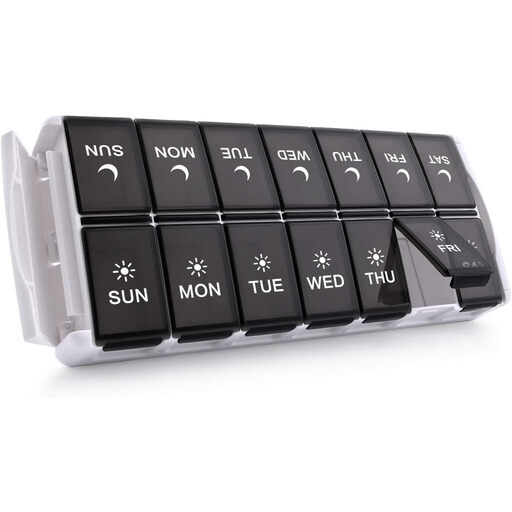
Why This Fits Their Persona: Users managing morning and evening doses can prepare a full week without mixing two daily periods in one compartment.
The AM/PM arrangement prevents the single-compartment-per-day limitation, while snap-shut lids help reduce spills during carrying.
Removable bottom cap for filling; compartments are stated to hold about 11 fish oils, 12 large vitamins or 18 capsules.
A travel pill organiser should be compact enough for luggage but large enough to avoid overfilling. A small four-compartment case, such as the Small Pill Case Travel Pill Organiser, may suit a handbag or short trip. For a full week, a detachable case with three compartments per day can separate doses while allowing only the required sections to be carried.
If you take supplements rather than prescription medicines, a vitamin organiser, supplement organiser or fish oil organiser can provide practical separation. However, check whether the compartments accommodate soft gels without excessive pressure on the lids.
Carers may prefer an AM/PM or four-times-a-day layout because it makes preparation and checking more structured. Keep the organiser away from children and ensure every compartment is completely dry before refilling.
We have compiled a complete, real-time list of products that fully satisfy these strict selection criteria and UK safety regulations.
Lifespan depends on the plastic, hinges, labels and how often the lids are opened. Inspect the case regularly for cracked compartments, loose closures or unclear markings. Replace it if it no longer closes securely or can be cleaned properly.
Not necessarily. Some medicines are sensitive to light, air or moisture, while others should remain in their original packaging. Check the medicine instructions or ask a pharmacist before transferring doses to an organiser.
“Pill box” is a broad term covering small daily cases and simple containers. A weekly medicine organiser normally divides doses across seven days and may include AM/PM, three-times-a-day or four-times-a-day sections. Choose according to your actual schedule rather than the product name alone.