
24/7 Customer Support

Free returns

Same-day & Next-day Delivery

Quality Guaranteed

Unlock Your Welcome Offers: FREE Delivery | Up to 80% OFF | Free 30-day JoyPlus trial
Download the APP
A weekly pill organiser can simplify medication, vitamin and supplement storage, but the wrong design may create daily frustration. Compartments that are too shallow, lids that are difficult to open or labels that become unreadable can make an organiser unsuitable after only a short period of use.
For UK households, the most useful choice depends on more than the number of days shown on the lid. You should consider dose frequency, tablet size, ease of opening, portability and how securely the compartments close.
A 7-day pill organiser may have only one small compartment per day. This can be unsuitable if you take several tablets, large vitamin capsules or fish oil supplements. Check the individual compartment dimensions and stated capacity rather than relying on “large” in the product title.
A snap-shut lid may help prevent spills, but it can be uncomfortable for anyone with arthritis or reduced hand strength. Conversely, a loose lid may open inside a handbag or suitcase. Look for a practical balance between a secure closure and an easy-open design.
Some daily pill organisers use small printed lettering, while others have larger day markings or etched labels. If the organiser will be used by an older person or shared with a carer, clearly separated days and dose periods are more important than decorative styling.
A compact portable pill box is useful for work, appointments and travel, but it may not provide the capacity needed for a complete week. A travel pill case should also close securely and be kept dry. Do not place medicines in an organiser if the packaging or prescribing instructions specifically require the original container or special storage conditions.
A basic daily pill organiser may have seven compartments, one for each day. An AM PM pill organiser provides 14 sections for morning and evening doses, while a three-times-a-day or four-times-a-day pill dispenser offers more separation for complex routines.
Before purchasing, count how many dose periods you need each day. If you take tablets at breakfast, lunchtime, dinner and bedtime, a 7-day organiser with only one compartment per day will not provide enough separation.
A large pill organiser should be assessed by compartment size, not title alone. Large capsules such as fish oil can occupy considerably more space than standard tablets. The VVM Easy-Fill model, for example, lists individual compartments measuring approximately 1.2 x 0.8 x 0.8 inches, with capacity stated for around 11 fish oils, 12 large vitamins or 18 capsules.
These figures are product listing estimates, so allow space for the actual items you use. Overfilling can prevent lids from closing correctly and may make it harder to identify individual doses.
Many organisers are made from polypropylene or BPA-free plastic. This can provide a lightweight format for home and travel use, but the closure and hinge design still require attention.
Check for:
A medication storage box should be used only for its intended purpose. Keep it away from children and pets, and follow the medicine’s packaging instructions. If you are unsure whether a medicine can be transferred from its original packaging, ask a pharmacist.
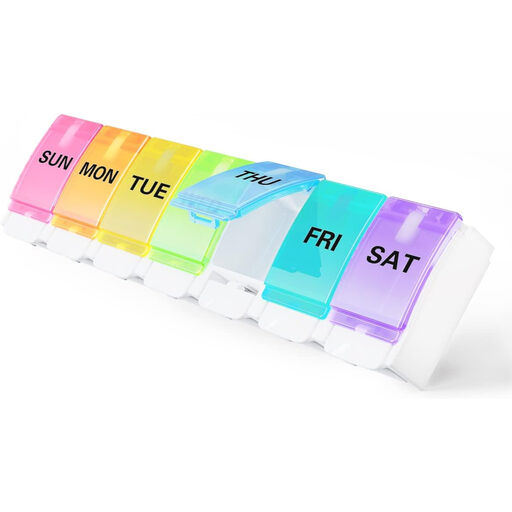
Why This Fits Their Persona: A straightforward option for someone beginning a weekly routine with separate morning and evening doses at home or while travelling.
Printed day labels and push-button lids reduce reliance on tiny lettering or loose covers.
BPA-free polypropylene construction, morning/evening separation and a compact listed size of 4.9 x 2.16 x 0.6 inches.
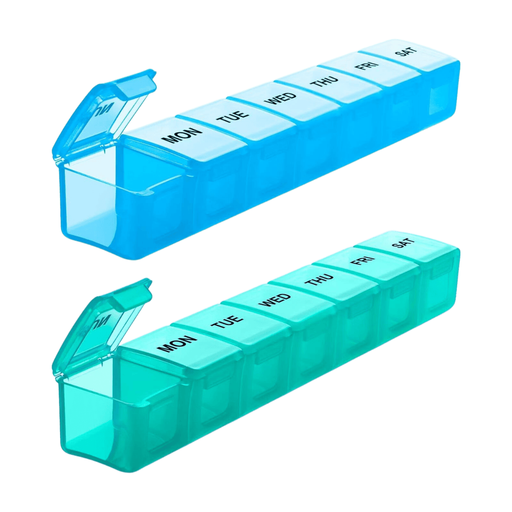
Why This Fits Their Persona: Suitable for households wanting a spare organiser or separate storage for medicines and supplements.
The listing specifies reinforced hinges, moisture-resistant construction and secure snap-shut lids.
Two organisers are included; each has seven compartments and listed capacity for large vitamins, fish oils and supplements.
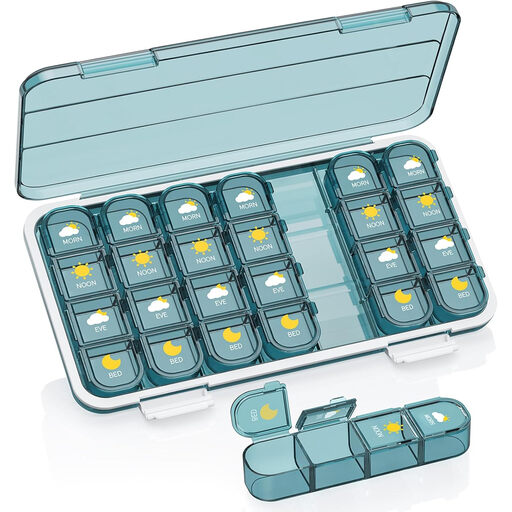
Why This Fits Their Persona: Designed for users who need four distinct daily dose periods rather than a simple morning-and-evening arrangement.
Four-times-a-day separation avoids mixing doses into one oversized daily compartment.
Seven-day format, separate daily storage and a portable layout for vitamins, fish oils and supplements.
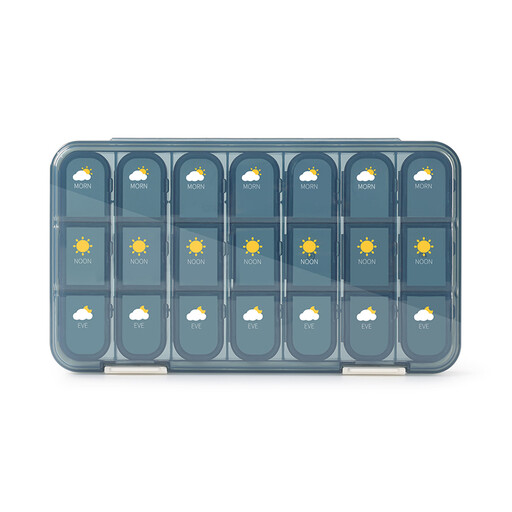
Why This Fits Their Persona: A useful format for carers preparing three daily dose periods or travellers carrying a full week of separated medication and supplements.
Its listed 21-compartment layout offers more dose separation than a single compartment for each day, while the sealed format addresses spill concerns.
Food-grade PP plastic, silicone sealing ring and seven removable daily sections listed for home, office and travel use.
We have compiled a complete, real-time list of products that fully satisfy these strict selection criteria and UK safety regulations.
Fill the organiser in a well-lit area and compare each section with the original packaging or your written schedule. A carer should use a second-person check where appropriate, particularly when several medicines look similar.
Keep the organiser:
A weekly medicine organiser is not a replacement for professional medication advice. If your prescription changes, empty and reorganise the affected compartments rather than assuming the previous arrangement remains correct.
It can be, provided each compartment is large enough and your daily routine does not require more dose periods than the organiser offers. For morning and evening medication, choose an AM PM pill organiser. For four scheduled doses, select a four-times-a-day format.
Replace it when the plastic cracks, lids stop closing securely, labels become difficult to read or hinges no longer work smoothly. There is no universal replacement interval because lifespan depends on handling, cleaning and frequency of use.
A portable pill box can be convenient for travel, but keep prescription medicines in their original labelled packaging where possible and carry supporting documentation for controlled or prescription medicines. Check the requirements of your airline and destination before departure.