
24/7 全天候客户支持

免费退货

当日/次日达

品质保障

开启新人专享福利: 全场免邮 | 低至 2 折 | 免费试用 30 天 JoyPlus 会员
下载 Joybuy
A weekly pill organiser can make regular medication, vitamins and supplements easier to manage, but the wrong design may create daily frustration. Small lids, unclear labels and shallow compartments can be particularly inconvenient for older adults, carers and anyone with limited hand mobility.
Before choosing a 7-day pill organiser, look beyond colourful packaging and phrases such as “large capacity” or “travel-ready”. The useful question is whether the organiser suits your routine, the size of your tablets and the way you intend to carry it.
A slim case may look convenient, but it may not hold larger tablets, fish oil capsules or several supplements together. Check the compartment dimensions where they are available, rather than relying only on the external size.
A large compartment pill box is generally more suitable if you take multiple items at once. However, a larger design may take up more space in a handbag or washbag, so capacity and portability need to be balanced.
Some pill boxes use small tabs or stiff snap closures. These can be awkward for people with arthritis, reduced grip strength or long nails. A genuinely practical easy-open pill box should have a visible lid edge, a smooth hinge or a push-button mechanism that does not require excessive force.
It is also worth checking that the lid still closes securely. A case that opens too easily inside luggage can mix tablets or leave compartments exposed.
Terms such as “waterproof”, “sealed” and “airtight” can refer to different design features. Unless the product provides tested specifications, regard these descriptions as storage features rather than a guarantee that medicines are protected in every environment.
Keep medicines away from heat, direct sunlight and damp areas such as bathrooms. Use the original packaging for medicines where required and ask a pharmacist if you are unsure whether a particular medicine can be transferred to a pill organiser.
A basic weekly medicine box usually has one compartment for each day. This works well if you take medicines at one consistent time.
For multiple dosing times, consider an AM and PM pill organiser, a three-times-daily organiser or a four-times-daily layout. Separate compartments can help prevent morning and evening items from being combined, but only if the labels match your routine.
Detachable daily boxes are useful for carers and travellers because one day can be removed without carrying the entire organiser. Confirm whether the compartments are permanently attached or removable before ordering.
Capacity is not measured only by the number of compartments. A case may have seven sections but still be unsuitable for bulky supplements. Look for descriptions that specifically mention fish oil, large vitamins or multiple capsules.
For example, the VVM colour-cover organiser states that each compartment can hold up to eight fish oils or 17 capsules. This is a product specification, not a recommendation for how much medication to take. Always follow the label or instructions from your healthcare professional.
A BPA-free plastic organiser may be preferable for everyday storage, while food-grade polypropylene and silicone sealing rings are features to look for in a sealed design. These materials do not make a case suitable for every type of medicine, so check the product guidance and medication instructions.
Choose a case that can be wiped or washed without abrasive chemicals. Compartments should be completely dry before refilling to help avoid trapped moisture. Do not place a pill organiser in a dishwasher, microwave or freezer unless the manufacturer specifically permits it.
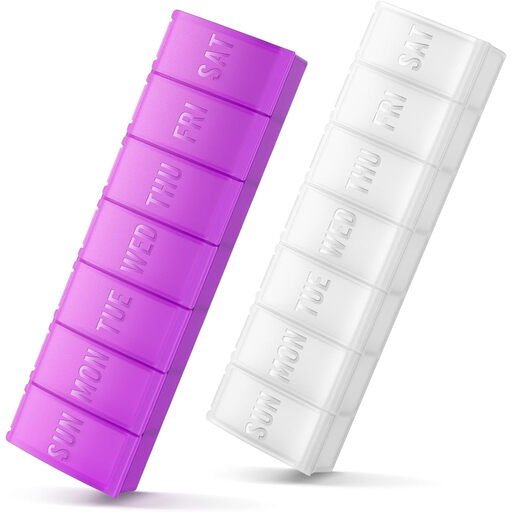
Why This Fits Their Persona: The two-piece format gives a straightforward way to organise a weekly routine at home while keeping a spare available for travel or a carer.
It uses permanently etched day labels and large compartments, addressing concerns about labels peeling or space running short.
BPA-free plastic, smooth hinges, easy-open lids and two organisers in the pack.
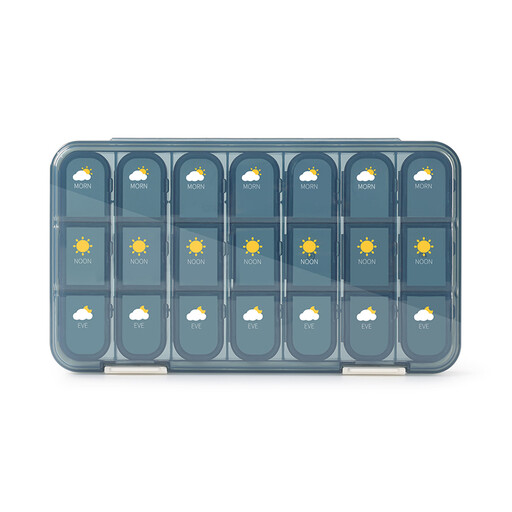
Why This Fits Their Persona: Suitable for users who want a more structured weekly layout, particularly when several items are taken throughout the day.
Seven removable daily boxes reduce the need to carry the complete case, while snap-lock lids and a silicone sealing ring address accidental opening and moisture concerns.
21 compartments, removable daily sections, large-capacity design and a silicone sealing ring.
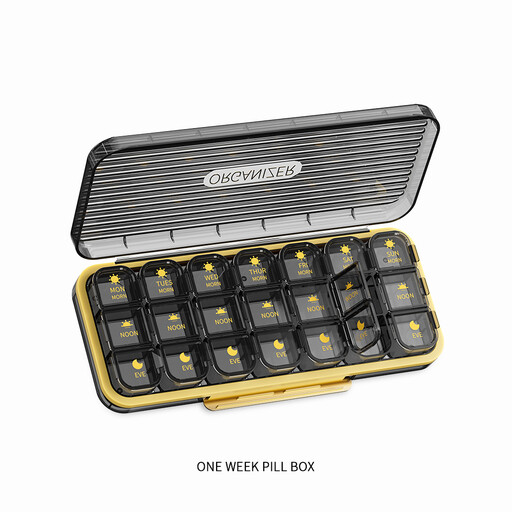
Why This Fits Their Persona: A three-times-daily layout suits users who need more separation than a simple morning-and-evening case provides.
The detachable design allows individual days to be carried separately, helping avoid the inconvenience of taking a full weekly case on shorter trips.
Three daily sorting sections, seven compartments and a portable format for vitamins, fish oil and supplements.
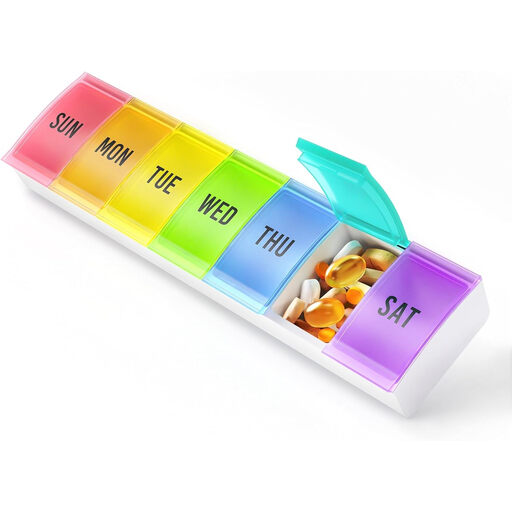
Why This Fits Their Persona: The ergonomic lids and colour covers are intended to make day identification and opening more manageable for older users or those with arthritis.
Push-friendly ergonomic lids and raised, fade-resistant day markings help address stiff closures and unclear labels.
Seven compartments, BPA-free food-grade plastic and stated capacity for multiple capsules.
We have compiled a complete, real-time list of products that fully satisfy these strict selection criteria and UK safety regulations.
It can be suitable for organising some medicines, but storage requirements differ. Certain tablets may need their original packaging or protection from light and moisture. Check the medicine leaflet or speak with a pharmacist before transferring prescription items.
Lifespan depends on how often it is opened, cleaned and carried. Smooth hinges, secure closures and durable labels can support regular use, but there is no universal replacement period. Check it each week for cracks, loose lids, damaged seals or fading markings.
An AM and PM pill organiser separates medicines into morning and evening sections, usually across seven days. A daily medication organiser may have one or more sections for each day without specifying times. If you take items three or four times daily, choose a layout that matches those dosing times rather than forcing everything into two compartments.