
24/7 Customer Support

Free returns

Same-day & Next-day Delivery

Quality Guaranteed

Unlock Your Welcome Offers: FREE Delivery | Up to 80% OFF | Free 30-day JoyPlus trial
Download the APP
A weekly pill organiser can simplify a routine involving prescriptions, vitamins, fish oil or supplements. However, the wrong design can create more problems than it solves: compartments may be too small, labels can become difficult to read or lids may open inside a handbag or suitcase.
For UK households, carers and travellers, the important question is not simply how many compartments a pill box has. It is whether the organiser matches your dosing schedule, the size of your tablets and the way you use it every day.
A standard 7-day pill box may be suitable for one daily dose, but not for medicines taken in the morning and evening. If you need several doses, look for an AM PM pill organiser or a box offering three or four sections per day.
A product labelled “weekly” does not automatically mean it supports every weekly medication routine. Check whether each day has one compartment or separate spaces for different times.
Marketing descriptions often use phrases such as “large capacity”, but capacity depends on the size and shape of the compartments. Fish oil capsules and bulky supplements can take up considerably more space than small tablets.
Check the listed compartment measurements where available. If you take several items at once, a large capacity pill organiser or one with removable daily cases may be more practical than a slim box.
A pill box that is difficult to open may be unsuitable for older users or people with arthritis. Conversely, a lid that opens too easily can spill tablets during travel.
Look for clear day markings, secure closures and lids that can be operated without excessive force. A detachable pill case can also be useful when you need to take one day’s doses to work, appointments or overnight stays.
First, match the organiser to your actual schedule:
A daily medicine organiser should make the routine easier to follow, not require you to remember which part of a mixed compartment contains which dose.
Compare the number of compartments with the amount you need to store. A compact portable pill organiser may fit easily in a coat pocket or handbag but offer limited space for large capsules.
For regular use, consider:
Some products listed here specify space for multiple fish oils, vitamins or capsules, but individual capacity varies according to pill shape and how tightly the compartments are filled.
A BPA-free pill container may appeal to shoppers who want a clearly specified plastic material. Product descriptions should also explain how to clean the organiser and whether it should be kept dry before refilling.
For travel or humid environments, a case with a sealed or moisture-resistant design may offer additional convenience. Do not assume that “waterproof” or “airtight” wording means medicines can be stored in any condition. Keep medicines according to the instructions supplied with them and ask a pharmacist if you are unsure whether a particular medicine can be transferred from its original packaging.
Clear, permanent or fade-resistant day labels are useful for people who need to identify doses quickly. Colour-coded lids may also help carers and users who prefer visual cues.
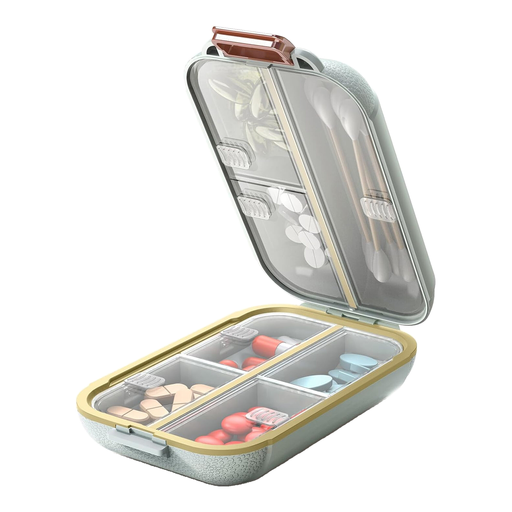
Why This Fits Their Persona: A straightforward option for someone starting a weekly medication or supplement routine and wanting a compact case for home, work or short trips.
The seven clearly separated compartments avoid mixing the days, while the compact format makes it less cumbersome than a larger weekly dispenser.
Seven compartments; listed as BPA-free; designed for daily medicine and travel use.
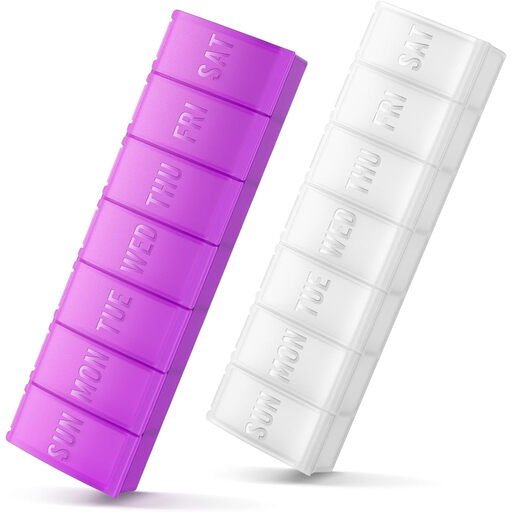
Why This Fits Their Persona: Suitable for shoppers prioritising durable labels, larger compartments and an easy-open design for regular use.
The product description specifies etched day labels and ergonomic lids, addressing concerns about fading markings and difficult opening.
BPA-free plastic; two-piece pack; compartments listed as suitable for larger vitamins, fish oil and supplements.
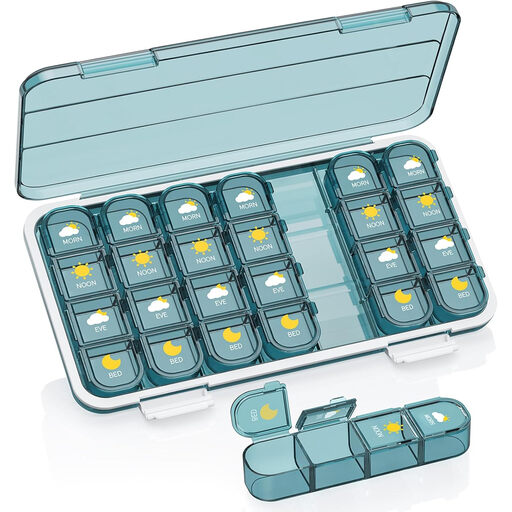
Why This Fits Their Persona: A practical match for users managing several daily doses, including carers preparing a more detailed weekly schedule.
Four daily sections reduce the risk of placing different dosing times together in a single compartment.
Seven-day layout; four sections per day; separate case included according to the product listing.
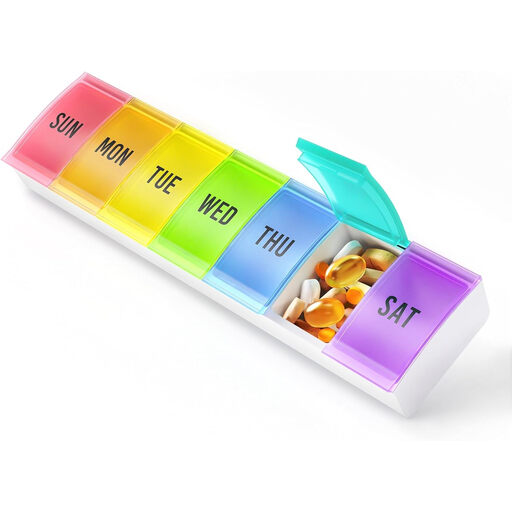
Why This Fits Their Persona: The compact seven-day format and ergonomic lid design may suit users who want a simple case for a handbag, overnight bag or bedside table.
Ergonomic lids address the common problem of stiff, awkward openings, while coloured covers provide an additional visual distinction between sections.
Seven compartments; BPA-free food-grade plastic listed; easy-open lids and colour covers.
We have compiled a complete, real-time list of products that fully satisfy these strict selection criteria and UK safety regulations.
Before filling a new organiser, check each medicine’s storage instructions. Some tablets should remain in their original packaging and not every medicine is suitable for transfer into a pill box. If uncertain, ask a pharmacist in the UK.
When using an organiser:
Clean it whenever residue or dust appears and follow the manufacturer’s instructions. A mild soap solution or damp cloth is commonly specified for these products. Allow every compartment to dry fully before refilling, as moisture can affect stored tablets and capsules.
Not necessarily. A twice-daily layout is a storage format, not a guarantee that every medicine can be removed from its original packaging. Check the medicine label or ask a pharmacist before transferring prescription items.
Lifespan depends on the plastic, hinges, closures and frequency of use. Inspect it regularly rather than relying on a fixed replacement date. A pill box should be replaced if it becomes cracked, difficult to open, unable to close properly or no longer provides readable day labels.