
24/7 全天候客户支持

免费退货

当日/次日达

品质保障

开启新人专享福利: 全场免邮 | 低至 2 折 | 免费试用 30 天 JoyPlus 会员
下载 Joybuy
A weekly pill organiser can make daily routines easier, but the wrong design may create more problems than it solves. Compartments that are too small, closures that open in a handbag and unclear day markings are common reasons buyers replace an organiser sooner than expected.
Whether you need a 7-day pill box for prescribed medicines, a vitamin and supplement storage box or a portable case for holidays, look beyond colour and capacity claims. The practical details below can help you choose a suitable organiser for life in the UK.
A product described as a “large pill organiser” may have spacious compartments but only one section per day. That works for once-daily routines, but not for people who take tablets in the morning, afternoon and evening.
Before buying, check:
A 28-compartment box may suit a complex schedule, while a seven-compartment organiser may be more convenient for a simple routine.
An “easy-open” lid is not a universal feature. Push buttons, snap-shut lids and lift tabs require different levels of finger pressure. A closure that feels secure during travel may be difficult for someone with arthritis or reduced hand strength.
Look for a clearly described opening mechanism and avoid assuming that a small, slim case will be effortless to use. If a carer or family member fills the box, removable daily sections can also make preparation easier.
A silicone seal or “airtight” lid can help limit exposure to moisture, but it does not make a pill organiser suitable for bathrooms, damp bags or liquid medication. Seals can also lose effectiveness if cracked, displaced or not closed properly.
Keep medicines in their original packaging where required, follow storage instructions from the pharmacist or manufacturer and use the organiser only for products suitable for repackaging. Keep it away from children and pets.
A useful daily medication organiser should make the correct dose and day easy to identify. Permanent or etched labels are less likely to peel than adhesive stickers, while high-contrast colour sections can help users distinguish days at a glance.
Choose the layout according to your routine:
A calendar layout should follow the user’s normal starting day. Check whether the organiser labels days from Sunday to Saturday or Monday to Sunday.
Capacity should be assessed using the size and number of items you take, not just the phrase “large capacity”. Fish oil, large vitamins and bulky capsules can occupy considerably more room than small tablets.
Compare the compartment measurements when available. A compact travel pill case may fit neatly into luggage but require daily refilling if the sections are too shallow. Conversely, a long organiser may hold a full week but take up more space in a smaller handbag.
A BPA-free pill container made from polypropylene or similar plastic can be a practical choice, but BPA-free does not automatically mean that every medicine can be stored in it. Check the product instructions and medicine packaging.
Useful features include:
Do not use an organiser in a dishwasher, microwave or freezer unless the product specifically permits it. Moisture left inside a compartment can affect the contents, so wipe the case and allow it to dry completely.
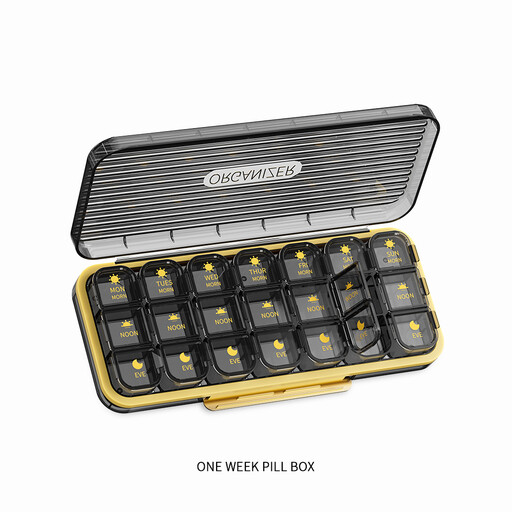
Why This Fits Their Persona: A practical starting point for users who want a weekly medicine organiser with three sorting points per day and detachable sections for home or travel.
The three-times-daily layout avoids relying on one oversized compartment for a more involved routine.
Seven compartments; detachable design; intended for vitamins, fish oil and supplements.
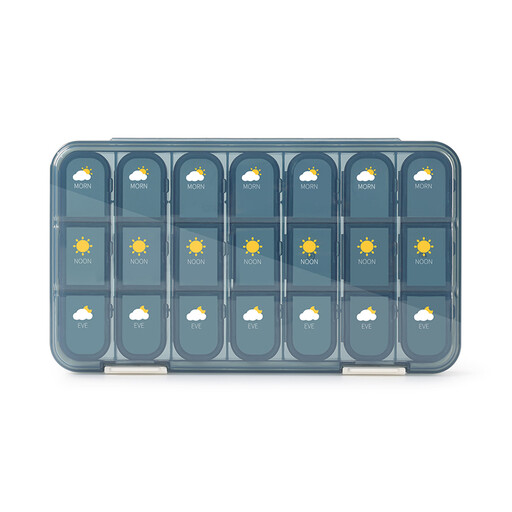
Why This Fits Their Persona: A suitable option for users who prioritise separate daily boxes, moisture-conscious storage and portability between home, work and travel.
Seven removable daily compartments provide more separation than a single undivided weekly tray.
Food-grade PP plastic; silicone sealing ring; snap-lock lid; large-capacity compartments.
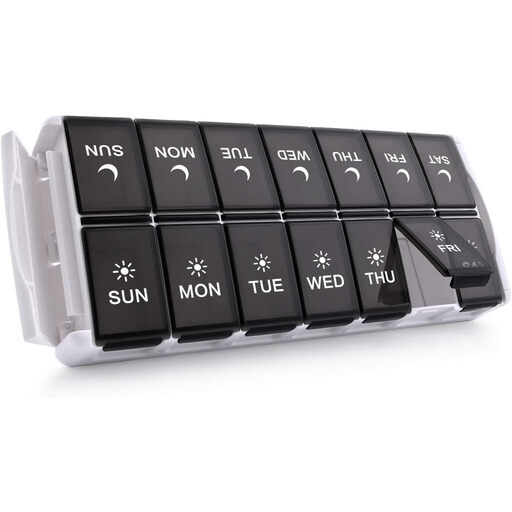
Why This Fits Their Persona: Designed for users handling larger daily quantities who want AM/PM separation and a removable filling feature.
Its two-times-daily structure avoids mixing morning and evening items, while the easy-fill base helps with weekly preparation.
Seven days of AM/PM organisation; BPA-free plastic; snap-shut lids; removable bottom cap.
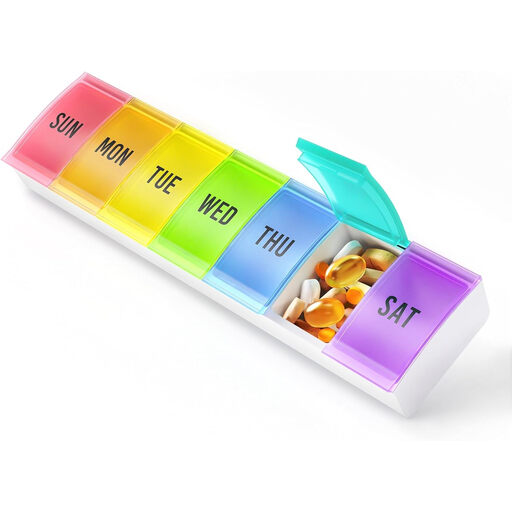
Why This Fits Their Persona: A clear choice for older users or anyone who prefers larger compartments, colour covers and an easy-open lid design.
Ergonomic lids and contrasting covers address the common problem of tiny, difficult-to-identify sections.
Seven compartments; BPA-free plastic; secure snap-shut lids; stated capacity for multiple capsules and vitamins.
When preparing an organiser, work from the original packaging and check each label carefully. Fill one day at a time in a well-lit area, then compare the organiser with the prescription instructions or supplement plan.
For safer everyday use:
An organiser supports organisation; it does not replace medical advice, prescription labels or pharmacist guidance.
We have compiled a complete, real-time list of products that fully satisfy these strict selection criteria and UK safety regulations.
Lifespan depends on the plastic, hinges, seals and frequency of opening. Inspect it regularly rather than relying on a printed durability claim. Cracks, loose lids, faded labels or a damaged seal are practical signs that replacement may be needed.
A travel pill case is convenient for carrying doses, but keep prescription medicines in their original labelled packaging where possible. For international travel, check the destination’s rules and carry relevant documentation. Ask a pharmacist or the airline about medicines requiring special handling.
No. Some medicines should remain in original packaging or may require protection from light, heat or moisture. Confirm suitability with a pharmacist before transferring any medicine. An AM/PM layout is a useful organisational format, but it does not change storage requirements.