
24/7 全天候客户支持

免费退货

当日/次日达

品质保障

开启新人专享福利: 全场免邮 | 低至 2 折 | 免费试用 30 天 JoyPlus 会员
下载 Joybuy
A weekly pill organiser can make daily medication, vitamins and supplements easier to arrange, but choosing the wrong design may create more inconvenience than it solves. A compartment that is too shallow may not hold larger fish-oil capsules, while a lid that is difficult to open can be frustrating for anyone with reduced dexterity.
Before buying, look beyond phrases such as “large capacity” or “travel-friendly”. Check the actual compartment layout, closure style, materials and cleaning instructions. The following guide explains the main buying pitfalls and highlights suitable options for different routines.
A 7-day pill organiser may contain seven, 14, 21 or 28 sections. More compartments can be helpful, but each section may be smaller. If you take several tablets, large vitamins or fish-oil capsules, check whether the listed dimensions and capacity are practical for your routine.
A simple 7-day pill organiser is generally suitable for one daily group. An AM PM pill organiser separates morning and evening doses, while a 3-times-a-day pill box or 4-times-a-day pill box is more appropriate for routines involving several dosing times.
Snap-shut lids help prevent spills in a handbag or suitcase, but a tight closure can be difficult for older users or people with arthritis. Look for push-button, ergonomic or individually detachable lids, and consider whether the organiser can be opened without excessive grip strength.
If a carer prepares medicines for another person, clear day markings and a straightforward opening mechanism can reduce filling errors. The organiser should still be checked against the prescribed instructions rather than used as a substitute for professional advice.
A moisture-resistant or sealed design can help limit exposure during ordinary storage, but it does not make medicines suitable for damp bathrooms, direct sunlight or high temperatures. Some medicines also need to remain in their original packaging. Always check the medicine label or ask a pharmacist before transferring tablets or capsules.
For a BPA-free pill box, check that the material is clearly stated in the listing. BPA-free plastic may be suitable for vitamins and supplements, but the organiser is not intended for liquid medicines or hazardous substances unless the product information specifically says otherwise.
Match the organiser to your actual schedule:
A weekly medicine organiser with separate daily cases may be more convenient for travel than one long box. However, detachable parts are easier to misplace, so check that each section has clear day labels.
Do not rely only on “extra-large” wording. Compare the product’s measurements with the pills or supplements you use. Fish oil and larger vitamins often need deeper compartments than standard tablets.
A large-capacity pill dispenser can be useful for people taking multiple supplements, but it may be less pocket-friendly. Compact cases suit handbags and overnight trips, while wider organisers are often easier to fill and read at home.
Look for:
Avoid storing an organiser in a humid room. Wipe or wash it only according to the manufacturer’s instructions, and inspect it regularly for cracks, loose hinges or damaged seals.
The following products are matched to different shopping needs rather than ranked universally. Suitability depends on the number of doses, pill size and the user’s preferred opening style.
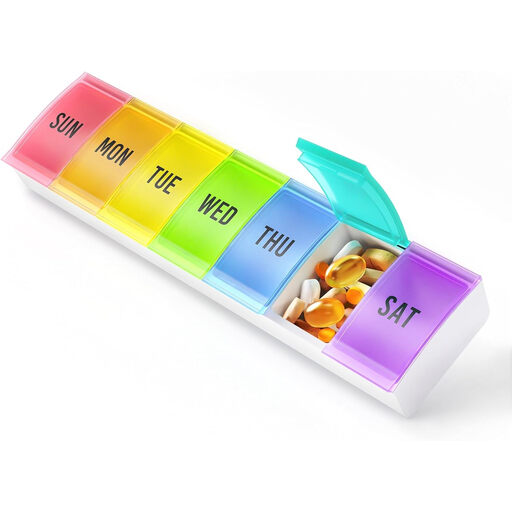
Why This Fits Their Persona: A straightforward seven-compartment format suits shoppers starting a weekly vitamin or medication routine at home or while travelling around the UK.
The listing specifies seven compartments, secure snap-shut lids and day covers, making the layout clearer than an undivided container.
BPA-free food-grade plastic; stated capacity of up to eight fish oils or 17 capsules per compartment.
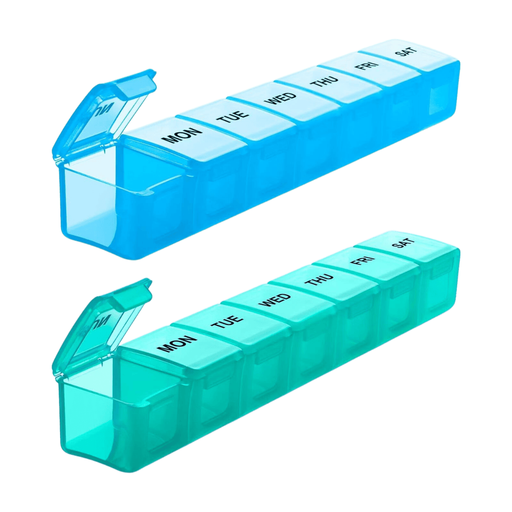
Why This Fits Their Persona: Two organisers allow one to stay at home and another to be used for travel, work or a carer’s preparation routine.
The listed 1.6mm plastic construction, reinforced hinges and moisture-proof design address concerns about thin walls and everyday handling.
Extra-large sections; BPA-free plastic; supplied as a blue and cyan two-pack.
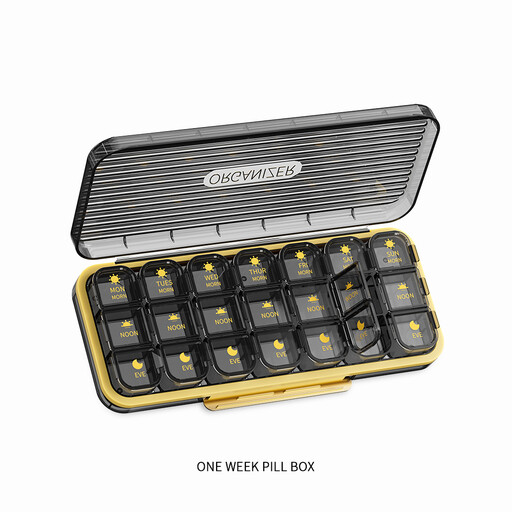
Why This Fits Their Persona: Its three-dose-per-day structure is suited to users whose schedule cannot be managed comfortably with a simple morning-and-evening case.
Separate sections for three daily periods reduce the need to place different dosing times in one compartment.
Seven detachable daily sections; designed for vitamins, fish oil and supplement storage.
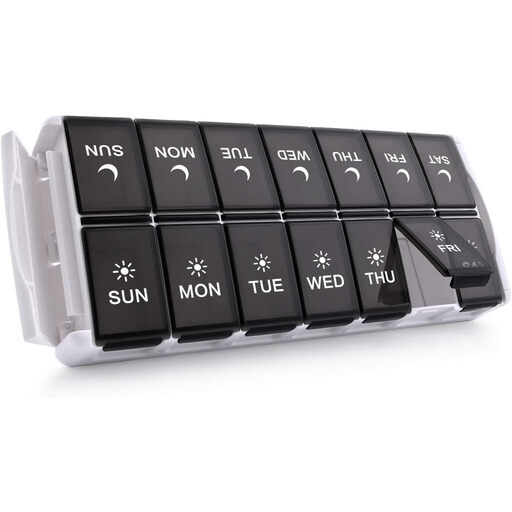
Why This Fits Their Persona: The morning-and-evening format keeps the weekly routine visible, while the stated easy-fill design may be more manageable for users who find small lids difficult.
Its AM/PM separation avoids an overcrowded single daily compartment, and the removable bottom cap is intended to support filling.
14 weekly compartments; BPA-free plastic; listed capacity for large vitamins, capsules and fish oil.
A travel pill case should be compact, secure and easy to identify. A detachable pill case can work well for a day trip, but keep the labels attached where possible. For air travel, retain prescription details and original packaging when required, particularly for controlled or temperature-sensitive medicines.
Before leaving home, check that every lid is fully closed and that the case is stored away from heat and moisture. Travellers with a larger routine may prefer a sealed 21- or 28-compartment organiser, while a simple seven-section case takes up less space.
For more AM/PM options, browse the 7-day, twice-a-day pill organiser range.
We have compiled a complete, real-time list of products that fully satisfy these strict selection criteria and UK safety regulations.
Not always. Some medicines must remain in their original blister or labelled packaging, and others may require protection from light or moisture. Check the instructions or speak to a pharmacist before transferring medication.
Follow the product instructions. In general, wipe or wash the organiser with mild soap where permitted, then allow every compartment to dry completely before refilling. Avoid harsh chemicals unless the manufacturer specifically allows them.
Count the separate dosing periods in your prescribed routine. Choose a 3-times-a-day pill box when three clearly separated periods are required, or a 4-times-a-day pill box when four are needed. Do not combine doses simply to fit a smaller organiser; ask a pharmacist if the layout is unclear.