For occasional chewing, a compact, clearly labelled sugar-free pack fits the single-pack brief better than a bottle or multipack; check the piece count, nutrition panel, ingredients and warnings before choosing. Do not buy gum expecting it to cause weight loss: an eight-week trial published in Obesity in 2012 found that scheduled gum chewing did not facilitate weight loss in the adults studied, while the NHS explains that weight loss requires an energy deficit.
Who is this choice for?
Occasional chewers
If you want gum after a meal or instead of an occasional sugary sweet, a small pack lets you buy for that routine without committing to a bottle. Gum itself should not be treated as a weight-loss method: the NHS describes an energy deficit as necessary for weight loss, and the 2012 trial published in Obesity found no weight-loss benefit from scheduled chewing in the adults studied.
Sugar-conscious shoppers
An explicitly sugar-free label is a useful starting point when comparing gum with sugary confectionery, but read the rest of the nutrition panel too. Sainsbury’s lists Extra White 10 Pieces at 0 g sugars, 147 kcal and 61 g polyols per 100 g.
Ingredient-aware shoppers
If phenylalanine, soya or polyols affect what you can choose, check the ingredients and warnings on the current pack rather than choosing by flavour or pack size alone. Tesco’s Extra Peppermint listing, for example, warns that excessive consumption may produce laxative effects.
What should you check?
Start with the quantity you intend to use, then read the nutrition panel and warnings for that particular gum.
| Priority | What to check | Your needs |
|---|
| Pack size |
Check whether the item is one 10-piece pack, a bottle or a bundle of separate packs. Confirm the total piece count, not just the size of each inner pack. |
I want a single pack for occasional chewing, rather than a larger quantity to store. |
| Nutrition |
Compare sugars, energy and polyols using the same per-100 g basis. Sainsbury’s lists Extra White 10 Pieces at 0 g sugars, 147 kcal and 61 g polyols per 100 g; sugar-free does not mean calorie-free. |
When choosing a non-sugary chewing option, I still want to know what the full nutrition panel says. |
| Ingredients and warnings |
Read the current ingredient list and any phenylalanine, allergen or excessive-consumption warnings. Check the exact variant rather than assuming two flavours have the same ingredients. |
I need to check whether the particular gum suits my ingredient requirements before I buy it. |
| Reason for buying |
Keep a chewing routine separate from a weight-loss plan. The NHS explains the role of an energy deficit; an eight-week trial published in Obesity in 2012 found that scheduled gum chewing did not facilitate weight loss in the adults studied. |
I may want gum after meals, but I do not want to mistake that habit for a weight-loss treatment. |
What is easy to overlook?
-
Expecting gum to cause weight loss
An eight-week randomised trial published in Obesity in 2012 found that scheduled gum chewing did not facilitate weight loss in the overweight and obese adults studied. The NHS explains that weight loss requires an energy deficit.
Choose gum only if you want it for chewing; assess any weight-management plan separately from the gum purchase.
-
Reading “sugar-free” as “calorie-free”
Sainsbury’s lists Extra White 10 Pieces at 0 g sugars, but also 147 kcal and 61 g polyols per 100 g.
Read sugars and energy together on the nutrition panel, using the same measurement basis when comparing products.
-
Skipping the warnings
Warnings can matter independently of flavour and pack size. Tesco’s Extra Peppermint listing states that excessive consumption may produce laxative effects.
Check the current pack for ingredients, allergens, phenylalanine statements and consumption warnings that matter to your choice.
Relevant brand references
These examples show why the exact product and pack format matter more than a brand name on its own.
Extra
Extra has compact sugar-free pack examples: Sainsbury’s lists Extra White in a 10-piece, 14 g pack, and Tesco lists Extra Peppermint in a 10-piece pack.
- Sainsbury’s lists Extra White at 0 g sugars, 147 kcal and 61 g polyols per 100 g, giving shoppers several figures to compare on the same basis.
- A sugar-free label does not establish a weight-loss effect. Check ingredients and warnings for the particular Extra variant you intend to buy.
Airwaves
Sainsbury’s lists Airwaves Menthol & Eucalyptus as a 46-piece, 64 g bottle rather than a compact single pack.
- Its Sainsbury’s listing states 143 kcal and less than 0.1 g sugars per 100 g.
- The 46-piece bottle is a different quantity from the occasional single-pack purchase considered here; check its ingredients and warnings if that format interests you.
Gum options on Joybuy
These Joybuy options are sugar-free gum in bottles or a multipack. They suit a larger-quantity purchase, rather than the single compact retail pack discussed above.
 No image available
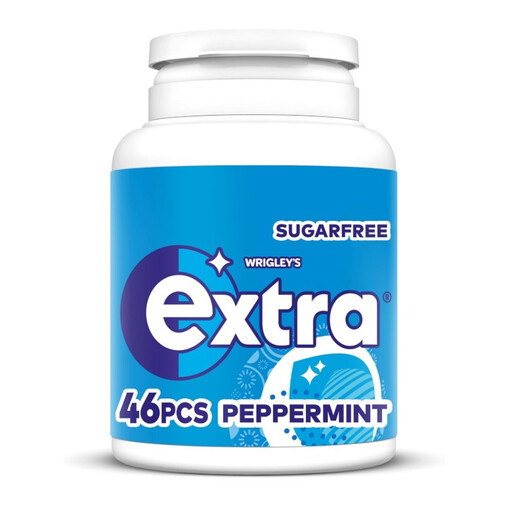
Extra Peppermint Sugar-Free Gum, 46 Pieces
This 46-piece bottle is a larger-quantity choice than a single 10-piece pack. Check the current label for nutrition, ingredients and warnings relevant to you.
View on Joybuy
 No image available
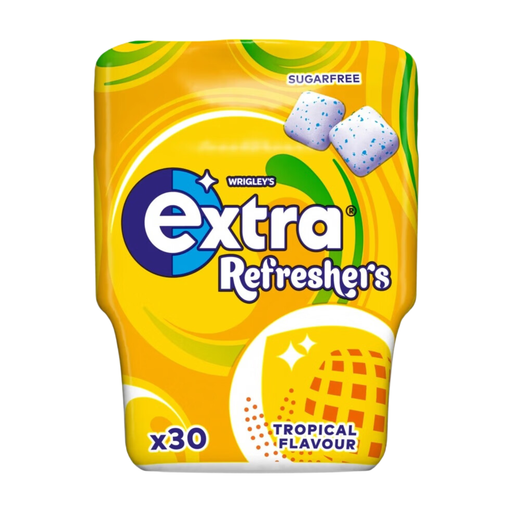
Extra Refreshers Tropical Sugarfree Gum, 30 Pieces, 67 g
The 30-piece bottle provides more gum than a compact single pack. Check the current label for the nutrition figures and warnings you need before choosing this variant.
View on Joybuy
 No image available
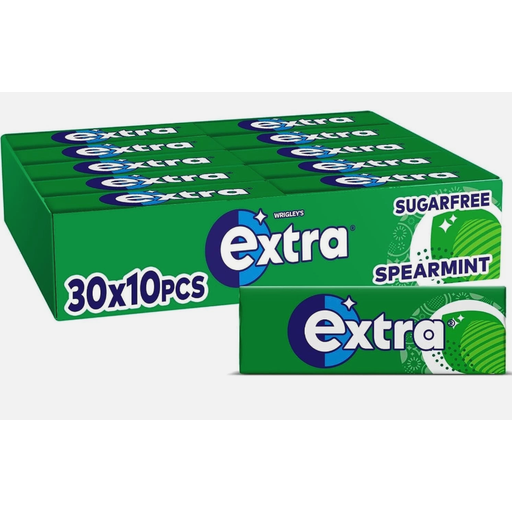
Wrigley Extra Sugar Free Spearmint Gum, 10 Pieces × 30
This is a bundle of 30 separate 10-piece packs, not one retail pack. An individual pack may fit a carrying routine, but the purchase quantity is much larger than the occasional single-pack brief.
View on Joybuy
Common questions
Can chewing gum make you lose weight?
Do not choose gum as a weight-loss treatment. An eight-week randomised trial of 201 overweight and obese adults, published in Obesity in 2012, found that scheduled chewing gum did not facilitate weight loss; the NHS explains that weight loss requires using more energy than you take in.
Is sugar-free gum calorie-free?
No. Sainsbury’s lists Extra White 10 Pieces at 0 g sugars, 147 kcal and 61 g polyols per 100 g. Read the full nutrition panel rather than relying on the sugar-free description alone.
What should I check if I want gum after meals?
Check the current pack’s ingredients, nutrition information and warnings, then choose a piece count that fits how often you intend to chew it. A post-meal gum routine is not a substitute for a weight-management plan.
When do gum ingredients and warnings need closer attention?
Read the exact product label if phenylalanine, soya or polyols matter to your choice. Also check consumption warnings: Tesco’s Extra Peppermint listing, for example, warns that excessive consumption may produce laxative effects.


